

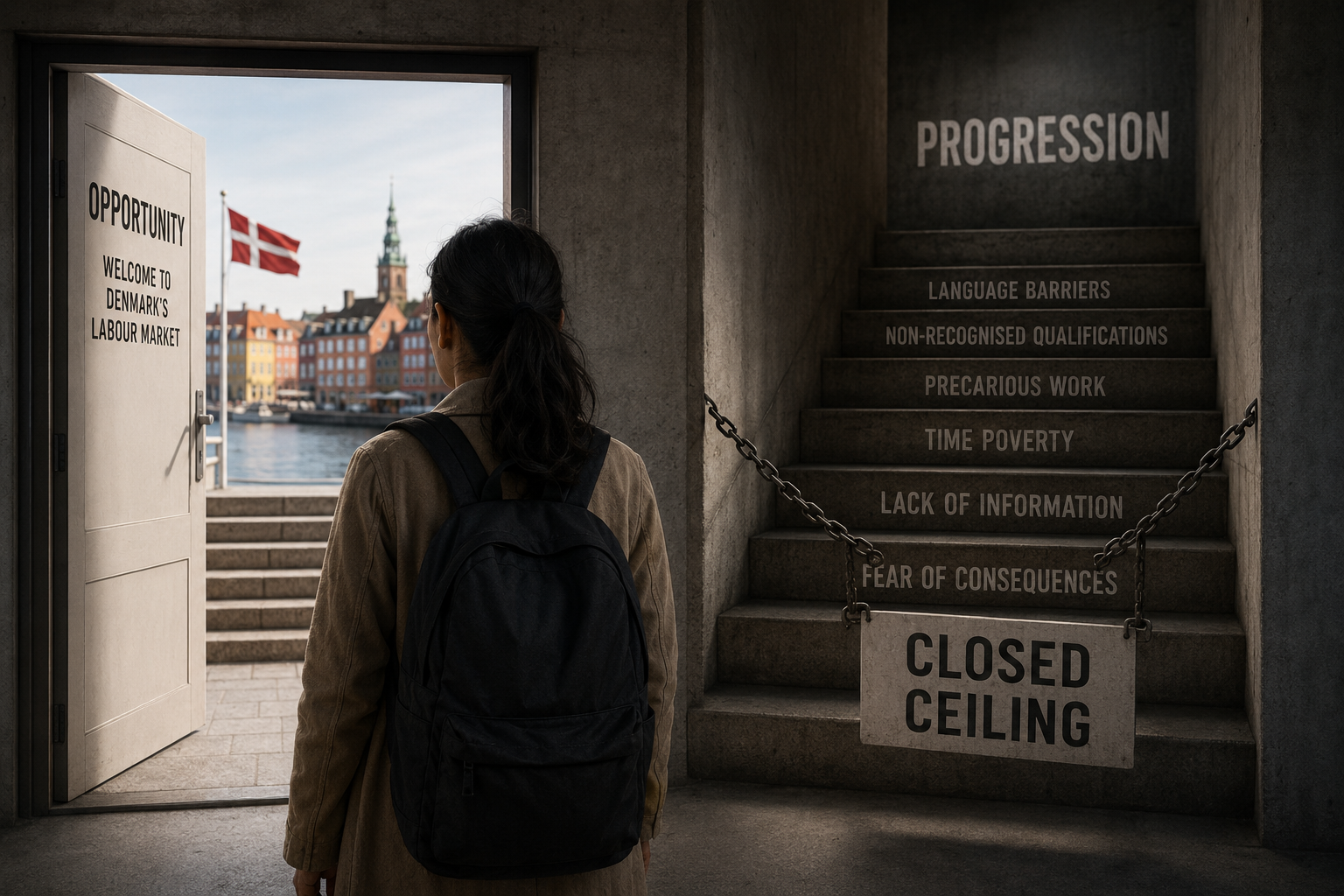
If you are an international in Denmark, you probably know someone like this. Maybe you are someone like this. An accountant delivering packages. An engineer washing dishes. A graduate with a Danish master’s degree cleaning offices at 5 a.m. while sending out application number eighty-seven.
The new Career Compass policy report, produced by the Aalborg Institute for Development with partners in Finland and Lithuania, gives this experience a name: horizontal mobility without progression. Young migrant workers move constantly—between jobs, between sectors, between cities, and even between countries. What they almost never do is move up. The movement is real. The progress is an illusion.
This finding did not surprise me. As part of my Master’s thesis research at Roskilde University, I interviewed eleven migrant workers in Denmark’s cleaning, hospitality, construction, and warehousing sectors. Their experiences mirror the report’s findings almost exactly—and they point to something uncomfortable about how the Danish labor market works for internationals.
Denmark is famous for “flexicurity”: a flexible labor market where hiring is easy, combined with security for workers. And for migrants, the first half of that promise works brilliantly. You can arrive on a Tuesday and be scrubbing hotel rooms or stacking warehouse shelves by Friday. The door in is wide open.
But here is what I call the flexicurity paradox, the pattern my research kept running into: the same flexibility that gets migrants in so quickly is often exactly what keeps many of them at the bottom. Entry-level sectors run on temporary contracts, irregular shifts, and agencies. There is no time for Danish classes when your schedule changes every week. There is no path to training when stepping away from shifts means losing income—or the job itself. The Career Compass team calls this “time poverty.” Their interviewees described taking the first job to survive, then finding it nearly impossible to move out of.
Language completes the trap. The report found that even when job advertisements list English as the working language, recruiters often expect fluent Danish anyway. Language is not just a skill here — it is a gatekeeper.
And there is a quieter mechanism my own interviews revealed, one the report’s findings echo—a pattern I call the information–fear–silence cycle. Information about rights, training, and pathways is fragmented, so workers rely on rumor. Fear—of losing shifts, of employer disapproval, of jeopardizing a residence permit—stops them from asking questions or requesting time for education. And silence means the problems never surface, so nothing changes. Each turn of the cycle keeps people exactly where they are.
It would be easy to read all this as a story about Denmark failing migrants. I think that is the wrong ending. The more urgent story is that Denmark is failing itself. Employers across the country face persistent shortages in healthcare, construction, and technical services—while trained engineers stack shelves and qualified nurses clean offices. The European Commission has a blunt term for it: brain waste. Every unrecognized qualification is a vacancy that stays open.
The report’s solutions are refreshingly practical: embed language learning in the workplace instead of demanding it as a precondition, make vocational training modular and evening-friendly, speed up—and simplify—recognition of foreign qualifications, and give employers real incentives to train. Denmark already has promising models to build on, from the IGU program to International House Copenhagen’s career initiatives.
The door to Denmark’s labor market is open. The task now is to build a staircase behind it.