

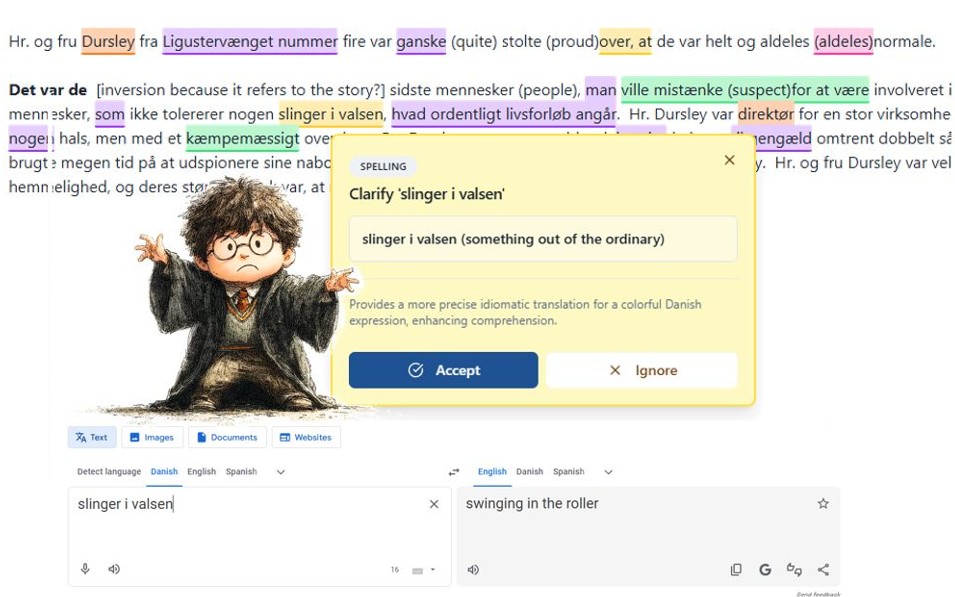
Anyone learning Danish will know that the challenge does not always begin with grammar, syntax or pronunciation. Sometimes it begins with the tools: a photo of a worksheet with unfamiliar vocabulary, a half-finished sentence in Word, a phrase copied into Google Translate, or a grammar explanation typed into ChatGPT while the teacher is making photocopies (true story).
This digital patchwork is often proof that students are trying everything they can to keep up.
For Bradley Sowter, founder of DanskAI, the idea for his language-learning platform grew directly out of his own experience as a Danish learner. What he saw in the classroom inspired him to build a tool designed to support students and teachers with clearer feedback, writing practice, and progress tracking. The aim is to help learners practice more confidently between lessons while supporting classroom teaching.
“I had been visiting Denmark regularly since December 2022, and in 2025 I finally made the move,” says Bradley, who is originally from the UK, “Thankfully, I arrived just as the weather was starting to improve, which felt like Denmark giving me the softest possible landing.”
A soft landing, however, does not mean an effortless one. Since then, life has meant managing the SIRI system (Styrelsen for International Rekruttering og Integration), setting up his own company, starting language school, and trying to understand the small cultural differences that only become obvious once you live here — and even then can take time to decipher. Still, he found encouragement in the international community around him and people who, like him, are also trying to work out everything “from tax systems to supermarket etiquette.”
Like many adult learners, Bradley quickly realized that the sticking point was not only Danish itself, but the time, energy and mental space required to keep learning while also building a life.
“By the time you sit down to study, your brain can already feel like it has done a full day’s work. The hardest part of learning Danish as an adult is finding the time and using it well.”
Even with Denmark’s kommune-funded language education — something Bradley describes as a privilege — the classes can feel too fast-paced. Reflecting on one thing he would change, Bradley wants to provide students with more structured support between lessons. “A lot of learning happens outside the classroom, but that is also where students can feel most alone,” he says.
“Surely this could be simpler”
Bradley first noticed the gap in class. Students were showing up, doing the work and trying. But the learning process had become fragmented. “It was not that students lacked motivation. Quite the opposite,” he says, “They were working hard and using whatever tools they could find. But the process was clunky.” As the course became more demanding, those inefficiencies started to compound, “That was the moment I thought: surely this could be simpler.”
When asked how he would describe DanskAI, he replies, “Grammarly meets a patient Danish tutor.” The platform gives students feedback on their writing, helps them understand their mistakes, and supports them both in class and on the go. For teachers and tutors, it aims to provide a secure space to track students’ written progress during lessons. “The aim is not to replace classroom teaching,” he explains, “but to give teachers better insight into where students are struggling, so they can modify their lessons and support students more effectively.”
“For students, the priority should be learning Danish, not spending half the lesson jumping between translation apps, AI tools, documents, screenshots, and browser tabs.”
Bradley emphasizes that DanskAI is not a shortcut or a way to remove the effort of learning Danish. Instead, he wants it to make that effort more focused. Like many learners, he began with apps such as Duolingo and Babbel. They helped build a foundation, but he noticed a disconnect between the apps and language school. “I could leave class after learning about inversion, then open an app and be asked to write a sentence about putting an elephant in a fridge.”
While general AI tools can also be helpful, Bradley sees a risk when they provide answers too quickly. With DanskAI, the goal is to build something more structured, “It supports students but still challenges them.”
DanskAI is still developing, and Bradley is clear that the platform is being shaped by the people testing it. One of the biggest lessons has been emotional rather than technical: “I hear that learners are tired. They are not lazy or unmotivated, just tired of juggling one too many things at once.” That understanding is now guiding the next stage of DanskAI: building a tool that meets learners where they are, with support that feels focused and practical.
Language as belonging
For most internationals, learning Danish is rarely only academic. It is tied to employment, confidence, friendship and the possibility of building a long-term life here. “I believe language is one of the main keys to unlocking Denmark — to feeling at home in a new place,” Bradley says. “It is not just about ordering coffee the right way or understanding letters from the kommune, though those are helpful. Language lets you enjoy humor, traditions, social rules, and the small daily moments that make a place feel familiar.”
As his Danish improves, Bradley says he has started to understand more about the culture — “not just what people say, but why they say it that way.”
Let internationals speak Danish badly
Over the next 12 months, Bradley hopes to keep developing the platform, secure funding and work with language schools interested in testing DanskAI in real classrooms, with a focus on supporting teachers without creating more admin.
When asked what advice he would give someone just starting their Danish-learning journey, Bradley talks about humility, “Allow yourself to be bad at something.”
For many adult learners, this may be the hardest part.
“Many of us are used to being capable adults in our own language, and then Danish comes along and makes us feel like toddlers tackling Skat,” Bradley says. It is a feeling many learners will recognize: being reduced to fragmented sentences, uncertain pronunciation, and the occasional deeply confusing encounter with word order.
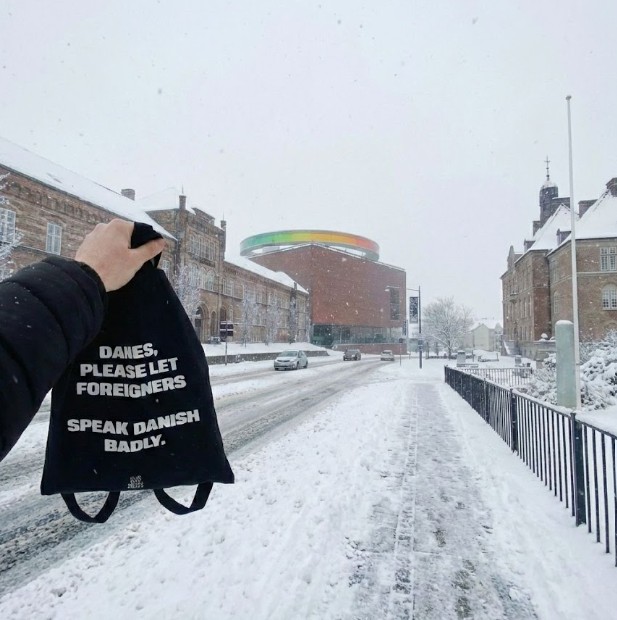
He has a tote bag from Curious Neighbor that reads: “Danes, please let foreigners speak Danish badly.” His advice is to make the process as fun as possible: “Play games, laugh at your mistakes, honor small wins, and if in doubt, play Vin Bingo to learn the numbers.” The process can feel slow, awkward, tiring, and humbling. But it is also one of the ways we begin to make Denmark feel more like home.
To learn more about DanskAI, you can visit danskai.co.uk, where you can also read blog posts about Danish learning, AI, and the platform’s development. The platform currently offers a free basic version, so you can try it out. You can also email Bradley at hello@danskai.co.uk. He would especially love to hear from students, teachers, tutors, schools, or anyone interested in getting involved with the project.