

A little over a year ago, I moved to Denmark and did what many newcomers do: I signed up for Danish classes through the kommune. Language school is practically a rite of passage for internationals here. You arrive with a notebook, a determined attitude and a resolute hope that Danish can’t be as difficult as people say it is. Then the first lessons begin.
The classes were a helpful start. They offer structure, vocabulary and the reassuring sense that progress can be measured. There were modules to complete, tests to pass, grammar rules to learn. But anyone who has tried to learn Danish will tell you that grammar isn’t the biggest piece of the puzzle. Pronunciation is.
Danish has a reputation among language learners for a reason. Words seem to dissolve somewhere between the page and the ear; letters disappear or blur together. It also has one of the largest vowel inventories in the world, with somewhere between 20 and 30 distinct sounds depending on how they are counted—far more than languages like English or Spanish.
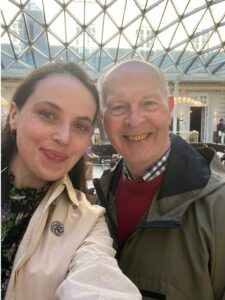
I wanted a more tailored approach, one that allowed time to slow down and really work through these nuances. That is how I began working with my Danish tutor, Jørgen “Yon” Wibskov. Our lessons are deliberately unhurried. Much of our time is spent reading—sentence by sentence, word by word. Sometimes I write a short passage; other times we work through a selected text. Recently, we’ve been reading a biography of Karen Blixen, adapted to an intermediate level (which is still a stretch for me). The goal is not speed, but clarity—and, eventually, confidence.
The emotional rhythm of learning a language
Our lessons begin the same way each time. Before we open a book, Jørgen asks a simple question: “How are you feeling about Danish this week?”
It offers a small pause, but an important one. Learning a language, especially as an adult, is rarely a linear process. Some weeks feel energizing—you pass a module test, you follow more of a conversation than before, a sentence comes out almost effortlessly. Other weeks feel markedly different. You try to decipher a regional accent on the train, or navigate a Danish-only app, or realize that a familiar word sounds entirely different when rattled off quickly by a native speaker.
Progress comes in waves. What makes Jørgen a remarkable teacher is the way he meets that fluctuation with patience and encouragement, creating space for both optimism and frustration without judgment. He understands language learning as a lived experience, as he explains:
“I grew up in a family in rural Denmark where only the every-man’s Danish was used, available, and necessary. Not until sixth grade was I goaded to attempt anything else. And my beginning was unimpressive. [When it comes to English] by the time I was offered a foreign exchange student scholarship in the US, I counted my English only a hair from perfect—I was somewhat wrong, of course, but month by month I stood continuously corrected (read: helped) and have lived to love even that part.”
His perspective resonated with me. Polish is my first language, and I still remember moving to New York at the age of six, knowing only how to say “I love you.” It made me the very friendly Polish girl (if not the most communicative one). Language came gradually after that, through immersion and correction. Later, I studied Italian and French in school. While far from perfect, I can still hold a conversation in Italian more than ten years after working there as an English teacher—a job I was drawn to because I distinctly remember what it felt like navigating those early days.
Jørgen carries that same sense of empathy into his teaching. As he puts it:
“My native tongue is not for the fainthearted.”
A language worth loving
If Jørgen approaches teaching with patience, it is because he genuinely loves the language, “Motivation most often is supported by love, and I was always in love with Danish.”
There is something lyrical in the way he speaks about dansk. He can gush about sentence structure, rhapsodize about the rhythm of a phrase and passionately delve into the art and science of precise pronunciation. That appreciation is felt and, especially in the more difficult moments of stumbling over words, it offers a deeper perspective.
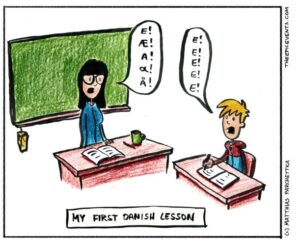
In practice, Danish rarely behaves phonetically: “Some languages are spelled as they sound. Danish is not one of them.” Linguistic research has consistently shown that Danish is the hardest of the Scandinavian languages for neighboring speakers to understand (as reflected in this affirming sketch). One reason may be speed: Danish is often spoken faster than Norwegian and Swedish, which—combined with its tendency to reduce or soften sounds—can significantly affect intelligibility.
The challenge begins early; even Danish children take longer to acquire their native language. Compared to children learning closely related languages, Danish toddlers understand significantly fewer words at the same age—likely because the sound structure makes it harder to distinguish where one word ends and another begins. If I were to compare languages to art movements, Italian feels like Cubism with clear lines, defined shapes, and each word distinct. Danish, by contrast, is closer to Impressionism: soft, undulating, with edges that blur and blend into one another.

I try to train my ear wherever I can. I listen to the radio, where Danish is often articulated more clearly. It helps—until it doesn’t. Because DR Danish is not quite the same as real-world Danish. There is a particular frustration in realizing that you can broadly follow an advertisement or news announcement, but struggle to understand a conversation at the dinner table, where even a simple request like “Pass the salt, please” can get lost in translation.
Practice, in this context, is repetition. Reading aloud. Listening. Trying again.
Another obstacle awaits many learners outside the classroom. You begin speaking Danish—and the conversation immediately switches to English. Jørgen understands why, “That happens because Danes are used to having to be able to speak something else, and many Danes are sufficiently capable to offer the easier connection.” But there is another layer to it. Danish, unlike English, is less forgiving when pronunciation is off. A small shift in sound can make a word difficult for a native speaker to recognize. For learners, this creates a paradox: even careful attempts can break down, and the switch to English is not always due to impatience—it is often due to confusion and trying to accommodate the Danish learner.
Something I’ve found useful in practice is to begin an interaction—whether in a restaurant or a store—with “Må jeg prøve på dansk?” (“May I try in Danish?”). This provides a brief moment of calibration for both parties, knowing that a foreign accent and slower speaking tempo are on the way. Every time I’ve tried this, I’ve received a kind and gracious response for the effort being made—though it’s worth noting that doing so during rush hour in a café might, understandably, lead to a slightly more rushed interaction.
A journey for the bold
One of the most reassuring lessons Jørgen offers is that perfection is not required.
“I have found it necessary to ask my students if sounding like a Dane is important or intelligible Danish is the fair goal.” For adult learners, this matters. Research suggests that achieving a completely native-like accent becomes significantly more difficult with age. Fluency, then, is not about perfection—it is about being understood. Or, as Jørgen often reminds me: fine can be better than perfect.
A year and a half into living in Denmark, I am still very much on that journey. Some weeks I feel confident; others, I find myself listening carefully, trying to catch a sound that still feels just out of reach. It all comes down to persistence without putting too much pressure on yourself (or so I’m told). Learning a language in my thirties often reminds me of a Polish expression: idzie jak krew z nosa—it’s going like a bloody nose—something that progresses (sometimes painfully) slowly with difficulties and obstacles.
And perhaps that is something Danes, too, might keep in mind. For many internationals, the struggle to speak Danish is not a lack of goodwill but a lack of time, opportunity, and the language’s inherent difficulty. Before we can even think about mastering Danish, many of us are trying to gain even a basic foothold.
But with patience—and the right teacher—the language begins, slowly, to open. Learning Danish definitely has its ups and downs, and having a patient tutor can change everything. If you’re looking for extra support, Jørgen offers wonderful one-to-one online sessions through Preply.
Held og lykke med din danske rejse!