
Are you starting a business in Denmark? Or do you have an existing business and want to move some of your operations to Denmark?
In this article we will dive into the advantages of getting a Danish Bank Account, how to transition into the Danish banking ecosystem and finally the key steps you will have to work through.
Contents
- Why you should secure a Business Bank Account in Denmark
- Maybe Don’t Start in Denmark
- How to Find Offers from Danish Banks
- Applying for your Business Bank Account in Denmark
- Why a Danish Business Bank Account is worth the struggle
Why you should secure a Business Bank Account in Denmark
First of all, Denmark is a really good country to run a business in. From a financial perspective, even if you do not see yourself as an entrepreneur, corporate tax rates are considerably lower than individual tax rates. If you have any side-income, organising your operations into a company can potentially bring your income tax rate down from 52% to 22%! So whether you are set on keeping a payroll job for most of your career, you might still consider starting a holding company or family business in Denmark.
Now if you have a business or company in Denmark, you should naturally have a bank account (or two) to hold your capital. By opening a business bank account in Denmark, you are making a strong commitment to the Danish market. It will become a lot easier for you to make purchases and sales within Denmark, where you will presumably be transferring funds between Danish banks.
But there is a lot more to it. You will also benefit from the Nemkonto system for companies, where you will become able to receive payments, grants and tax returns from Danish public authorities. Danish bank accounts also integrate with MobilePay, BetalingService and similar financial services in the Danish/Nordic market.
Yet there is also a catch. Despite all the positives, Denmark is also one of the trickiest countries for starting a business. That is to say, the first few steps can be difficult, such as securing a business bank account with a Danish bank for the first time.
So one idea you might consider is first opening your business (or bank account) in another country, and later moving it to Denmark.
Maybe Don’t Start in Denmark?
Danish banks can be highly selective and even a bit conservative when deciding who to open an account for. This closedness is rooted in several notorious money laundering scandals, involving Danske Bank and Nordea. So Danish banks will not open accounts for anyone, and they like to ask a lot of questions about business activities. That of course leads to a catch 22: you need a bank account for a business, and Danish banks will insist on a business history, before you can even open your first business account here.
! Caution Please ensure that your business is associated with a business account at all times. Using your business account for personal spending or vice versa can lead to your accounts being closed.
But don’t just take my word for it. As a graduate of ITU Copenhagen I reached out about business accounts to some of the folks at the ITU Next Gen start-up hub. When asked about setting up a Danish business account, many international students expressed that they felt underprepared. Even with prototypes starting to take shape, many teams hold off on banking and financial steps until the project feels more established.
Other entrepreneurs I have met from Erhvervshusene and Iværksetter Danmark have often suggested that it’s better to start operating your business first and to find a Danish bank account second. If you take this route, your business will first set up with an online bank and then transition to a Danish bank.
Some options you might explore here are:
If possible, try to work with financial institutions well-integrated with the EU. So if you want to set up a Nemkonto Abroad, you should pick options recognised as a ‘Credit Institution’ by the ECB. This is an ever-evolving ecosystem, so your experience might vary from others. For example Wise was granted ‘Credit Institution’ status only recently this year.
Other than that, every company will have its own account features, billing/subscription model and set of Know-Your-Consumer (KYC) policies, i.e. personal and financial data you will be asked to determine whether you are eligible for their services. With that in mind, you might be interested in holding more than one account in the long-term, to take advantage of unique services offered and varying interest rates.
What’s important here is that you should:
- Settle on at least one service where you can create a business account.
– Preferably one where you can hold DKK. - Try to accumulate 1-3 months of business activity.
– Because Danish Banks want to see operations history.
How to Find Offers from Banks
While you run your business -either registered in Denmark or elsewhere- for the next couple of months, you should keep your eyes peeled for offers from Danish banks.
In the closely-knit Danish business ecosystem many banks, companies, trade unions, pension providers etc. are partnered with each other into little clusters. While as a private individual, you would be hunting for the bank that offers the cheapest fees or highest interest rate; securing your first business account in Denmark is all about finding a bank that will ‘trust’ you. So this section will go over the 5 potential entry-points into your first bank account.
- A Basic Business Account with the Big Danish Banks: Per new regulations introduced in early 2025, the big banks in Denmark are now obligated to respond to applications for business accounts within 10 days, or provide a timely refusal in the event that they suspect money laundering. These banks are:
Some options you might explore here are:
- Lunar: Lunar is a next-gen online bank founded in 2015, that is considerably modern. Lunar appeals to many customers as the ‘bank for internationals’ and that isn’t just limited to very good customer support in English. Lunar’s international customers who travel frequently can benefit from the SAS Card, which lets customers convert their spendings into EuroBonus points with SAS (Scandinavian Airlines).
What’s more, Lunar offers many services geared for businesses, making it a very attractive option for international entrepreneurs. Lunar integrates with your bookkeeping, offers accessible loans and an affordable subscription fee. Serving over 30,000 Danish businesses, Lunar boasts a low entry bar! If you have any friends or acquaintances that use Lunar, ask them for a referral code to see if you can earn a discount! For example, dinero users can get a -20% discount on Lunar.
- Trade Unions: Certain trade unions in Denmark are partnered with certain banks. In addition to private accounts, union membership can also reduce the queue time and trust needed to open a business account.
| Group | Trade Union, Fagforening | Bank Partner(s) | Benefits |
| Lån & Spar Network | DM (Dansk Magisterforening), IDA (Engineers’ Union) |
Lån & Spar Bank | DM and IDA members benefit from better loan/interest rates, priority service when opening accounts, as well as pension advising. |
| Akademikerne Network | Akademikerne (AC) | Danske Bank, Jyske Bank | AC members can access priority services as well as counselling with Danske Bank and Jyske Bank. |
| Workers Network | 3F | Arbejdernes Landsbank | 3F members get priority at AL-bank, including financial counselling as well as lower fee services. |
As an international, your union can be a valuable ally in securing your business account. Take for example Italian entrepreneur Giorgio, one of the minds behind the game studio Brainglyph.
At Brainglyph I and my partner Søren are trying to develop our dream game called Heli.os. That’s easier said than done because creative projects like this require funding, they require sales. We got our first start with a business account thanks to Lån og Spar. I was able to do that through my union DM (Dansk Magisterforening), that I had joined while still in the university.
DM and Lån og Spar have a partnership where union members get a personal account with the bank, and then you can also access additional services like requesting a business bank account. And I think it works similar for IDA and the other unions. I think it’s a big help when trade unions can support entrepreneurs like this.
– Giorgio, Brainglyph, ITU Next Gen alumni.
- Business Organisations and Start-Up Incubators: If you are a member of a business organisation and/or start-up incubator, they may have partnerships with certain banks. Not only that, student entrepreneurship incubators can also offer free/affordable legal and accounting services that can help make your application for a bank account much more favorable. And if you are not already a member of a business organisation or start-up incubator, maybe consider joining one!
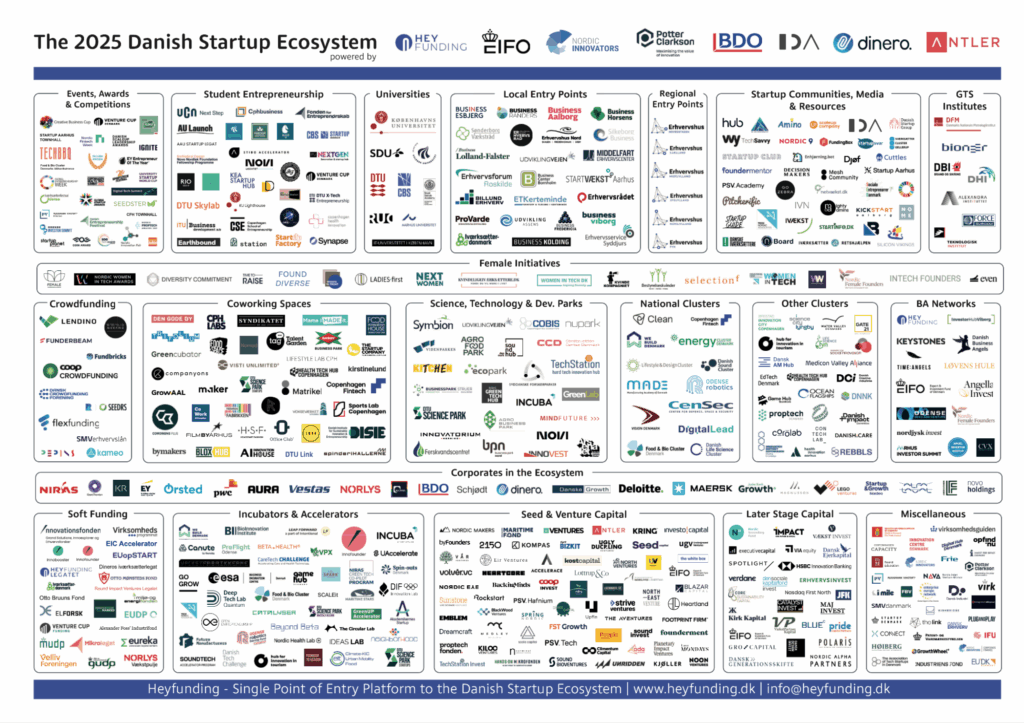
Image: Heyfunding’s – Danish Startup Ecosytem guide.
- Insiders: If you know anyone who works as a bank consultant or similar, you should definitely get in touch with them to inquire about their banks’ opportunities. What’s important here is that you talk to the right person. It’s not very likely that a colleague working in IT at the bank can really help you. And of course, it’s an added plus if you already have a private account with said bank.
Do you see any connection you can make to a Danish bank? In that case let’s talk about how to apply to your bank of choice!
Applying for your Business Bank Account in Denmark
If you haven’t done it already, you must register your business on the CVR, the Danish Business Registry. If you have an existing business abroad, you should instead aim to create a company that will function as a Danish branch. The form can be completed in only 15 minutes, but it will often take a few days to complete it the first time and maybe a week or so to update. Expect some waiting on bank holidays!
The CVR registration is the only ‘official’ requirement, but there is also an ‘unofficial’ requirement to create a public presence for your company and brand. In addition to your CVR number, you should set up a contact email, phone number, homepage and maybe social media accounts. Remember, Danish banks are afraid of fake companies so ensure that you are reachable. You might need to provide this information later when applying for your bank account.
Fortunately, Denmark is a very digital country so you can usually apply for your account on the bank’s website. Be aware that a lot of the pages and questions you will be asked will all be in Danish. Set up Chrome to translate the pages and maybe ask a Danish-speaking friend to help you.
During your application you will be asked information to describe your business, so that the bank can assess whether you are a fit customer.
- Your business model, in a few words (not a powerpoint)
- Product descriptions can be kept vague in the name of protecting business ideas and trade secrets.
- Revenue history for the last year(s)
- Your forecasted income/profit for this year.
- Bank history (if applicable) for the last ~3 months.
- Customer and Supplier information
- Who is your biggest customer? How much do they pay you?
- Who is your biggest supplier? How much do you pay them?
And it’s not over until the bank says it’s over: expect to go through multiple rounds of follow-up! The bank will either contact you for further details or send additional forms that you are expected to complete in a timely manner.
Keep it up until you finally see that sweet ‘welcome new customer’ email in your inbox. You have my personal congratulations if you have gotten there!
Why a Danish Business Bank Account is worth the struggle
Let’s face it, opening a Danish business bank account is not the easiest thing in the world. Many discouraged internationals become content with keeping their business activities outside of Denmark, although the tax implications of running a business abroad merits its own article. In spite of that struggle, there is a lot of prestige to being able to say you own a business in Denmark.
One such entrepreneur who has ‘made it’ in Denmark is Boran Seven. Boran is the founder of EasyPlus.dk, an online marketplace where you can shop for Turkish ethnic goods and imports.
Something that needs to be said is that we have a gatekeeping problem in Danish banking. When I came to Denmark about a decade ago, opening a business account was as simple as contacting your bank advisor. I was a Danske Bank customer for my private account and so I was able to apply for a Danske Bank business account with them.
Last year I met another entrepeneur who had also just come to Denmark from Turkey full of ambition with the Start-Up Denmark Visa Scheme. In spite of a sound business plan, in spite of succeeding in the highly selective Start-Up Denmark program and in spite of the trust of Danish authorities no Danish bank accepted to open a bank account for him.
If you ask me the obstacles to opening a bank account are no longer just financial, they represent a social issue determining whether people can continue to live in Denmark. So I would like to call on civil society and interest groups to act as facilitators on this matter for the international community in Denmark. We ought to use our platforms to support the new intake of international entrepreneurship in Denmark.
– Boran, founder of EasyPlus.dk, board member of the Denmark Türkiye Business Association.
Stories like this demonstrate how being an international business owner in Denmark also represents having a strong tie to Denmark. And as internationals perhaps we have an interest in encouraging one another to integrate our businesses into the Danish market.
The good news is that everything will become much easier once you have secured that first business account. Before you know it, you will suddenly become very desirable to Danish banks trying to outbid each other in offers: higher interest rates, bigger loans, loyalty benefits… And not just banks, the same goes for businesses who might begin to view your business as a key supplier or partner. The world is now your oyster!
Will you succeed in opening a business account after following our guide?
Please let us know if our guide has helped you in the comments!