

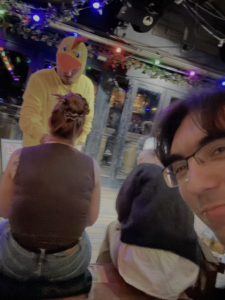
On any given Monday, the first floor of Proud Mary Pub becomes a lively hub for Copenhagen’s international community, hosting the weekly English Comedy Night. The space, with a terrace to the side, attracts a diverse audience of Danes, Swedes, Icelanders, Germans, Americans and other internationals, with some even making the trip from Malmö. If somehow nothing makes you laugh, you get to see a guy in a chicken costume!
The English Comedy nights showcase various comedians, all expertly wrangled by the host, Ira Sylvester. Ira is a comedian of Jamaican and Irish heritage who has been based in Copenhagen for the last couple of years.
On Wednesdays, Ira also curates a more experimental, intimate comedy night at The No Stress cocktail bar. This is also aimed at giving up-and-coming performers a chance on stage. Ira brings together a community of performers and audience members, establishing himself as a key figure in the city’s English-speaking comedy scene. Ira was kind enough to offer us an interview on what he and the English Comedy Nights are all about.
> Editor’s Note: This Interview was originally recorded in November 2025, due to unforeseen circumstances we are pleased to publish it now in June 2026.
AA: Alright, I’ll start with an icebreaker: who was your favourite act today?
IS: My favourite act today was almost, not even almost, definitely Jeff in a chicken costume. It was unexpected, it was beautiful, it was also just- it was a once in a lifetime thing. Because Jeff is getting married on Saturday, that’s what’s so incredible. I was at his bachelor party in mid-August, and it was a good time. But that right there, the spontaneity of it, the kind of out of the blue, the rough around the edges, is also what I love most about stand-up comedy.
Don’t get me wrong, everyone, tonight was fantastic, absolutely, but that was just weird and different, and I like that!
AA: Right, can you tell me who Ira Sylvester is and what brought you to Copenhagen?

IS: I am a comedian by heart. I was going to say by night because I do still have a day job. I am international, I am weird, I am probably a little bit narcissistic, I try not to be. I have fun, I like thinking about ideas, I like playing with ideas, and I’ve always felt very much like an outsider.
So I’m a comedian; fundamentally.
Which is simultaneously thinking that you’re like everyone else and can share these experiences, and then at the same time are very special and unique and want to talk about them when you’re on stage.
And what brought me to Denmark was that I was engaged, I’m a love refugee, like so many other non-Danish, now-Danish residents. I fell in love with a Dane. Viking-style, she brought me over.
And then as soon as she got me to move here and give up my life, my friends, my job, my everything else.. She then, SURPRISE!- broke up with me. Which was so funny, oh my God! We actually ended on really good terms. She’s a wonderful person; it’s just that things didn’t work out. And Denmark is cool, so I ended up staying, yeah, that’s pretty much it.
AA: Makes a lot of sense.
AA: So I’ve been to a few of your acts, and the general pattern seems to be that you’re a comedian who specializes in bringing attention to social issues. Bringing the humor out of it, but also doing it in an educational way. Is there any particular reason why you’re driven to do this?
IS: It’s my background, back in the UK I used to be the national organizer of LMHR: Love Music, Hate Racism.
I was raised as a lefty; my mom’s always been highly political, and she’s also really funny, and she pushes me. It’s always been part of our mutual culture. Because it was always just me and my mom, no dad, my family’s quite small, the ones that do exist are really lovely, but we don’t see them that often.
My mom instilled in me very early on about who is the butt of your joke. Now, don’t get me wrong, I love dark humor, but there is a skill, there is a nuance, and there is an art to dark humor. Because you can joke about the fact that a stereotype exists, but at the end of the day, who are you actually making fun of? Because I don’t want to be a bully!
I was lucky enough that I have always been weird and a bit of an outsider in terms of personality, but physically, I’ve been larger than a lot of people, so I never got physically pushed around. Except for one dude who is actually now one of my closest friends. But I never wanted to be on the other side of that. I didn’t want to be that guy who would be like, ‘oh yeah, look this is all funny for a very select group of people!’
Don’t get me wrong, humor can be separating, it can be dividing, it can create like these little cultures, so to speak, but it’s important to me about who we are laughing at and why. And I just enjoy it.
I originally got into comedy because I wanted to be a philosopher, which sounds kind of pretentious, like I said, I’m a little bit narcissistic, but ‘philosopher’ isn’t really a job. The only real forms of being a philosopher are being an author, or being a stand-up comic, and if I’m up here and I’m talking about things that I find funny and I want to make other people feel this kind of joy and laugh about things that I’ve observed.
I most certainly do not want to be pushing them down routes that are belittling or agitating people who are otherwise kind of already a little bit undefended, so I like the politicism, after all, I do have the Fist of Solidarity tattoo on my chest. I like standing together, I like having fun, and I like playing with dark topics. But I like doing it well.
Jerry Corley talks a lot about this, on how the notion of just saying something because it’s wrong isn’t necessarily funny, because it can also propagate stereotypes. It can be like ‘oh, it’s funny because it’s true!’ So it’s like, do you cross over that boundary? And that is a finer tightrope to walk than a lot of people give it credit for.
So I try to do that, I like a challenge, you know, like when people go “oh my God you can’t say anything anymore!”, C’mon, man! Like, it’s just you’re just not good enough to do it! I like being able to walk down the tightrope and be like, “Yeah, this is my high wire act, this is ‘oh I’m not actually being offensive. But it sounds like I am being!’’ That’s fun, like it’s playing with fire, and you don’t want to go up in flames on stage!
AA: Okay, today we’re at the Proud Mary Pub in Copenhagen, but where else can I catch your acts?
IS: So I run shows every single Monday at Proud Mary at 8 p.m, I also run shows every single Wednesday at No Stress Bar at 8 p.m as well, and they are both free shows. I encourage any and all English speaking people to come down!
Even if you’re not an English speaker, I think come down anyway because maybe it will teach you English. It’ll be a weird way to learn, especially if you learn English the same way that I learned Danish. I hear things, I repeat them, and then I end up learning weird sentences.
AA: English or Danish, you can also be a bit edgy sometimes.
IS: I’m like a razor blade, bro!
AA: Today you were also the host, so you didn’t actually have much to say, but you introduced the other comedians. Is the English comedy night sort of a pet project for you?
IS: I don’t think pet project is quite the right term; these are my shows, but I’m almost always the host. The job of a host and the job of a comedian are extremely similar but slightly different, so the reason why I begin the night with ‘I’m the least important person in the room,’ is because I AM the least important person in the room.
At the same time, I’m still the conductor on the train, so you know the point of a train is to get you where you need to go. The conductor doesn’t direct the train; the conductor just makes sure that it doesn’t crash into a bunch of trees or whatever at the end of the day. It’s making sure that the train stays on the tracks and does what it needs to do.
That means that as a comedian, I will do jokes, which I know work. I don’t have as much free rein to be unfunny. I have to know my material, I have to know what I’m dealing with, and I will still do newer stuff, but if I do that, it’s within a context of I have something to preface it and something to back it up either way.
Mondays are a little bit easier for me than Wednesdays because tonight has very practiced comedians, who already know what they’re doing. So there’s very little for me to do; on Wednesdays, it’s a little bit more amateur-friendly. So I have to prepare a lot more material because I need to pick up the slack when people aren’t funny. Because for the audience, they are very important. If the person who goes on falls flat, I have to pick up the act. I have to be so confident in the material I’m doing that it doesn’t matter what happens.
Whereas tonight is more professional, there are really good comedians who know what they’re doing. Not much for me to do. Come in, introduce, set the rules, make some jokes, have my moment in the sun, go off and then try and keep it on. I mostly argue with comedians behind closed doors while everyone else is watching the show.
AA: How will Wednesday be different?
IS: It’s newer people. I was saying before about how some people think that comedy is going up and saying the most offensive thing you possibly can in front of a group of people and being like ‘oh my God, I can’t believe you just said that!’ So then you’ve got to take that energy and then make the audience member who is maybe offended, upset, or angry, and just bring them right back to a state of “Oh, I’m here to have a good time!” That is much harder!
And they pay less.
AA: Thank you very much!
IS: Final thing! They’re not pet projects; they’re passion projects! First and foremost, before being a host, before being a comedian, I’m a huge fan of comedy. I love comedy, and there wasn’t much of anything going on in Copenhagen. The two people who really started the scene were Jacob Tårnhøj and Jefferson Bond, and they’ve been doing this for a couple of years longer than I have.
I run these shows because, as an international, there isn’t much English-speaking entertainment in general going on around the city. This is something that I love, and it’s something that I want to do. So these two nights, yeah, I guess they’re not my pet projects but my passion projects! In the sense that I do get paid something for them, not enough to survive, but they’re things I would never ever let go!
Unless I get something that pays more.
But if I were to let go, it would be to introduce another act to then take this over so then they
can do the same thing and then carry on and so forth. Because comedy in this area is only 8 or so years old, it’s still growing and it’s still something that needs to be built upon.
So yeah, it’s my pet project, it’s my passion project. That’s what I do!
AA: Alright, I’m looking forward to also catching you on Wednesday!
IS: I am very much looking forward to having you there. And I hope you laugh big and have a really, really good time.

Image Credit: Ahmet Akkoç
Be sure to also follow @copenhagencomedyscene (IG, TikTok) and @irasylvester on (IG, TikTok).
And also follow Ira’s newsletter on Substack for updates about these shows and other shows in Copenhagen, and potentially other parts of Denmark!