


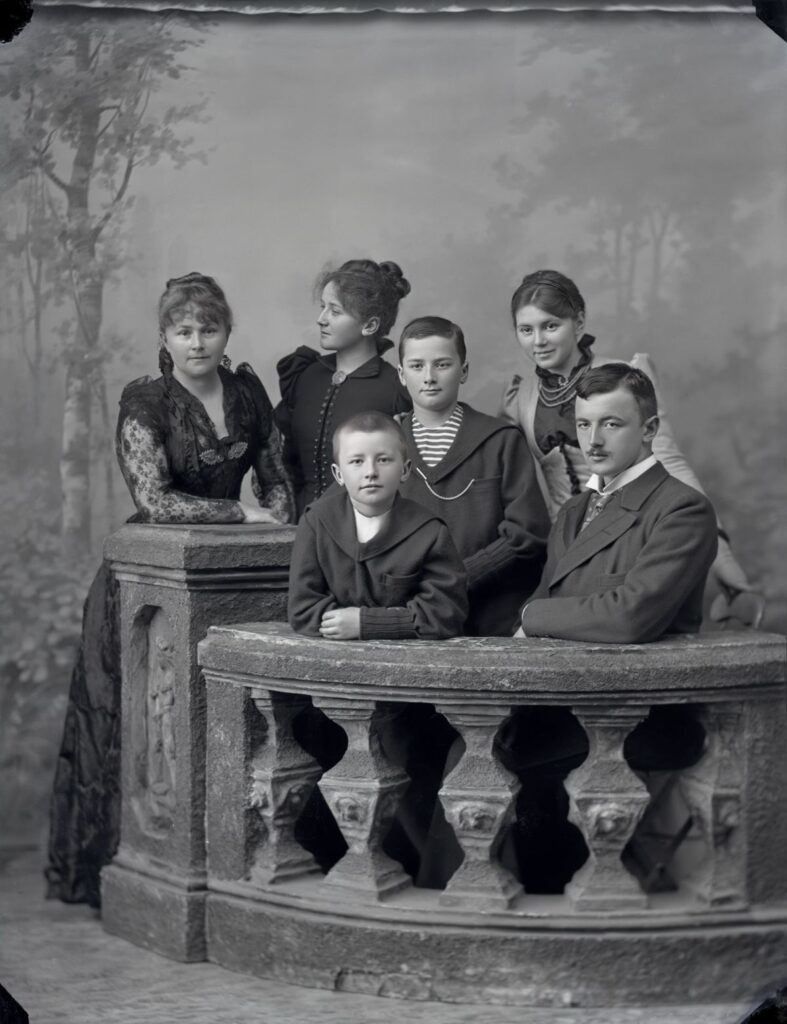
Picture this: You are a photographer from Copenhagen in your late 20s, and for years, your family has shared with you facts, stories, and anecdotes about the city where you were born and raised, but they never fully captured your interest. And then one day, your father hands you a well-preserved photographic glass plate from the 1890s that he found in his mother’s old things. Would you too immediately feel the urge to develop the image recorded on the plate?
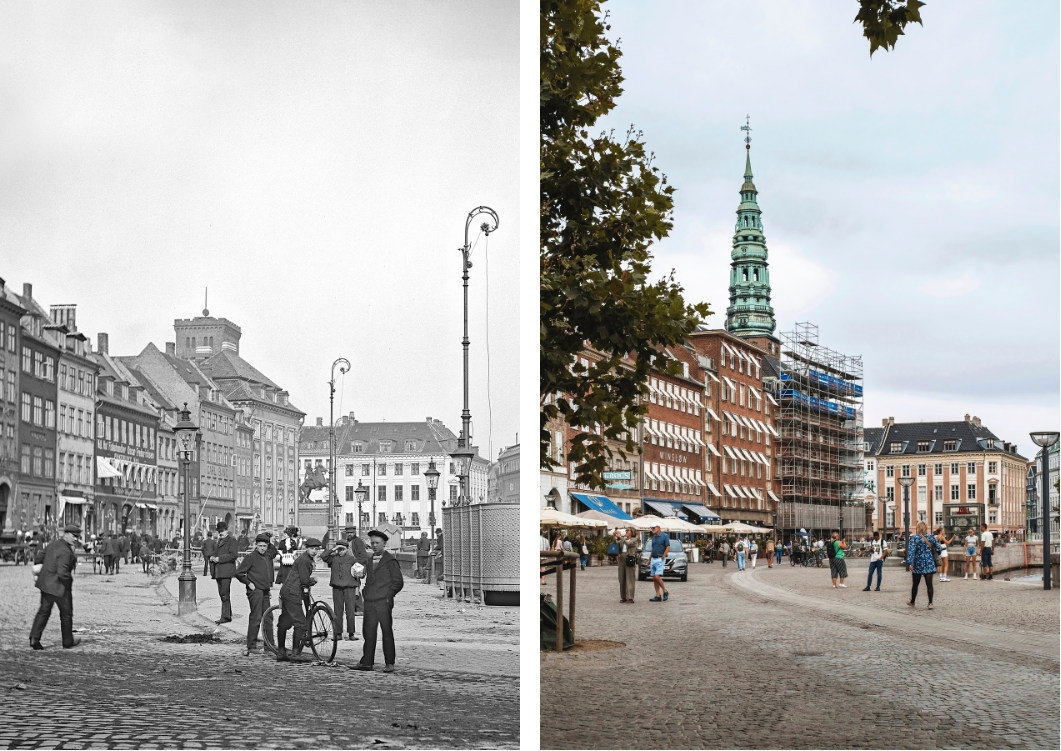
This is exactly what Christian H. Nielsen did. Author of København For & Nu, a book that visually tells the story of urban development by comparing historical photographs largely from the celebrated Danish Royal Photographer Peter Elfelt’s collection to how things look in our contemporary world.
Christian’s journey, however, goes beyond a simple “spot the differences” exercise. It’s an exploration of the city’s living history, a dialogue between past and present captured with remarkable technical precision. The initial spark came not just from the glass plate, but from an earlier photograph from his own family’s archive.
“I was handed an old photo by a family member, which my great-grandfather shot in the 30’s,” Christian explains. “Call me sentimental or nostalgic or whatever, but I immediately got the urge to go to the location and stand in my great-grandfather’s footsteps and recreate the shot.”
In the book’s foreword, historian Mathias C. Stougaard of Kend Din By describes Christian’s work as, “A voice he speaks with through the camera he always carries with him.”
It can’t be done without passion
The first thing you notice about Christian’s work is the passion. I came across it on Instagram in the fall of 2023. A simple reel, “Recreating old photos of Copenhagen – Part 7,” started playing. I was captivated by the images, but what truly hooked me was the caption: “My great-grandfather, Erling Bloch, plays the violin in the song you hear.” As a history enthusiast, that connection was everything. Here was a Dane sharing a piece of his family’s past with the world, and I knew I had to dig deeper. I knew I had to reach out to him.
Early this summer, I decided to message Christian on LinkedIn, not even sure if he’d see it. To my delight, his response arrived sooner than I’d expected. Our meeting was set for Matrikel1, a vibrant spot just outside the Gammel Strand metro. A location fittingly connected to the very photograph that had set his entire journey in motion.
With a smile under his moustache, the 28-year-old from Østerbro reveals the simple truth behind his passion: “It’s fun, and it wasn’t meant to be a book.” But as he gained a following on Instagram, he realised his audience wanted more. Their messages made it clear that they craved a deeper experience than a quick reel could offer. After weighing up options like exhibitions and posters, a photobook emerged as the natural next step.
The key, he stresses, is an unwavering commitment to accuracy. “Sometimes I have to revisit a location and try again, because it has to be perfect or near perfect. And you can only achieve that by standing exactly where the photographer once stood.” This commitment intensified when the book became a reality. “Once the book project was on the table, I definitely took it even more seriously and went more systematically with my approach.”
The book is not a critique of urban development but a way of documenting the subtle and obvious changes that have shaped the city. Christian hopes his work awakens something within the reader as they flip through the pages. This project, he notes, is not political and doesn’t seek to glorify the past. Although some of his ‘Then and Now’ pictures have sparked a debate on social media. It’s a deeply personal act of observation, something, he adds, that an AI-generated application would never be able to replicate.
Christian’s process is a blend of archival research, journalistic detective work, and technical photographic precision. It starts with spending hours browsing in archives, especially those of Det Kgl. Bibliotek (The Royal Library) and the Museum of Copenhagen.
“Then I try to determine the location of the photo, and the detective work that goes into this could make a whole article in itself,” Christian notes. After pinpointing the spot, the technical challenge begins. “I don’t want to give away all the details, it’s been a long journey of trial/error, and I found my own methods of catching the angle/perspective in a way that everything aligns.”
The Peter Elfelt Collection
One of the most remarkable things about the book is the unique visual dialogue it creates with the work of one of Denmark’s most celebrated photographers, Peter Elfelt. Known as the Danish Royal photographer, Peter Elfelt (1866–1931) was a true pioneer of his time, according to Christian.
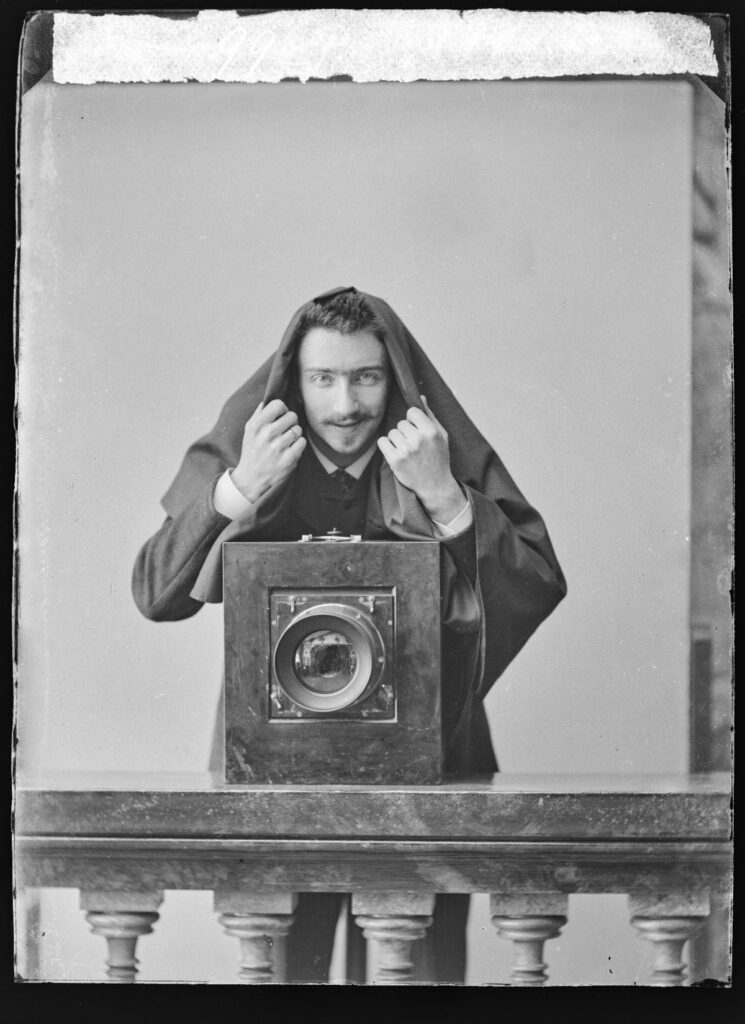
With an enormous body of work encompassing over 170,000 glass negatives, he not only documented the Danish royal family but also captured the everyday life, architecture, and societal transformations of Copenhagen at the turn of the 20th century. His immense collection is a historical treasure, now fully digitised and made accessible to the public by the Royal Library. “I hope there is a movie about Peter someday”, Christian wishes out loud.
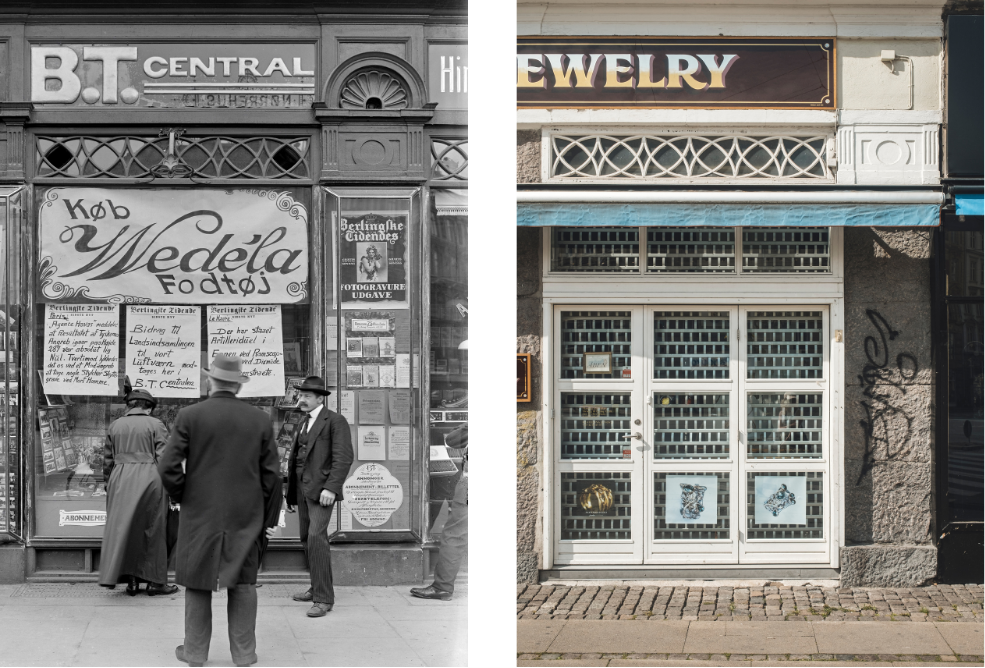
One of Elfelt’s photographs, included in the book, presented a unique challenge: it had no location information. The solution was found by scrutinising a reflection in a storefront mirror, which revealed the name “Nørrehus” on a building across the street. This single detail was enough for Christian to pinpoint the exact location.
The original 1916 image is a remarkable artefact, its storefront window displaying subtle but powerful details like postcards from Russia and various newspapers, including a Danish one with a headline about World War I on its front page. As an international in Copenhagen or a Dane, the effect of flipping through the book feels like a simulation of travelling back in time.
A Passion for the Past, A Lens on the Future
The true magic of Christian’s work lies in these moments of personal connection that bridge the gap between past and present. This is perhaps best exemplified by one of the final images in the book: a “then vs. now” comparison of the Chinese-style gazebo in Frederiksberg Have.
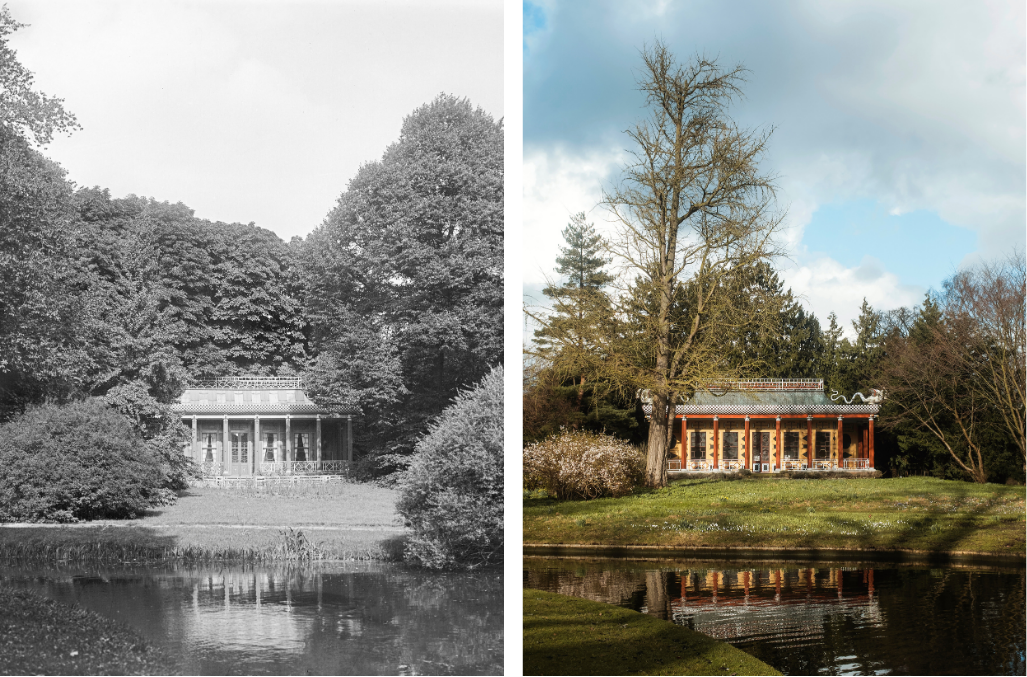
The elegant structure, with its exotic silhouette, is both a familiar landmark and a deeply personal one for Christian. As the caption reveals, the gazebo was designed six generations before him by his own ancestor, Andreas Kirkerup, who tragically passed away from injuries sustained during the bombing of Copenhagen in 1807.
“The Copenhagen Project will always be special because it’s my city,” Christian shares, reflecting on the overwhelming success of his book. The first print sold out quickly, a testament to the community it built, and a second printing is now available.
Christian’s journey has shown him that photographs offer the easiest way to understand a place’s history. He recently experienced this first-hand on his first trip to London, where he recreated images found in Peter Elfelt’s collection. The British Embassy in Copenhagen quickly showed interest and invited Christian for a video interview about his project’s expansion to London.
By using social media, Christian has reached a wide audience beyond those who grew up in Denmark. He’s grateful for many of the internationals in Denmark who have interacted with him online, as he offers them an opportunity to connect with a history that may have been previously unseen to them as new residents of the country.
He’s using this momentum in his new projects. Thanks to his recent growth, he’s now turning his focus to the city of Aarhus.
To follow along with Christian’s work and his new Aarhus project, you can find him on Instagram and TikTok. He is also open to collaborations, so feel free to reach out to him.