
The entirety of my experience in politics dates back to the fall of 2025, when I volunteered to report on international candidates running for local council positions within different districts of Denmark. Prior to this, I identified as an actor, a writer, an educator, a storyteller… but definitely not a political writer. I embraced the assignment and learned to love the role. I found my voice as an American journalist reporting on Danish politics.
In January of 2026, my Facebook feed fed me a post from someone within my algorithm. It was essentially an open invitation to get involved in a local council focused on making decisions and policies related to culture and leisure activities. There was a link and a deadline. And suddenly, here was an opportunity for me to enter the room where it happens: potentially having a platform to promote the arts I value and cherish so passionately.
I learned that as a person living in Denmark with a registered CPR number, I could fill out a form and become a candidate for one of these local positions. So I did. I got on the ballot.
Then, I learned that this election was not heavily publicized. As I humbly shared my candidacy, I encountered a reaction of surprise each time. “I didn’t know there was an election. When, where, and how do I vote?” I treated the experience entirely as a learning experiment. I waited until the day of the election, curious about the process but not yet knowledgeable enough to know what to expect.
On the day of the local culture and leisure council election, I went to the Billund Idrætscenter with my wife on our lunch break. There was no queue.
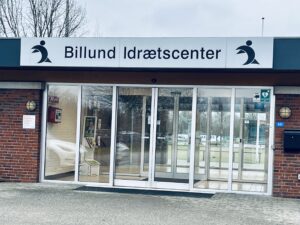
Image credit: John Dixon
Two people would be elected to the arts council, and voters were only allowed to vote for one of the five candidates. I used a random pen and marked my kryds on one and only one name on the ballot.
Later that evening, I received an email sharing the results of the election.
In total, 243 people voted in this particular election. The two members elected to the cultural council received 73 and 67 votes, respectively. I received 37, which is actually slightly impressive, considering I did zero canvassing.
I’m now an alternate on the Billund Kommune’s Leisure and Council Committee.
After all that, what I really learned is this:
As a resident of Denmark, the opportunity to become involved in local politics is available to everyone. You do need to be active, and you do need to take action, and best of all, you do have a voice.
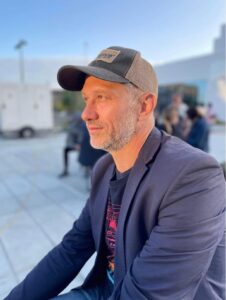
Image credit: Wouter Marck
Like me, Bret Schafbuch is an American who moved to Billund because of LEGO. We both have children at the same international school, and we both love our lives here. Bret ran for the same election as me, but in a different council. He got elected to the Sports Council, with a whopping 56 individual votes. We both have a lot to learn, and we’re both willing to admit that.
Last fall, Bret ran on the ballot of the Billund municipal council, as part of the newly formed “International List.” They did not get enough votes to secure a seat on the council, but they did help shine light on a specific perspective: That of the already prominent and steadily growing community of internationals who migrated here by choice, many of whom are deeply committed to living in and contributing to life in Denmark.
Now serving a four-year term as a member of the culture and leisure council, Bret shared with me some insight into what he has learned on his unexpected journey into Danish politics.
“I was most surprised to learn that there were so few internationals and so few young people on the council,” he shared. This doesn’t mean they are not open to all perspectives, however, inclusivity and representation are highly valued.
“They take me seriously in the meetings,” he says, offering his role within the committee as an opportunity for anyone to contact him as a representative of the international perspective. “Anyone can raise a question or concern at any meeting. It may not get resolved immediately, but it is always considered.”
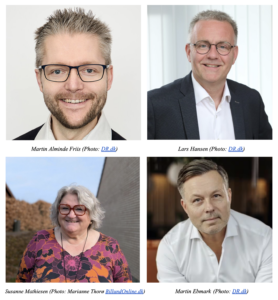
Image credits: DR.dk, and Marianne Thorø for BillundOnline.dk
As a journalist, I wanted to invite all parties to contribute to this dialogue. I wrote to the mayor of my kommune, Stephanie Storbank, and she responded promptly with an invitation for me to attend the next council meeting. I was unavailable, so she instead shared my invitation with the entire council and assured me that all inquiries are always welcome. This has been my experience as an international living in Denmark.
I arranged a phone interview with Martin Alminde Friis, Deputy Mayor of Billund and member of the Socialdemokratiet (A). He shared this insight:
“Council meetings are open. Anyone can come to the meetings. The council can’t answer questions in the meeting, but you can talk to someone before or after the meeting, and anybody can book a time to attend a meeting and share their thoughts and ideas.”
I asked him if he could speak to the differences between how internationals play a role within Billund, compared to other towns in Denmark.
“Billund has strong support for internationals,” he says. “We listen and take all voices seriously.” He shared with me that Billund municipality has a plan in development this year for “a council dedicated to providing a voice and platform specifically for internationals.” This includes not just internationals based in Billund around LEGO, but also those working in farming and other services. It will be an opportunity for anyone who wants to get involved.
Mayor Storbank will give more details about the upcoming international committee as soon as the council is ready for a public announcement.
Later that day, I received an email with responses to my questions from Lars Hansen, Chairman of Billund’s Konservative Folkeparti (C). Here is the email:
How do you see internationals playing a role in Danish politics?
They have made themselves visible and have persuaded the municipal council to establish an international forum.
How can internationals find a way to share their thoughts, experiences, and views?
By participating in the debate. Join a political party.
Can you tell us whether you see a difference in how internationals are represented in Billund compared to other cities in Denmark?
No, because I don’t know what it’s like in the other 97 municipalities.
What advice would you give to an international/ex-pat who lives in Denmark and loves living in Denmark, but feels limited in their power to create change, or feels unheard or underrepresented?
Again, joining a political party will be the way forward. Apply for citizenship.
These responses, from distinctively different party members, gave me continued hope about the generosity and support across my local council. I wanted to include as many different party voices as possible, so I continued to follow the path that opened for me.
While working as a teacher at the International School of Billund, I made friends with Susanne Mathiesen, a council member affiliated with the Socialistisk Folkeparti (SF). She agreed to speak with me on the phone, with the specification that her beliefs are hers alone, not to be assumed as representing her entire party.
“I understand that there were a lot of internationals who were unhappy about not being able to vote in the national election,” she acknowledged. She offered assurance that “whether you are Danish or international, you have the same opportunities to contact us.” This can be either formal or informal, as I have learned.
“Every time we have a meeting, there is time set aside for anyone outside the council to come and ask a question. It’s called åben taletid (open talk time).” You can book an appointment on the kommune’s website.
According to Susanne, all members of the Billund Kommune are obliged to receive emails from residents, and are open to respectful dialogue. They have offered their contact information on the kommune’s website.
I made an appointment to meet with Martin Ebmark, council member and representative of Venstre (V). Martin is also the CEO/Director of Billund Airport Hotel. We met for coffee, and he agreed to share his views on the topic.
“I don’t feel different from those who see themselves as others,” he expressed. “I sometimes feel like a foreigner in my own country.”
Martin was born in Denmark, but has spent a significant time living abroad, including Singapore and Malta. He identifies as an international and hopes to use his Danish voice in Danish politics to support those who might share some of his concerns.
“I fear for the future of Internationals…but they do have a voice here,” he offers. “Twenty percent of our salary goes to city hall, and in exchange, city hall is open to all. You can come speak to me, or anyone else on the council, at any time.”
I may not have gotten enough votes to officially join the room where it happens, but I know the door is always open. I know my voice is always welcome. And so is yours.
Tak, og velbekomme, til alle.