




If you spend any time in Denmark, sooner or later, you’ll hear about janteloven. It’s one of those cultural concepts that’s hard to translate, but easy to feel. Some call it “the law of social conformity”. Others see it as a quiet, unspoken rule that keeps people from thinking they’re better than anyone else. All in all, janteloven values humility, modesty and equality while discouraging loud displays of personal success or individuality.
To outsiders, this can seem like a strange, almost dystopian way of thinking. Why would a society that consistently ranks among the happiest in the world embrace a culture that appears to put people down rather than lift them up?
As a Dane raised with janteloven, I see both its charm and its flaws. On one hand, it creates a strong sense of social unity. It’s the backbone of Denmark’s egalitarianism, ensuring that no one is left behind. It keeps our culture grounded, reinforcing the idea that a person’s worth isn’t measured by status symbols or bragging rights.
But on the other hand, janteloven can be limiting. It can restrain ambition, creativity and self-confidence. After all, why should we feel guilty for wanting to be extraordinary? Why should success come with a side of shame?
But before we go deeper, let’s first break down what janteloven really is.
What Is Janteloven?
The concept originates from Aksel Sandemose’s 1933 novel, A Fugitive Crosses His Tracks. In the book, the fictional Danish-Norwegian town of Jante operates according to ten unwritten rules designed to prevent people from thinking too highly of themselves:
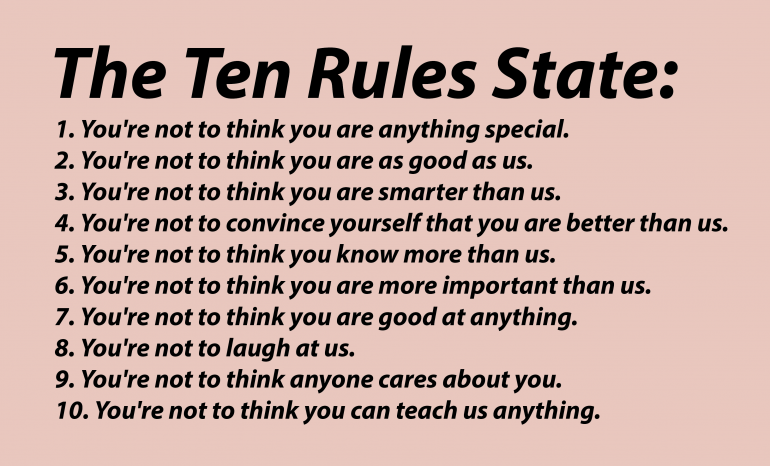
While these rules aren’t actual laws, they capture an underlying cultural expectation: in Denmark, nobody should consider themselves inherently superior to others. If you succeed, we celebrate quietly. If you fail, we don’t gloat. Success isn’t necessarily discouraged, but excessive boasting, pride or self-importance is definitely frowned upon.
On paper, this might sound pretty great: humility, respect, social harmony. But in reality? Well, it’s a bit more complicated than that…
The Origins of Janteloven
While janteloven officially entered the Danish vocabulary in 1933, the mindset is much older. Historically, Denmark was a nation of farmers and small communities, where cooperation was crucial for survival. Unlike many European countries, Danish farmers weren’t serfs, but their success still depended on collective effort.
If one farmer suddenly started showing off his wealth, you can bet his neighbours would make sure he didn’t get too full of himself. This was janteloven before janteloven, a quiet, subtle social mechanism keeping everyone grounded.
Fast forward to the 19th and 20th centuries, and this mindset found its way into Denmark’s political and social structures. The rise of democracy and the welfare state reinforced janteloven’s principles that society should provide equal opportunities for all. Why should one person surge ahead while others are left struggling? Why shouldn’t we all move forward and get better together?
This logic still defines much of Danish life today. Free education, free healthcare, strong social safety nets for all. These aren’t seen as charity, but as a collective agreement that everyone deserves a fair shot in life.
How Janteloven Has Shaped My Life
Growing up in Denmark, I was never explicitly taught about janteloven. Yet, looking back, I see how it has shaped so many aspects of my life. At school, in friendships, in sports, even in the way people speak about themselves. It is this ever-present, invisible force guiding how we interact, like an unspoken rule that everyone instinctively understands but no one ever needs to say aloud.
I was raised to keep my achievements low-key. If I did something well, the response was never a standing ovation. Boasting also makes me feel uncomfortable, almost as if I’m breaking some sacred rule. This cultural framework has, to some extent, made me hyper-aware of behaviours that might be seen as standing out too much or taking up too much space.
Basically, it has shaped my personality in ways I’m still unravelling. I’ve learned to be humble and rarely boast, even when I should celebrate my achievements. I’ve learned to keep my voice down, even when I should speak up. I instinctively try not to take up too much space. Instead, I often find myself blending in, keeping things simple and quiet, and avoiding any form of self-promotion.
That being said, I know my personal anecdotes might make it sound like janteloven is all bad, but that’s not the whole picture. There are parts of it I genuinely appreciate. I love that we don’t worship wealth or status. I love that success isn’t about flashy displays but about being competent, reliable, and respected by your peers. And I genuinely appreciate and value Denmark’s social safety net. It gives me peace of mind knowing that if things ever go wrong, I won’t be left to struggle alone.
School and Work: The Collective Over the Individual
In Danish schools, group work is prioritized over individual achievement. If you are the best in class, you won’t be praised as the “star student”. Instead, you will be encouraged to help your classmates.
I still remember a moment in 6th grade when me and a few classmates were pulled aside and offered advanced English homework. But we weren’t allowed to tell the rest of the class. Even this small act shows how deeply embedded janteloven is.
Danish workplaces reflect the same mindset. Office culture is notoriously egalitarian. Titles and hierarchies exist, but they are subtle. The CEO will definitely be found in the canteen with everyone else and probably biking to work just like everyone else. Titles or success isn’t about standing out, it’s about teamwork.
For internationals used to more competitive cultures, this can be confusing. If you come from a culture where standing out is the primary path to career advancement and success, Denmark might feel like a place where ambition goes to die. But that’s not entirely true. Ambition here just looks different.
Friendship & Social Life: Fitting In Over Standing out
Janteloven doesn’t just shape how we act at school or work, it also influences our friendships and social life.
Danes are often described as friendly and nice but difficult to befriend. In Denmark, relationships are usually built on equality and an unspoken understanding that no one is more special than anyone else. If you’ve just landed your dream job or achieved something big, your friends will definitely acknowledge it, but don’t expect an outpouring round of applause.
Bragging is frowned upon, and self-deprecation is often a more effective social tool. In some situations, talking yourself down rather than up can actually make you more likable. On the other hand, standing out too much or being too loud with your achievements, can sometimes make people take a step back.
The Downsides of Janteloven
For all its strengths, janteloven also has its dark side and can be quite restrictive.
It can make people afraid to stand out, even when they should. It can make it difficult to celebrate your achievements or take proud in your accomplishments. Fear of appearing arrogant can discourage people from taking initiative at school or work such as speaking up in meetings or pushing for leadership roles. Creativity and innovation can suffer when people hesitate to challenge the status quo.
Some internationals working in Denmark might also notice that Danes can be reluctant to express disagreement or engage in difficult conversations, as confrontation goes against janteloven’s cooperative spirit.
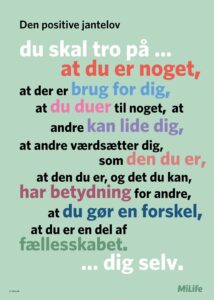
However, in recent years, there’s been a growing pushback against its restrictive aspects, encouraging people to embrace their potential rather than shrink themselves. Just do a quick Google search and you’ll find plenty of posters with the exact opposite message: “You need to believe you are something. That others like you. That you make a difference. That there is a need for you.”

Do Danes Still Believe in Janteloven?
While janteloven still shapes Danish culture, many now argue that it discourages risk-taking, innovation, and self-confidence. Social media and globalization have also played a role in weakening janteloven, as younger generations become more individualistic and open to celebrating success.
Even King Frederik X of Denmark addressed this in his 2024 book Kongeord.
“We Danes must believe that we are something. We must have faith in ourselves and take up space, because we are capable, and we matter. (…) When we celebrate success, it creates action and confidence that we can succeed again. Generosity also means celebrating others and growing with the people around us. We must never be afraid to praise those who succeed in Denmark.”
His words reflect a growing shift in Denmark, not a rejection of janteloven, but an adaptation and evolution of it. The idea that we can maintain our sense of community without suppressing individuality.
A Modern Take on Janteloven
So where does that leave us? Somewhere in the middle, I guess.
Today, Denmark is finding a balance between janteloven and a more open approach to ambition and self-expression. Especially younger generations are starting to blend traditional humility with a more modern take on how to express your success and individuality. While modesty remains a core value, many now believe that humility shouldn’t come at the expense of ambition.
At its best, janteloven creates a society where no one is left behind. At its worst, it suppresses individuality. As with most things, the key is balance.
So, if you’re new to Denmark, and struggling with janteloven, here’s my advice:
- Don’t take it too literally
- Be humble, but don’t be afraid to succeed or stand out
- Join in on the self-deprecating humour, it is often how Danes show affection
- And remember, if a Dane teases you about your success, it probably means they like you
Danish culture, like everything else, evolves over time. And so does the historical and traditional ‘rules’ of janteloven.



Thank you Josephine, for a truly remarkable deep dive into the fabric of Danish culture.
It was an amazing read, showing the evolution up to the urrent state and a glimpse into the future – really beautifully crafted, congratulations.
But most important, I feel like it’s the conversation I never had when thinking about Denmark, even if janteloven gets thrown occasionally into some topics. Thank you!
With this point of view of janteloven.
Everyone is “equal” as long as you are white danish.. If not, you are definitly lower or less.
Oohhh boy and they let you feel it.
Janteloven: “You shouldn’t think you’re something”.
A teacher/sales person rephrase it : “You shouldn’t think you’re something, You should know it”
Me: It’s fine you know, but keep your silence
The latter, being a polymath and sensitizer (both), appeals more to me, than the broader audience.