
Christmas in Denmark doesn’t announce itself loudly.
It doesn’t rush in.
It arrives slowly, almost cautiously. One extra candle in a window. Then another. Suddenly, it’s dark at four in the afternoon, and instead of resisting, people add more blankets, start decorating their houses with lights and stars, and gardens with reindeer. By the end of November, Christmas is already quietly underway.
As an international living in Denmark, I’ve learned that this slow beginning is not accidental. Danish Christmas doesn’t focus on one dramatic moment. It stretches itself out over weeks, sometimes months. And for those of us who come from elsewhere, this rhythm sometimes collides — gently, but unmistakably — with the traditions we bring with us.
Over the years, listening to friends from Ukraine, Argentina, the United States, Poland, and beyond, I’ve realised that Christmas here rarely replaces anything. Instead, it becomes a framework. A structure spacious enough to hold other customs, foods, songs, and memories. What emerges is not a compromise, but a layered celebration.
Learning to Wait
One of the first things I noticed — and one that many internationals comment on — is the importance of Advent in Denmark. Four weeks. Four Sundays. Four candles. The season builds gradually, with small, repeated rituals rather than a single peak.
Oksana, who grew up in Ukraine, told me how surprised she was by this.
“One of the things I’ve really embraced from Danish Christmas traditions is the whole idea of hygge,” she said. “Slowly building the festive atmosphere and savoring the anticipation rather than rushing to the main event.”
In Ukraine, the rhythm is different. People concentrate on preparing Christmas Eve, Sviat Vechir. Families cook, clean, and prepare all day, waiting for the first star to appear in the sky before beginning the meal. The table holds twelve symbolic dishes, each with meaning rooted in tradition and belief.
“The excitement is focused on one big evening,” Oksana explained. “With carols and traditional food. In Denmark, the whole month feels like a slow, cozy build-up, while in Ukraine the rhythm is sharper, more intense.”
Experiencing both has changed how she relates to the season. Instead of feeling diluted, her Christmas has expanded.
How Long Joy Is Allowed to Stay
Some differences only become visible through small details. One that still surprises Oksana — and many others — is how quickly Christmas seems to end in Denmark.
“I’m often surprised by how quickly Christmas trees are discarded here,” she said. “Sometimes the day after Christmas. Back home, the tree stays for weeks. Taking it down immediately would feel almost unthinkable.”
It’s a small thing, but it says a lot. About closure. About rhythm. About how long the celebration is allowed to linger.
These are the moments when living between cultures sharpens your attention. You start noticing not just what people do, but how long they do it.
Food That Carries Memory
When you move countries, food is often the first thing you hold on to.
For Oksana, certain dishes remain essential. Kutia — made from wheat, poppy seeds, honey, and nuts — always appears on the Christmas Eve table. So do varenyky. These foods are not decorative; they carry meaning, history, and continuity.
Ukrainian Christmas is also deeply spiritual. Carols — kolyadky — function not just as songs, but as blessings. They blend Christian themes with older folk traditions, creating something layered and alive.
Another tradition is the didukh, a symbolic sheaf of wheat placed in the home, connecting the present household with ancestors and the land. And always, there is the waiting for the first star.
Music, too, becomes a way of holding on. When everyone sings Carol of the Bells in English, Oksana sings it in Ukrainian.
“The song itself is Ukrainian,” she reminded me. “Long before it became a global Christmas classic, it was Shchedryk.”
Composed by Mykola Leontovych in 1916, Shchedryk was originally a New Year’s song about a swallow bringing wishes of prosperity and renewal to a household.
“These days, my Christmas is a blend of both countries,” she said. “And I’m happy that my traditions have become even richer.”
Christmas in the Wrong Season — Until It Isn’t
For friends from the Southern Hemisphere, the contrast is even more dramatic.
Milena grew up in Argentina, where Christmas means summer. Heat. Long evenings. Fireworks at midnight. Family dinner first, then — especially as a teenager — celebrating with friends until morning.
“In Argentina, Christmas is one of the most important celebrations,” she told me. “It’s a moment to spend with family and friends.”
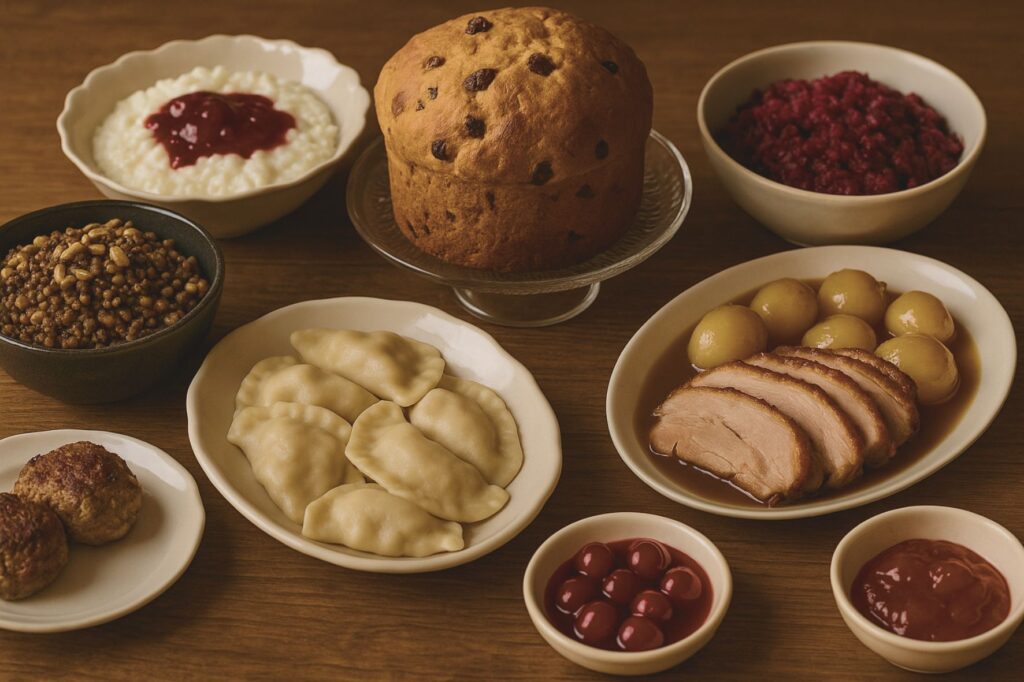
The table is full: vitel toné, matambre, empanadas, nougat, champagne, or cider. And always pan dulce — panettone.
“Something that I realized is very important for me is the panettone,” Milena said. “And I’m glad I can get some imported from Italy.”
Moving to Denmark meant encountering Christmas in the cold. Snow. Darkness. Short days.
Surprisingly, she loved it.
“I think my favourite things from Danish Christmas are having snow and cold weather,” she said, “and eating æbleskiver and risalamande.”
Now, Danish cookies from the supermarket sit next to ginger cookies, panettone, and filled tomatoes — a typical Argentine Christmas dish. Nothing has disappeared. The table has simply grown.
Forest Santas and Dancing Around the Tree
Dana, who grew up in the United States, often says she wasn’t particularly attached to Christmas — until she experienced it in Denmark.
“I’ve been excited to show my parents Danish Christmas,” she told me. “I think it is far superior to American Christmas. So much more hyggeligt.”
What she noticed first was the aesthetic. Danish Christmas feels quieter, closer to nature.
“Julemand is more of a man of the forest with woodland creature friends,” she said, “as opposed to the red-suited Coca-Cola guy in America.”
She’s taking her parents to a traditional kro for julefrokost so that they can experience the whole sequence of dishes, snaps, and risalamande. She often has to explain that in the U.S., Christmas doesn’t have a fixed menu.
“We have that for Thanksgiving,” she said. “For Christmas, my mom usually made spinach lasagna because it is red and green.”
One tradition that made a strong impression on her — and her sister — was dancing around the Christmas tree.
“Our favorite part was dancing around the Christmas tree,” Dana recalled. “It felt pagan. Like people were trying to keep warm in a cold time of year.”
These days, she prefers to be in Denmark—or at least in Europe —for Christmas.
Learning Danish Christmas by Accident
My own Danish Christmas story started, like many others, through everyday life rather than conscious choice.
In our first year in Denmark, my child came home from kindergarten with a nisse. Not a drawing. Not a story. An actual little toy, plus a notebook.
The nisse was going to stay with us for the weekend and then visit another child. Our job was to take care of it and document its stay.
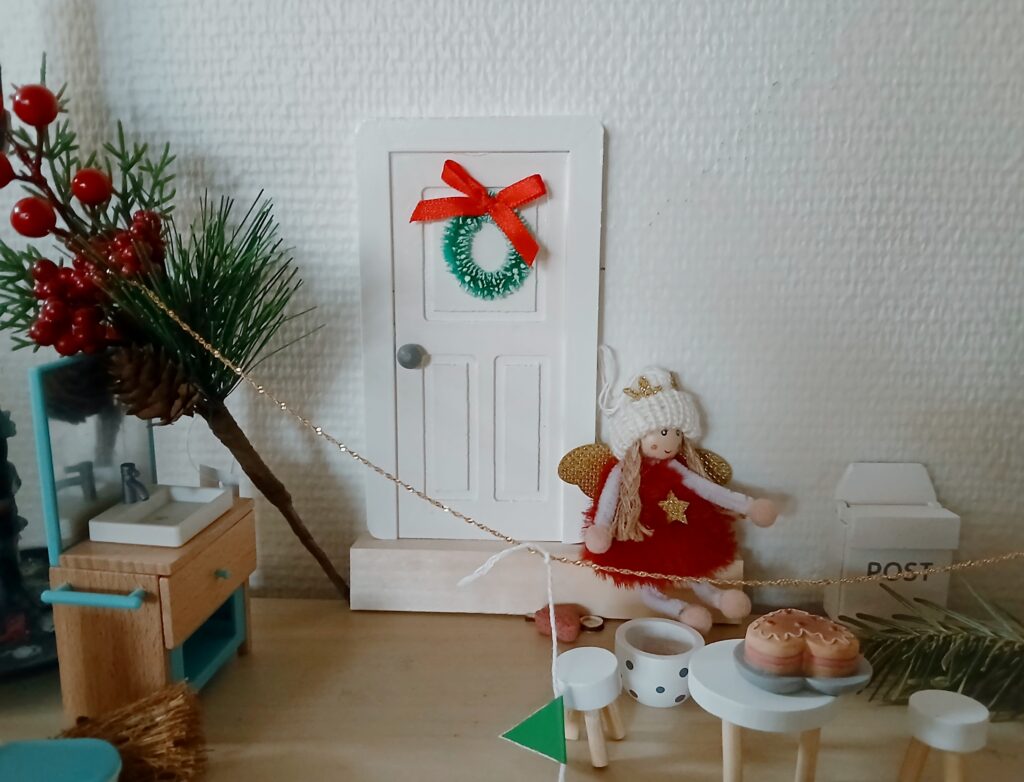
At the same time, I kept noticing tiny doors, ladders, and decorations in supermarkets, without understanding why. Only later did I learn about the nissedør — the little door that allows a nisse to come and go.
We installed one. We started feeding our nisse. And just like that, a tradition entered our home and never left.
Other things followed. Risengrød became our winter comfort food. The Advent wreath moved into our home and claimed a place on the table. Every Sunday, my kid insists on lighting the candles, even at 8 a.m. And Christmas markets — which in Denmark often start already in November — quietly shifted my sense of when the season actually begins.
Trees, Bonfires, and Shared Tables
Living in Denmark also opens the door to traditions that feel local, even if no one would label them strictly “Danish.” Many Polish families I know take advantage of the abundance of Christmas tree plantations and go out together to cut their own tree. It has become one of their Advent activities – a family celebration, where they carefully choose a tree, saw it down, and carry it home.
This little trip turns into a winter outing: pancakes made over a bonfire, warm gløgg or æblegløgg passed from hand to hand, cold fingers, red cheeks, and the tree tied carefully to the car before everyone goes home. The tree matters — not as decoration alone, but as something you’ve spent time with before bringing it inside.
In my bofællesskab, Christmas is collective. Shared kitchens and shared tables mean that traditions move easily between households. Since we moved here, I’ve continued to bring Polish food into Danish contexts. This year, for julefrokost, we had piernik — a spiced Polish gingerbread cake — sharing space with herring and rye bread. Someone sliced it thinly and added butter on top. I had never eaten piernik that way before.
It worked. And it didn’t feel out of place.
Religion, Or Something Else
In many countries — Poland included — Christmas is explicitly religious. In Denmark, it often feels more cultural than theological. It is more about hygge with your family and friends than a formal expression of faith.
A Ukrainian friend once told me a story that stayed with me. After three years in Denmark, her ten-year-old son came home from school visibly surprised.
“Did you know that Christmas was actually about the birth of Christ?” he asked her.
“It does not feel this way at all here in Denmark,” she said, laughing.
That difference, too, shapes how traditions travel. Danish Christmas leaves space for belief, but doesn’t insist on it. Which, for many internationals, makes it easier to participate fully.
Layering Instead of Choosing
Some families alternate Christmas between countries and traditions. Others divide the days.
One friend described it simply: Danish Christmas on the 24th, with Danish family presents. American Christmas on the 25th, with American gifts.
Rather than choosing one tradition over another, many internationals layer them.
That may be why Danish Christmas adapts so well. It is built around atmosphere rather than rules. Around light, food, and togetherness rather than correctness.
Somewhere between the last candle burning down and a plate of cookies forgotten on the table, Christmas here becomes something shared — not despite our differences, but because of them.