

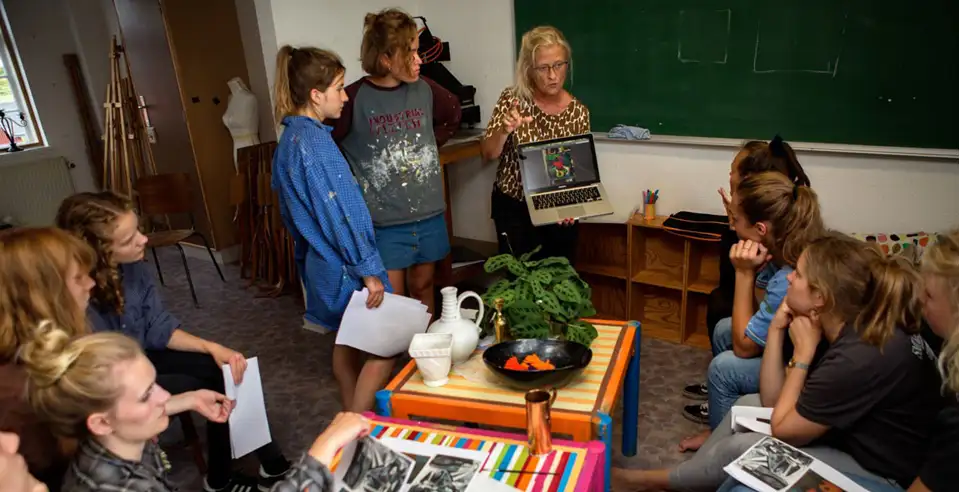
Earlier this year, Minister of Culture Jakob Engel-Schmidt held a public vote to determine Denmark’s UNESCO Intangible Cultural Heritage nominations. The minister, along with TV garden personality Søren Ryge and actress Ghita Nørby curated a list of 20 proposals from a public hearing of over 10.000 proposals.
A total of 58.793 Danes voted, and the 5 official nominations turned out to be the Danish hot dog stands (pølsevogne), the trusting society (tillidssamfundet), handball, association culture (foreningsliv), and, in first place, with 7176 of the votes: The Danish folk high schools (højskoler).
The nominations have been added to the national folklore archive, marking the first step toward official recognition from UNESCO. So the Danish folk high schools or the Danish hot dog stands might be joining such notable entries as Argentinian tango, French baguettes or Japanese sake brewing.
But why would a school deserve this honor? What makes them so special? And why do they have such a convoluted English translation?
Let’s get into it.
A school of the people, by the people, for the people
The literal translation of “folke-høj-skoler” actually is “folk high schools”, but they are not to be confused with high schools in the traditional sense of upper secondary education. In Denmark, these schools are called gymnasiums and are part of the formal educational system, forming the requirements for further studies.
Instead, folk high schools are meant as an education for life, an enlightenment of the people and a way to get in touch with your roots. There are no academic requirements for admission, no grades or exams, and they are not part of the formal educational system.
They are a kind of boarding school where students eat, sleep and live together for shorter or longer periods of time. Anybody above 17,5 years of age can attend, but most students are younger people, especially between 20 and 24 for the longer stays (usually 4-5 months), and people above 60 for the shorter stays (usually a week or two). A common stay could, for example, be in a sabbatical year or during holidays.
The majority of folk high schools are generalist with a wide range of subjects to choose from, but many also have specific profiles like schools for film, art, theater or music, or schools with outdoor profiles, focus on sports, lifestyle or Christian spiritualist schools. There are also specific youth schools (for 16-19 year olds) and senior schools.
Common to all of them is that they share the same core principles based on the romantic and democratic ideas of the early 19th century. The focus on the people and their general enlightenment – also called “dannelse” in Danish or “Bildung” in German – was originally developed by the German philosophers Herder and Fichte. These ideas, sweeping across Europe, became sources of inspiration for Grundtvig, who laid the foundation for the folk high schools.
Grundtvig and The Living Word
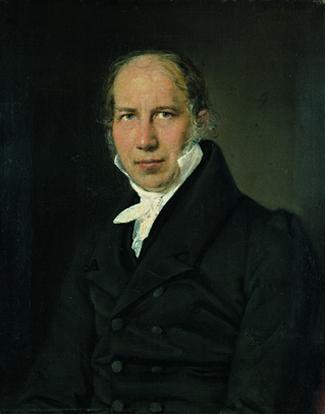
N.F.S. Grundtvig (1783-1872) was a theologian, poet and political figure with a lasting impact on Danish culture and society. He wrote many of the hymns that are still sung in churches to this day, he developed a “softer” form of Christianity, which was based on verbal preachings instead of literal interpretations of the bible, and he got the idea for the folk high schools in the 1830s, which he developed in a number of writings in the following years.
The core idea was to educate the people to take part in the future of the country. People should be taught the history and the language of their motherland and what it means to be Danish. There was a special focus on national folklore and national cohesion. Even though Grundtvig was a Christian, the schools were meant to be secular and to focus on “dannelse”, i.e. general knowledge, rather than missionary activity. One of his slogans was “human first, then Christian”.
He wrote about these ideas at a time when the monarchy was heavily criticized by citizens and intellectuals. The pedagogy behind the folk high schools was also quite revolutionary for its time, since it was based on the students asking questions and receiving answers, instead of the schoolmasters lecturing in elitist fashion. This was due to Grundtvig’s doctrine of “the living word”, which was a focus on the spoken tradition as a means of spiritual awakening. The tradition of “the living word” has been carried on in the folk high schools as an ideal of democratic conversation ever since.
Inspired by Grundtvig’s writings, the first folk high school was established in 1844. But it was especially after the loss to Prussia in the war of 1864, which was a national trauma for Denmark, that the folk high schools got their breakthrough as part of a national identity project. The number of schools grew rapidly in the following years, and by 1890, there were 72 schools across the country. At first, they only accepted young men, but schools for women also appeared in the 1860s.
Impact on Danish society
The schools became particularly important for people in the countryside. They gave the rural population a sense of self-esteem and of democratic participation. As an example, another item on the list for UNESCO nominations was the cooperative movement (andelsbevægelsen), which was a movement for farmers to get a larger share of their products by joining in cooperatives. This movement grew out of the folk high schools, with many of the leading figures being former students. It still exists today, for instance, in the form of cooperative housing.
Another lasting cultural institution is the Folk High School Songbook (Højskolesangbogen), which is used on the schools themselves and in other contexts. It is a collection of hymns and folksy songs used in communal singing. The canonization of songs in new editions of the book often receives lots of media attention and can sometimes be subject to controversy. In 2018, for example, there was quite a bit of debate about an incident where a lecturer at CBS had felt excluded due to a song called “The Danish Song is a Young Blonde Girl”.
Today, the schools continue to be part of the culture in broad sections of the population. In 2021, the analysis and consultant firm Moos-Bjerre conducted a study for the Association of Folk High Schools in Denmark, investigating a misconception that only people from the upper class attended folk high schools. The study concluded that most students attending longer courses had the same income level as the general average in the population. On the contrary, the highest income group was under-represented among students of longer courses.
But the study also concluded that students often come from families with a higher level of education than the average population. 22 percent of young people on longer courses had at least one parent with a long academic education, while the same was true of only 13 percent in the average population.
As such, the folk high schools have been able to adapt to changing demographics throughout their history and continue to have diversity as a focal point. “It is important both for the folk high schools and for democracy that the folk high schools can be a gathering place for people with different views and backgrounds”, Lisbeth Trinskjær, chairwoman for the Danish Folk High Schools, said in connection with the study.
Options for internationals
Most courses at the folk high schools are in Danish, but various schools offer English courses or have an international profile. Attending one of these schools can be a great way for internationals to get closer to Danish culture, learn the language and establish new friendships.
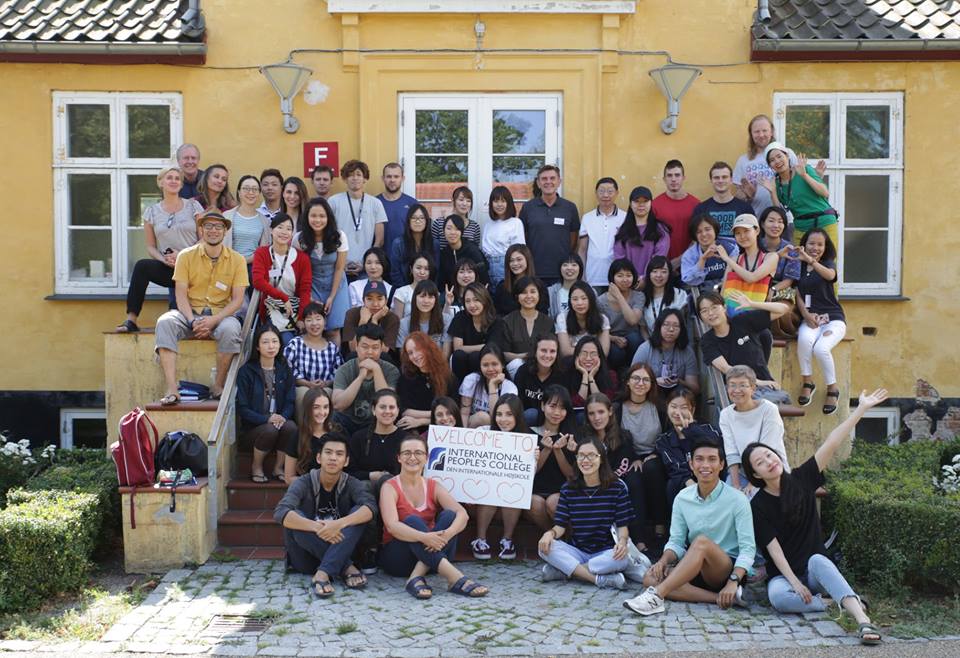
The International People’s College in Helsingør is focused on internationals and sometimes has shorter, one-week courses like a Shakespeare Course or an LGBTQIA+ and Human Rights Course. There’s also the European Film College in Ebeltoft that promises a 1-year film foundation program “to young people from all over the world”. And Rønne Folk High School offers Danish courses at all levels, e.g. for people who need to fulfil a residency requirement for dual citizenship.
A stay at a folk high school usually costs around 1200-5000 kr. a week, which includes food and accommodation. But there are a number of scholarships and subsidies available, including for internationals. These include scholarships for people from the Nordic countries, a special endowment to students from Ukraine, a diversity scholarship, and several options for people with refugee status, e.g. to attend a folk high school as part of their integration program.
It has also become possible to go to a folk high school if you have a self-picked education agreement as part of your job contract. But keep in mind that the purpose of the schools is for general enlightenment and democratic conversation and not usually for specific vocational training.
Check your local folk high school or go to danishfolkhighschools.com to view the courses. Most of the applications for scholarships for spring 2026 closes in October.