

In 2021, Queen Margrethe of Denmark was seen, highly out of character, on the stage of the biggest revy in Denmark, Cirkusrevyen at Dyrehavsbakken in Klampenborg. She was there to surprise the 80-year old comedic actor Ulf Pilgaard during his final performance in the show, where he, as he had done for many years, was delivering his parody of the Queen’s New Year’s speech. With his characteristically growling voice tuned up an octave, he would for instance make fun of the former monarch’s excessive cigarette consumption. For the same reason, she handed the vocally surprised and overwhelmed actor an ashtray and congratulated him on his upcoming retirement. All while the audience was laughing, cheering and clapping along.
Growing up in Denmark, I used to get a similar response from the adults in my family when I imitated Ulf Pilgaard, who in turn was imitating the Danish Prime Minister of the 90’s Poul Nyrup Rasmussen. Pilgaard was talking about there being pigs in the Social Democratic Party, and asked himself “Why are they there?” Responding “I don’t knooww,” in the Prime Minister’s familiar cadence. That silly impression used to be a sure crowd pleaser in my family, at a time when the revy had been institutionalized as the most mainstream form of comedy and political satire in the country.
But what exactly is a revy, and how does it differ from other forms of cabaret theater?
The Danish Revy Tradition
When thinking of cabaret theater, you might imagine cancan-dancers at the Moulin Rouge in Paris, smoky bars and edgy social satire, delivered in front of tables with bohemians drinking absinthe. You might even imagine Charles Baudelaire or Arthur Rimbaud sitting somewhere in the audience, scribbling erotic fantasies in their notebooks. But the Danish tradition is much more catered towards a bigger audience and far less avant-garde in nature.
It consists of a potpourri of narrative songs, dances, monologues and sketches with highly topical political satire and social commentary. As with the French word of its origin, revue, it is supposed to give a review or an overview of the preceding period, often the preceding year, as most of the shows like Cirkusrevyen and Tivolirevyen take place in the summertime.
The first revy took place on New Year’s Night in 1850. So this year actually marks the 175-year anniversary of this tradition, roughly the same length as that of the Danish constitution and therefore the democracy itself. Because of this, the revy has been intimately connected with the democratic culture and the cultural habits of a growing electorate throughout the 20th century and beyond.
Stylistically, it was inspired by the vaudeville as adapted by the playwright and critic J. L. Heiberg in the first part of the 19th century, incorporating songs and a lighthearted character into the theater. The revy was similarly a popular form of entertainment that went against the elitist genres of opera and classical theater, reflecting the spirit of the people, also known by the special Danish term “folkelighed”.
Folkelighed – The Voice of the People
The Danish term “folkelighed” is hard to translate into English. The most direct translation would be something like “people-ly-ness”, meaning an ideology and a style of popular discourse with some of the same connotations of vulgarity that the term “populism” carries, but with a general positive and democratic sense of referring to the people at large. As a journalist once quipped: “Anyone who does not like folkelighed has no humour”.
The revy tradition is the embodiment of this people-spirit. With its topical satire, making fun of the powers that be, it gives the people a voice and a sense of community, as well as a sense of democratic participation that presupposes knowing the issues of the day. It can fluctuate between lighthearted fun and more serious social and political criticism, wrapped in the cloth of entertainment. A similar version of the sketch part of the show would be Saturday Night Live.
The designer and architect Poul Henningsen – for instance famous for the PH-lamp – wrote a number of highly popular revys (plural: revyer) in the 30’s. One of them included a song about the delights of beer, “The beer dog is barking”, sung by Oswald Helmuth. But during the nazi occupation of Denmark in the 40’s, he also wrote songs with coded messages that would pass the censorship laws as a way of silently protesting the occupation, for instance the song “You bind us by the mouth and hand”, sung by Liva Weel, which has become a symbol of constrained resistance during the Second World War.
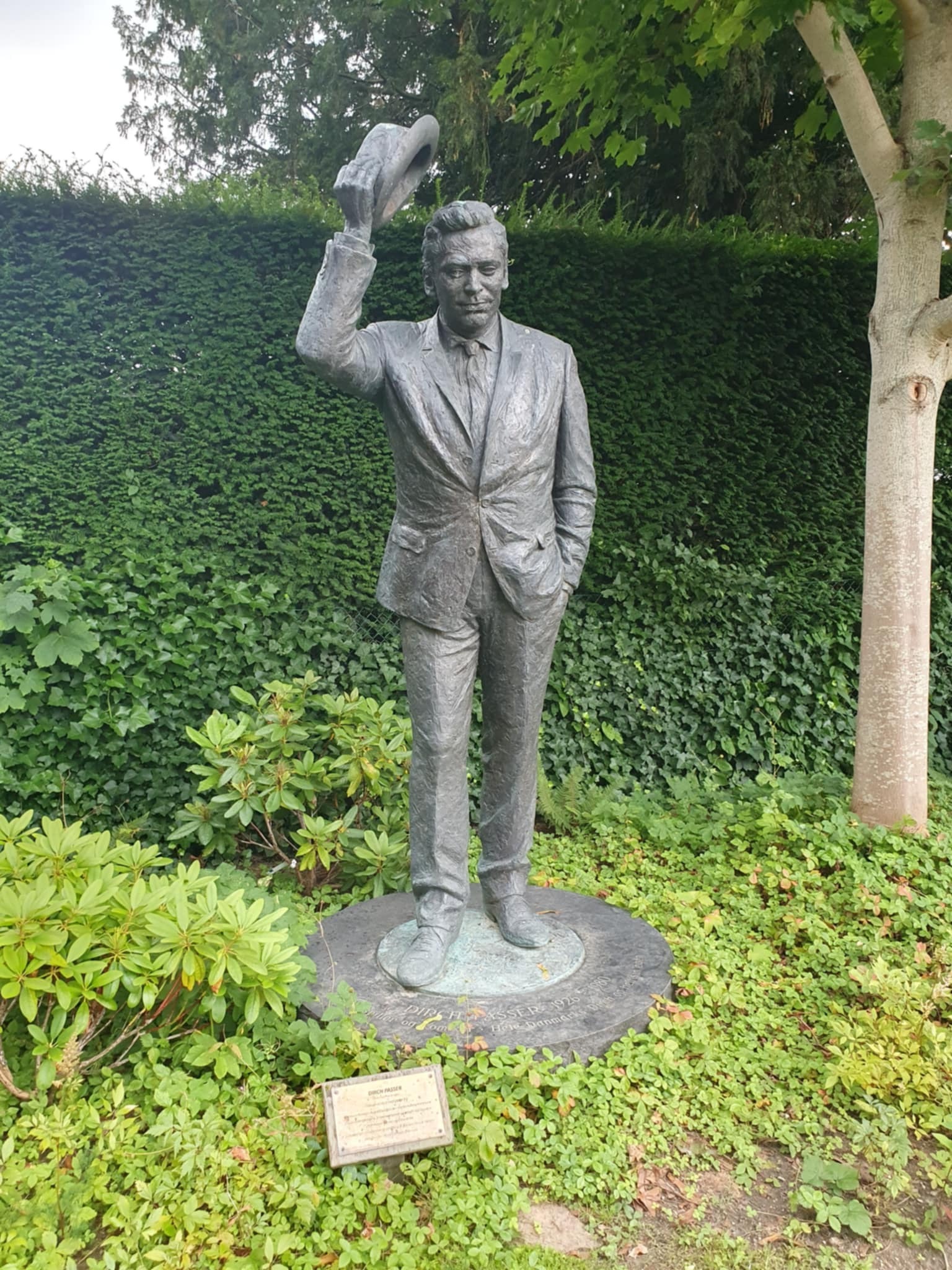
Along with Helmuth and Weel, the revy scene created many celebrated entertainers with comedic flair and musical talent, among them Victor Borge, who went on to become famous in the United States. One of the all time greats at home was Dirch Passer.
Dirch Passer and the ABC Theater
Stig Lommer created the ABC Theater in Frederiksberg in 1949, which quickly became the most successful theater in town. He was known as a cigar wielding impresario who was famous for his so called Lommer girls, a troupe of lightly dressed female dancers. He is for instance reported to have denied ventilation to the venue because people would buy more drinks if they were thirsty. In other words, his reputation preceded him as a sly business man, surrounded by lore.
In the revy of the ABC Theater, he introduced the duo Kellerdirk Bros, consisting of one of the most popular entertainers in Danish history, Dirch Passer, along with his partner Keld Petersen. Both are skilfully portrayed in the biopic Dirch from 2011, where the leading role is played by Nikolai Lie Kaas, himself a son of Preben Kaas, who was another big figure in the Danish revy tradition, working alongside Dirch Passer and helping to establish Cirkusrevyen.
Kellerdirk Bros was a slapstick comedy duo in the style of Laurel and Hardy or Abbott and Costello, but with an erratic and unpredictable twist that has labeled the style “crazy comedy”. Dirch Passer was known for his loud outbursts and Keld Petersen for his more subtle wit. Passer went on to perform in many of the social realistic comedy movies of the 50’s and 60’s, which has made his name synonymous with popular entertainment in Danish history.
The Revy Today
Today, the revy tradition is still being carried on by popular actors such as Niels Olsen, Lisbeth Dahl and Henrik Lykkegaard. But as with the general media landscape, the habits of consumers are changing. According to a survey of the Danish cultural habits in 2024 from Statistics Denmark, younger people prefer stand up comedy to revy or cabaret. Less than 10% of people below 54 had seen revy or cabaret either live, on tv or on the internet in the preceding year, while the number was double that for the age group above 55. Conversely, more than 25% of people under the age of 54 had seen stand up, while it was significantly lower in the older age groups.
Arguably, this trend has been underway ever since stand up had its boom in Denmark in the 90’s and 00’s. Stand up comedians such as Casper Christensen and Thomas Wivel were partly reacting to the mainstream comedy that the revy represented. Today, we even see weekly – as opposed to annual – political satire on television, in programs such as Close to the Truth, the Danish equivalent of The Daily Show.
But the revy tradition has been a staple of democratic entertainment throughout the country’s history. It tells a lot about the political involvement of the Danish citizens and their generally humorous and lighthearted take on power and authority. The voice of the people expressed by the particularly Danish word “folkelighed” is also something that is pervasive in other parts of Danish society, as for instance in the Højskole (adult education) movement, another one of the nominations on the UNESCO Intangible Cultural Heritage list.
So stay tuned for that.