

Did you know that in just under two months, Denmark will be holding municipal and regional elections? And did you know there’s a good chance you’re eligible to vote, even if you don’t hold Danish citizenship?
In fact, if you come from an EU country, the UK, Norway, or Iceland and live in Denmark, you can vote in both municipal and regional elections. If you’re from another country, you can also vote provided you’ve lived in Denmark for at least four years.
If you’re eligible to vote, you will receive a voting card in your mailbox, showing both where and when you can cast your vote. You must bring the voting card with you when you go to vote, and to be on the safe side, it’s a good idea to also bring your passport or driver’s license.
Municipalities are responsible for many areas of daily life: schools, employment, integration, traffic, culture, and healthcare services. This means that the municipality handles urban development, making sure there are apartments for the many people who want to live in Copenhagen. Similarly, the development of the Metro system is something the municipality is responsible for. The quality of schools and teaching is also managed at the local level, even though Parliament sets the overall rules for education.
Regions, on the other hand, take care of hospitals and coordinate large-scale transportation. On November 18th, voters will elect representatives at both municipal and regional levels.
And you will have plenty of options. In Copenhagen alone, there are usually more than 25 different parties to choose from. At the last election, 10 of them won seats in the City Council, which has 55 members. These seats are distributed proportionally according to the share of votes each party receives.
But being eligible to vote is one thing – deciding who to vote for is another. With so many parties, how do you figure out which one best represents your views? That can be a challenge, especially since most party materials are only available in Danish. Some individual candidates, however, do publish campaign leaflets in English or other international languages. I’ve done so myself.
The good news is that Danish politics is very accessible. Most politicians share their public contact details, and you’re welcome to email them directly with your questions. They’ll be happy to respond – especially during election season! You can write to individual candidates or to entire parties. Many are active on Facebook or other social media platforms. Often, there is content in English or the option to translate via the platforms’ built-in translation functions. Quite a few municipalities also arrange information meetings in English, for example at libraries.
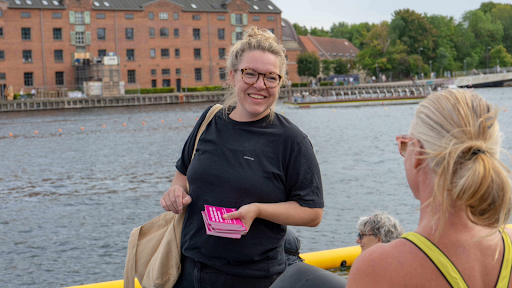
As the election approaches, you can meet candidates out on the streets. There, you can get answers to your questions. I myself have been out handing out campaign material over the past many months, and one day while standing at Østerport Station, I met a woman from the U.S. who immediately turned me down because – as she said – she couldn’t vote in Denmark at all.
But it wasn’t that easy. I asked her how long she had lived here, and she was very surprised when I told her that she actually had the right to vote in the upcoming elections this November. We had a great conversation about local politics and parted with a hug. She was very grateful, and I was happy to have engaged her in the election.
But how do you find out who is running? It’s actually simple. Starting October 6, the municipalities are required to publish which parties and candidates you can vote for in this year’s municipal and regional elections so go to the website of your municipality.
You’ll also find debates taking place in many settings. Keep an eye out at universities, international community websites, larger workplaces in your municipality, and of course on social media. Political debate in Denmark is lively, informal, and highly interactive. Politicians are, after all, the voice of the people.
You might think your single vote won’t make much of a difference. But in Copenhagen, there are more than 100,000 foreign citizens eligible to vote. That’s almost one in five voters. Together, these votes can absolutely influence who gets elected – and even shift majorities in the City Council.
So why not take part? Denmark has a proud tradition of high voter turnout. Democracy here is for everyone – and that includes you. And since voter turnout among foreign residents is usually somewhat lower than among Danish citizens, your vote actually carries extra weight. Only Danish citizens can vote for Parliament but in the municipal and regional elections, most foreign residents can participate on equal footing with Danes. So it’s time to take part in local democracy.