
When transitions create resistance – and what it looks like in the Nordics
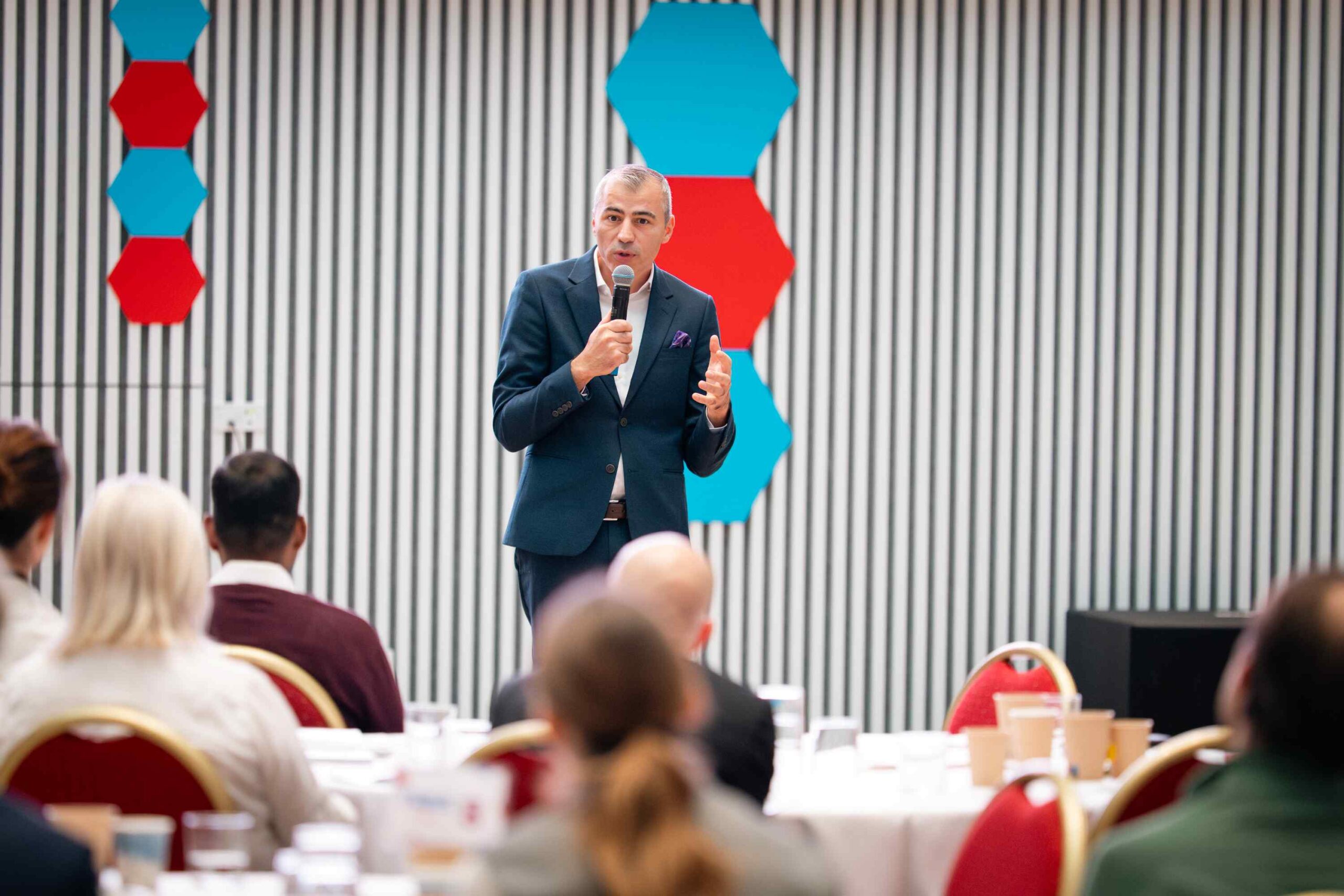
Last week, I joined the People People Meetup in Copenhagen – a warm, buzzing room filled with thoughtful HR and leadership professionals discussing one of my favorite topics: ownership.
It was one of those conversations that stays with you after the event, not because of any single comment, but because of the energy in the room. The more I listened, the more a question began forming in my mind.
We talk so often about the need for ownership in organizations – ownership of decisions, of outcomes, of culture. But when we ask people to take ownership, what are we really asking of them?
Very often, we’re asking them to change. To stop doing things one way and start doing them another. To see themselves not just as executors of tasks, but as co-creators of something new.
And that’s where many well-intentioned leaders hit a wall. Because change – no matter how logical, well-designed, or well-communicated – creates resistance. Sometimes open and sometimes silent. And in the Nordics, more often the latter.
The story behind the gap
A few days after the event, I had a coaching session with a leader who is right in the middle of such a challenge.
His company provides accounting and financial services. Business is steady, clients are happy, and everything seems to “work.”
But he can see what others can’t yet. He wants to implement a new system for tracking productivity – a structure that records when clients submit documents, how long each case takes, and when the work is completed.
To him, it’s obvious that this will make the business more predictable, improve planning, and open the door to new clients and increased revenue. But to the team, it feels unnecessary. From their perspective, things are fine.
That’s the tricky part. The leader sees the future benefit. The team considers the present cost.
In other words, there’s a gap – what I call the Change Gap – between the vision of change and the emotional readiness for it. It’s not that people don’t care or don’t understand. It’s that they don’t yet see themselves in the new picture.
Through our conversation, we identified four common reasons this happens.
1. People resist when they can’t see how the change benefits them.
2. They resist when they haven’t been included in shaping it.
3. As John Maxwell puts it, everyone wants change, but no one wants to be changed.
4. They resist when they haven’t had enough time to accept the idea.
These are universal truths, but in Nordic cultures, they show up in subtle ways. Leaders here work in environments built on trust and equality. People are thoughtful, they prefer consensus to confrontation, and they rarely challenge decisions publicly.
That means resistance doesn’t always look like conflict. It looks like silence.
Like a polite nod. Like a project that moves more slowly than expected.
It’s not sabotage. It’s hesitation. And silence isn’t agreement – it’s data. It tells you where your team is.
A mistake we often make after introducing a new idea or initiative is giving people only a brief moment to share their thoughts. If no one speaks up immediately, we may proceed with the agenda and assume they are on board. But silence is a data point that’s telling us we need to create more space for people to share their views so we can gauge where they stand on the topic.
The PCIHO Map
At this point in the coaching conversation, I introduced a framework I often use called the PCIHO Map.
In every organization, when change begins, people fall into five categories:
- Pioneers, who see possibilities before anyone else.
- Champions, who carry the message forward.
- Influencers, who make change socially acceptable.
- Hesitaters, who wait for proof that it’s safe.
- Obstructors, who openly or quietly resist.
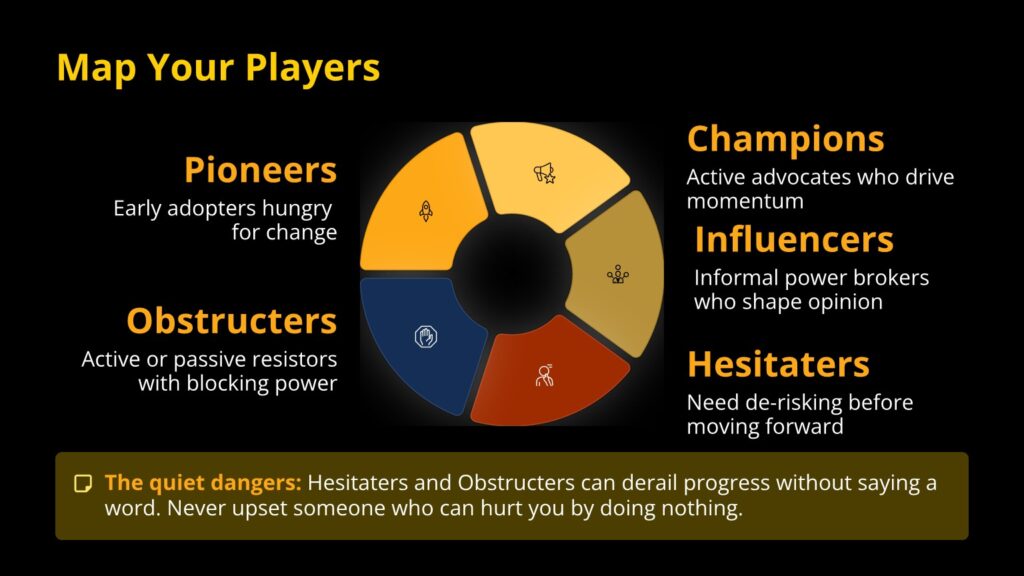
Most leaders assume resistance only lives with the last group, but that’s not true. Hesitaters can slow change more than obstructors, especially in cultures where disagreement isn’t voiced directly.
So the first step to closing the Change Gap is to map your people. See where they stand. Then adjust your communication to meet them where they are.
Hide the broccoli inside the cake
When we talked about how to move from insight to action, I suggested borrowing a few marketing principles. Because leading change is, in many ways, a campaign. The first principle is what I call hiding the broccoli inside the cake.
You see, many people want the cake – recognition, ease, progress. But not many wake up craving broccoli – discipline, systems, structure. But they still need it.
So the question becomes: how do you give people what they want while also giving them what they need?
In this case, if the leader introduced the project as “a new productivity tracking system,” people would hear: more control, more reporting, more work.
But when he framed it as “a way to plan work better and reduce last-minute stress,” the conversation changed. Same system. Different story.
That’s how you help people take the first step – by making the change serve their goals, not just the organization’s.
The seven-touch rule
The second marketing principle we discussed was the seven-touch rule.
In marketing, it’s said that people need to see or hear a message at least seven times before they act on it. The same is true for change.
Leaders often forget that while they’ve been thinking about a change for weeks or months, for the team, it’s brand new. They need time to process it emotionally, not just intellectually.
So instead of announcing change once and expecting buy-in, you plan for a series of gentle touch points.
It might start with, “I’ve been looking at some data, and it seems we may need to change.”
A few weeks later, “The pattern’s getting clearer – change might be necessary.”
Then, “We’re exploring what the change could look like.”
And later, “We’ve tested a few ideas, and this approach seems to work.”
By the seventh touch, the idea is no longer foreign. It’s familiar. And once it’s familiar, it’s far less threatening.
That’s how ownership grows – through repeated connection, not repeated instruction.
Bridging the Change Gap
The truth is, change leadership isn’t about pushing harder. It’s about pacing wisely. You can’t drag people across the Change Gap. You have to walk with them.
If you’re leading change right now, take a moment to reflect:
- Who in your team are the pioneers and champions?
- Who’s hesitating quietly?
- And what story are they hearing about the change – yours, or their own?
Because the Change Gap doesn’t close with more communication. It closes with more connection.
And in cultures where silence speaks loudly, the leaders who listen first always move fastest.
We’ll explore this in more depth during our next Leadership Gap session on December 2, where we’ll map how pioneers, champions, influencers, hesitators, and obstructors show up in your organization—and how to turn quiet resistance into steady momentum.
Register for the Live Zoom session here.
Until then, keep leading with curiosity.
Make it a fantastic day,
Florin