

Party: Billund International
Candidate for: Local council: Billund Municipality
Simone’s story
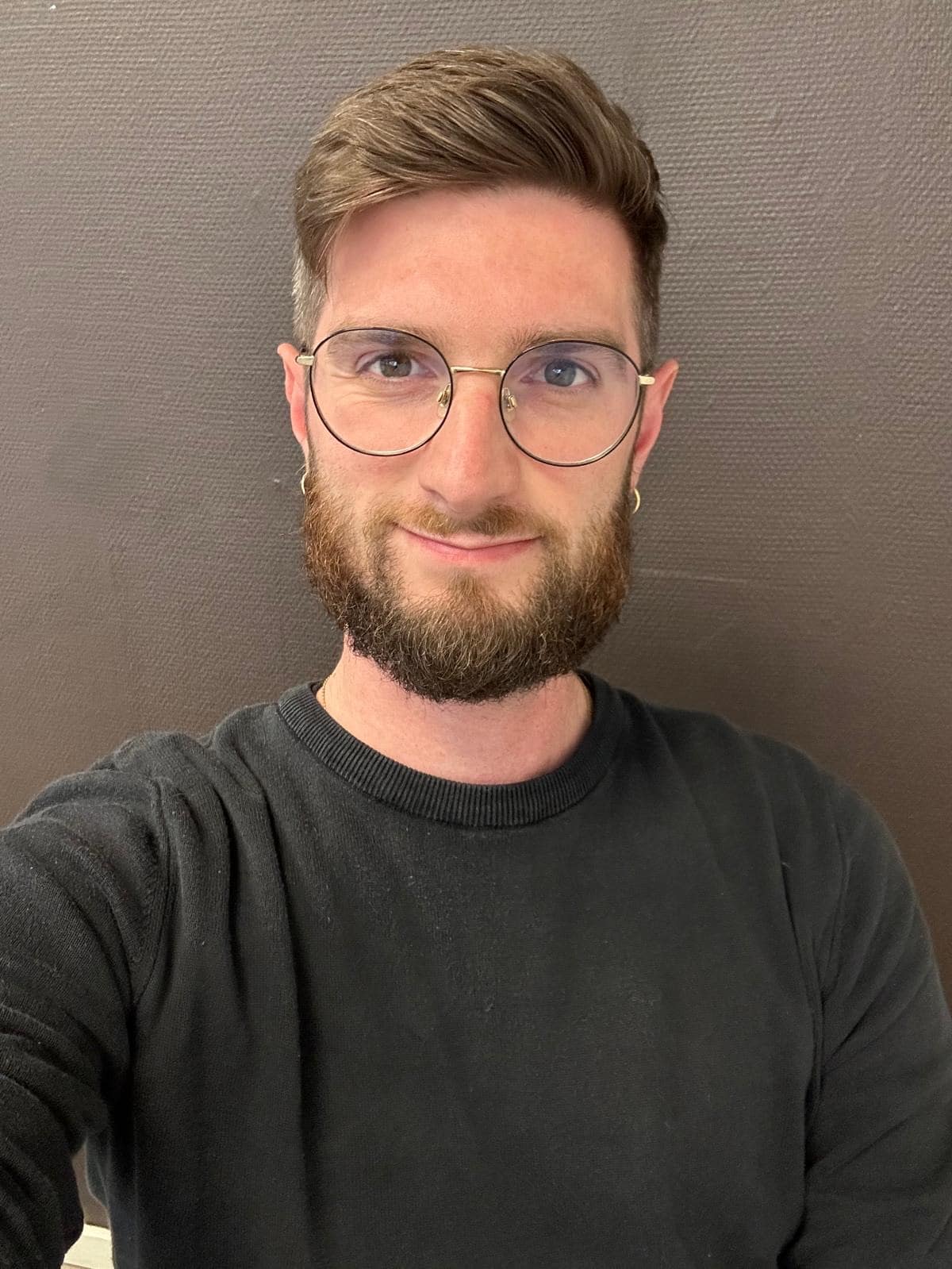
Simone Giuseppe Uggeri differs from all the other candidates Last Week in Denmark has interviewed for the upcoming elections in a few ways. He’s not standing for a political party. He hasn’t come armed with a detailed manifesto of pledges to discuss. Most surprisingly of all, he says he doesn’t actually want to be elected. It all sounds a bit wild, but as our conversation unfolds, everything begins to make sense. What emerges is a story of determination, inclusive values and future-oriented democracy, internationals participating in Danish politics in a completely new way.
Simone grew up in Milan, Italy, and arrived in Denmark in 2016 as a postgraduate student. Passionate about politics from an early age, he learned EU students could do Masters programmes at Aarhus University for free. He couldn’t have afforded it otherwise, he says. Simone specialised in human security, specifically how international crises can be prevented. “Basically, high participation in society is a good antidote to these problems,” he says.
“I come from a country where it’s mandatory to have a political opinion. Everybody has to participate.”
Simone’s studies went on to strongly influence his political beliefs and involvement, as did his youth in Italy. “I come from a country where it’s mandatory to have a political opinion,” he says. “Everybody has to participate. Anti-fascism runs in many families. You can’t just live your life and ignore things.”
In Aarhus, and now Billund, the Jutland city where Simone now lives and works as a data analyst, he found a second home whose values spoke to him. “I feel safe here,” he says. “I feel respected, not in a hierarchical sense but as a human. People here give each other space, they listen actively to each other. There is quite a high level of emotional intelligence as well. I really believe that the core value of respect is a big part of why people stay here as internationals.”
Admittedly, few internationals move from Aarhus to Billund but Simone has no regrets: “My biggest fear was losing the international feeling and community I’d built up in Aarhus but it was mind-blowing what I found here in Billund. It was easy to meet people, easy to connect and to feel at home. Much easier than Aarhus actually!”
Entering politics
In Italy, Simone was politically active, working with young people interested in politics and promoting ways they could participate in their local community, the municipality of Segrate. He’s keen it’s name-checked here. “People will be happy when they read it!” he says, his face glowing with pride.
“I see democracy not as a battle for power but a tool for representation.”
In Aarhus, Simone was involved with the establishment of Volt Denmark, the pan-European party founded in 2018. It helped him understand that as a European without a Danish passport, he still could participate in politics here. It also cemented what was most important about politics for him: “It’s about inclusion, integration and participation, regardless of the values people might have. I see democracy not as a battle for power but a tool for representation.”
Simone had never considered running for office, especially in Billund, where he has only lived for one year. But he was becoming increasingly aware of the changing demographics in the area. Billund now has 16% internationals, with numbers rapidly rising over the past decade with the growth of LEGO as an international company.
“I really believe internationals are not included and they’re not participating either,” Simone says. “People need to know this is their right and at the same time we need to make sure people want to exercise that right.”
“The demographics of the country are changing and local politics doesn’t reflect that.”
“The demographics of the country are changing and local politics in Billund doesn’t reflect that. All the parties and their representatives are Danish, and the parties are traditional Danish parties. But 16% of the people living here are not.”
In early September, Simone saw a post on a local Facebook group for internationals and locals. Written by a local Danish man, Rasmus Rydahl, himself a local candidate for Alternativet, the post encouraged internationals to create a Civic List for the upcoming local elections so they could have their own dedicated voice on the council. No political experience needed, the post said. Only 4-5 willing individuals and 150 signatures supporting them.
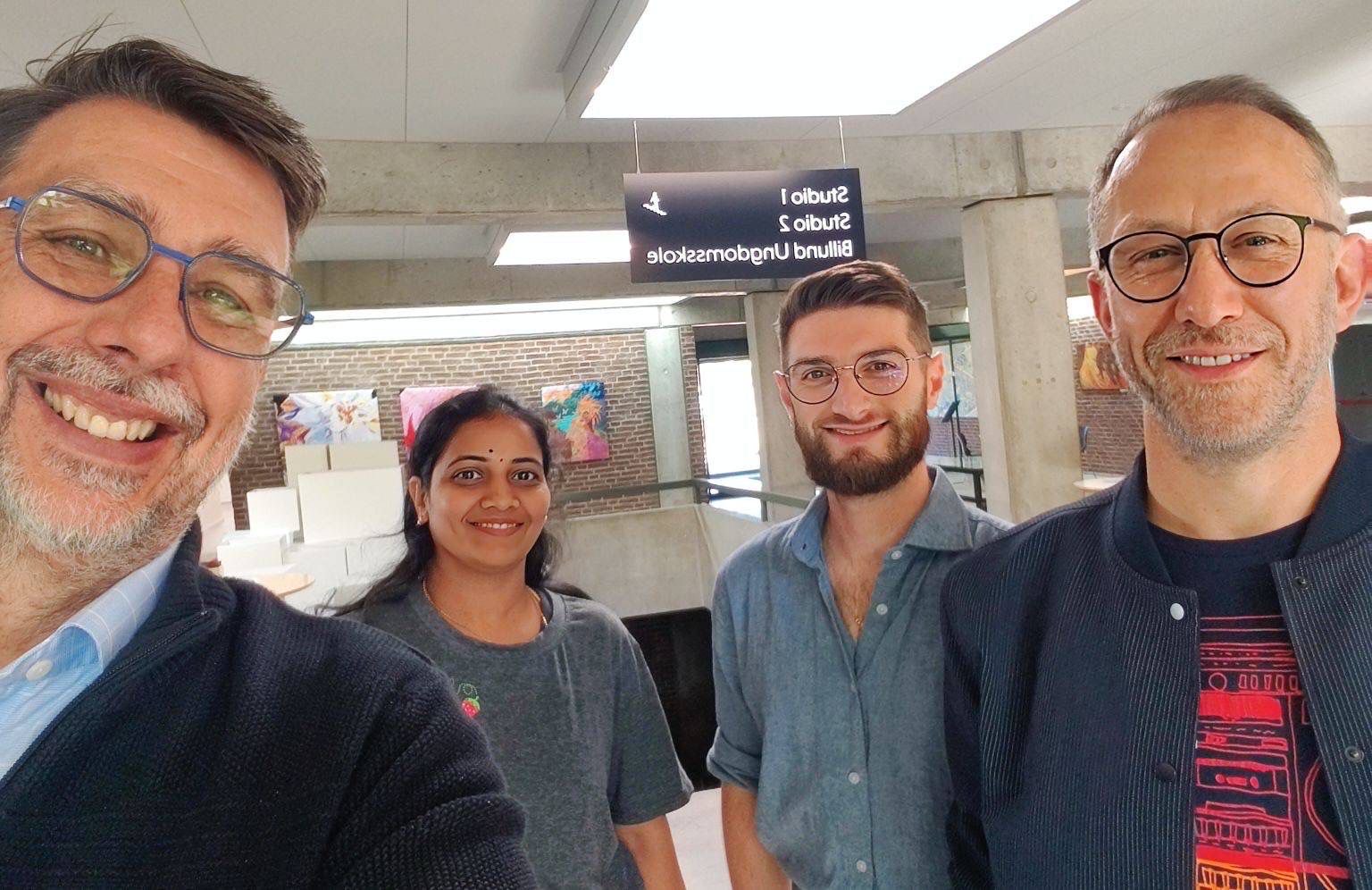
“I knew it was possible to have a civic list in Italian elections but I never thought about doing it in Denmark,” Simone says. “I wouldn’t have had a clue we could do this without Rasmus’s help.” That led to a meeting around Rasmus’s dining table, where the list of four candidates was formed and initial plans for Billund International, a civic and political engagement group, were drawn up. It is the country’s first ever international civic list. Simone agreed to be the lead candidate, with Ashwini Shastri from India, Ricco Sheepers from South Africa and Bret Schafbuch from the US making up the rest of the list.
Simone’s campaign
“A civic list is a different way of doing politics, a different way of campaigning. It’s really about passion for democracy.”
Simone stresses that Billund International represents “a different way of doing politics, a different way of campaigning. It’s really about passion for democracy.” He sees the civic list approach as offering particular advantages for internationals here: “Traditional Danish parties traditionally reflect what Danish people want to hear and we believe there is a disconnect between Danish society and international society.”
As the lead candidate for Billund International, more of the public speaking and promotion falls to Simone, but he doesn’t want to be seen as a figurehead. “I don’t care if people vote for me or somebody else,” he says. “I just want them to be involved. My goal is not to be elected. It’s to build a bridge.”
Billund International has no manifesto as such. This will be decided by the community. Its ideology is firm though: “Inclusion, integration and participation,” says Simone. “I know it’s not traditional. It doesn’t sound like liberalism or social democratic values but it is an ideology and if that ideology doesn’t exist in the traditional politics of Denmark, that doesn’t matter. Can’t we nurture the political culture of this community by asking people what they think? That’s direct democracy. As a civic list of people, we all agree that the community should decide for us.”
“My goal is not to be elected. It’s to build a bridge.”
A key decision Simone and his colleagues have handed over to the community, via a poll in the recently created Billund International Facebook group, is whether or not to form an alliance with one of the four Danish parties who reached out to them. There are divided views, Simone says. An alliance makes winning easier, but some people are very against it as they feel traditional Danish parties have never thought about internationals. The poll is due to close shortly after our interview, and Simone has no idea what the outcome will be. Although such uncertainty less than six weeks before an election would probably drive traditional politicians over the edge, Simone genuinely finds not knowing exciting. In the end, the decision is not to form an alliance. The people have spoken and Simone and his colleagues will of course respect that.
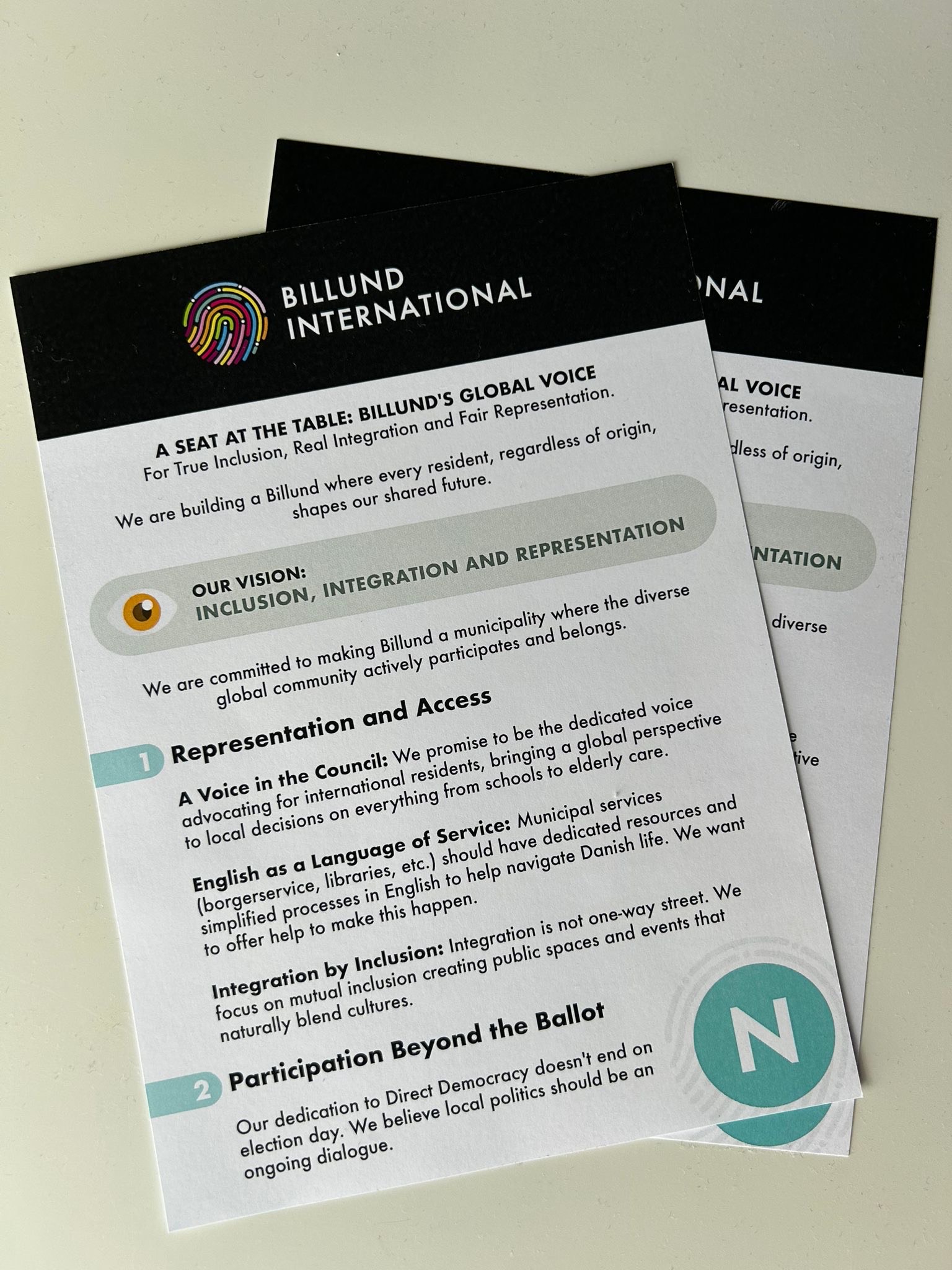
Ease of communication is another central principle of Billund International as a political movement. Traditional Danish parties usually communicate and campaign in Danish, which can lead internationals to feel excluded from voting, let alone joining parties and standing as candidates. Simone wants to change this.
“I understand the fear Danish people have of losing their identity if more English is spoken, but that’s not going to happen,” Simone says. “Italy has a German-speaking region and a French- speaking region. Communication is in both languages. We are not inventing warm water, or the wheel here! When I meet the party leaders here, sometimes I speak in English, sometimes in Danish, sometimes a hybrid of the two. Whichever is best in the situation! We should communicate officially in Danish and also in English.”
True to their word, the Billund International Facebook group shares information, in English, not only on their own campaign but the campaigns of other local candidates and local election events in Danish and English. It is a very different way of doing politics and it’s being received well by the traditional Danish parties in Billund.
“The level of democratic maturity in Denmark is mind-blowing.”
“The level of democratic maturity in Denmark is mind-blowing,” Simone says. “I’ve spoken to representatives from all the major parties. All of them showed support, openness, and even happiness that we are trying to help internationals to vote.” He’s excited, he says, about the future possibilities but says he can’t say more at the moment.
Simone is also self-aware enough to know his limitations: “I can’t represent somebody that has a different life from mine, who has lived here 40 years and speaks Danish perfectly because I don’t know their life. I know the lives of my community, which is international people. That’s who I can represent and I’m OK with that.”
Final thoughts
A few days after our interview, Billund International announces a major cross-party agreement with Venstre, the Social Democrats and the Conservatives to establish a brand new International Council after the elections are over. With the announcement of the abolishing of the National Integration Council by June 2026, International Councils that advise local governments on matters such as housing, education, employment and cultural needs of internationals could be the future. Billund is the first Municipality to announce the creation of one. For Simone and his colleagues, the International Council is of much greater significance than winning seats on November 18th, but inclusion and participation still means turning out to vote, and ensuring Billund International is represented on the Council. “I can’t stress how important it is for people to leave their homes on 18th November and come and vote,” Simone says.
“I can’t stress how important it is for people to leave their homes on 18th November and come and vote.”
Simone would like to raise greater awareness of the civic list as a political tool. He’s not aware of any other municipality where one has been formed for the upcoming elections. “There is a process that can be followed for the future,” he says. “It would be great if we had a guide in English on how to open up a civic list and be represented as you wish. Do you want a train station locally? Then start a political party focused on getting a train station. That’s democracy. I don’t feel there is that knowledge, that we can participate in this way.”
“Do you want a train station locally? Then start a political party focused on getting a train station. That’s democracy.”
Simone leaves me with a reminder of the Billund International ideology of inclusion, integration and participation. By now, when he says he doesn’t want to win the election, it all makes sense: “I’m just the messenger. I’m a citizen like anyone else. I can help get the municipality to talk to the community but I need the community to participate.”
Billund International – Civic List – Facebook group:
https://www.facebook.com/share/g/1CNBGaugwn/?mibextid=wwXIfr