


Many politicians and business leaders say Denmark has a workforce problem. Christina Egelund, Minister for Education and Research, has noted: “Right now, we are short of employees to perform important tasks in our society” — and research backs this up. The most recent OECD economic survey for Denmark indicates ongoing recruitment difficulties, particularly in sectors like construction, long-term care, and information and communications technology. The report continues that Denmark has “room to facilitate the recruitment of foreign-born workers where there are shortages.”
The Danish Ministry of Employment and labor unions agree and, in June 2025, announced the Collective Agreement-based Employment Scheme. The program aims to facilitate Danish companies hiring qualified workers from abroad and address social dumping. While there isn’t yet a proposed bill that would bring the initiative into force, it is expected to take effect in 2026.
Program Basics
The Collective Agreement-based Employment Scheme is similar to the existing Fast Track scheme, with notable differences in union participation, salary requirements, and eligibility based on nationality.
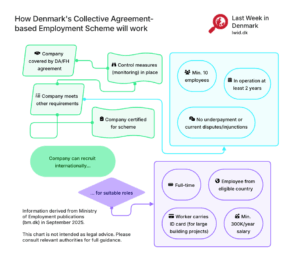
In order to take part in the program, companies must employ a minimum of ten full-time workers and have agreements in place with the Trade Union Organization (Fagbevægelsens Hovedorganisation – FH) and the Confederation of Danish Employers (Dansk Arbejdsgiverforening – DA).
What are collective agreements?
Collective agreements (overenskomster in Danish) are agreed between employers and unions regarding salary and working conditions. They form an important part of the Danish model of employment (also called ‘flexicurity’), in which the labor market relies on a foundation of voluntary agreements between employers and unions.
These agreements are collective as they apply to all employees in a workplace or represented by the same union. Additionally, many workplaces have local agreements with their union representatives.
Companies can be in either the public or private sector and will need special certification, which indicates they have been operating for at least two years prior to certification and have not underpaid foreign workers in those two years. In order to be certified, companies cannot be currently involved in a lawful labour dispute, have any unresolved immediate injunctions from the Danish Working Environment Authority (Arbejdstilsynet), or have more than two Aliens Act violations in the last year. Companies will also be required to participate in an online meeting with SIRI (Denmark’s Agency for International Recruitment and Integration, which exists within the Ministry of Immigration and Integration).
Positions taking advantage of this new initiative must be full-time and pay at least 300,000 DKK a year. Lowering the salary threshold from 514,000 DKK (as is the 2025 minimum for the Fast track program) aims to help small- and medium-sized businesses in industries like construction, healthcare, and technology recruit skilled labor. There are no restrictions by industry or job type, and no requirement for the work to be in a profession currently experiencing shortages of qualified or skilled professionals.
There are two fees associated with the new scheme, both of which are in line with the Fast Track program. Companies are expected to pay 6,055 DKK for certification and prospective employees will be charged 6,055 DKK to apply for or extend a Collective Agreement-based Employment Scheme. Both company certifications and individual permits are valid for three years and may be renewed for four years at a time.
The permits allow employees to begin immediately (e.g. a worker’s start date may be prior to the work permit being formally issued). If a company loses its certification status, employees are allowed to remain in Denmark and work until their permits expire.
To receive a residence and work permit through the Collective Agreement-based Employment Scheme, employees must be citizens from one of the following countries: the United States, the United Kingdom, Singapore, China, Japan, Australia, Canada, India, Brazil, Malaysia, Montenegro, Serbia, North Macedonia, Albania, Ukraine or Moldova. The Ministry of Employment notes that these 16 countries have been selected because they are key trading partners with Denmark or are pursuing EU membership.
Denmark has not previously differentiated between third-country citizens (e.g. non-EU) when granting residence and work permits, but this proposal echoes comments from Prime Minister Mette Frederiksen that Denmark should “focus more on countries with which we share common interests and countries with which we trade when it comes to foreign labour.”
Social Dumping
Alongside union involvement, lowered salary requirements, and restrictions by citizenship, the proposed scheme intends to prevent internationals from being hired under conditions that undercut local labor practices. Trade unions have long been concerned about ‘social dumping’ and how it can endanger international employees and make it less desirable for companies to pay standard wages and prioritize good working conditions. Such practices in Denmark have made headlines recently, with reports of possible fraud and exploitation of foreign construction workers and claims of employees on large public construction projects being required to repay wages.
What is social dumping?
Social dumping refers to companies employing people (generally from abroad or non-citizens) for less pay and/or under worse circumstances than local hires, thus undermining social norms and circumventing common employment conditions. By treating foreign employees differently (generally by paying less or not paying social contributions, providing fewer benefits, or breaching health, safety, or working environment regulations), companies may gain an economic advantage over their competitors. But this can lead to labor market insecurity and social tensions.
The Collective Agreement-based Employment Scheme will enable trade unions to monitor pay and working conditions at individual workplaces through strengthened control measures. It also mandates that workers on major construction sites (projects larger than 100 million DKK) carry ID cards, making it easier for authorities to check that work is being carried out legally and in accordance with Danish standards.
While SIRI already requires that anyone with residency status (e.g. through spousal reunification or a current work visa program) carry their residence card at all times, the ID cards for this new scheme will contain substantially more information. In addition to the employee’s name, photo, and nationality, which are also on the existing residence card (opholdskort in Danish), the new cards will also display the employee’s telephone number, place of residence, job title, statutory training, and work duration on the project. The name and registration numbers (corporate registration CVR and the Register of Foreign Service Providers or RUT number) of the employer will be on the ID cards as well.

Varied Opinions
While those behind the Collective Agreement-based Employment Scheme call it “a breakthrough in the way we grant access to Denmark for foreign labour,” as Employment Minister Ane Halsboe-Jørgensen said, others aren’t so sure.
Some business leaders wish the program was not restricted to a handful of countries. For example, Troels Blicher Danielsen, CEO of trade organisation TEKNIQ, disagrees with Immigration and Integration Minister Kaare Dybvad’s view that “it matters where international labour comes from.” Danielsen says TEKNIQ “would have liked to see a more ambitious approach than the 16 countries from which companies can recruit. If you really want to secure qualified employees for future needs, you have to look beyond the colour of their passport and welcome everyone.”
The scheme has been criticised for overlooking potential employees already within the country. As Morten Messerschmidt, leader of the Danish People’s Party, told TV 2: “‘They are ignoring the many senior citizens and people with disabilities in this country who want to contribute – they are being kept out of a system that would rather bring in labour from the other side of the world.”
Morten Skov Christiansen, Chairman of FH (one of the two Danish trade union groups involved in the program), is supportive of the scheme as a whole, but notes that Denmark needs “to invest in those who are already here – not just those we bring in from outside.”
This sentiment echoes the idea that Danish employers are overlooking international professionals already in the country. Lyndsay Jensen (Editor-in-Chief and Founder of The International) coined the term ‘Forgotten Gold’ for this group of educated potential employees that businesses don’t seem to see. Given that it appears workers need to be recruited from outside of Denmark for this new program, it’s hard to see benefits for “the skilled people already here, knocking on the same doors that remain shut” as Last Week in Denmark’s Executive Editor Narcis George Matache characterized the ‘Forgotten Gold.’
With estimates that the scheme could introduce 550 new international workers to Denmark (contrasted with over 400,000 already employed here), there’s also the argument that it is more performative than potent. Add in the fact that Statistics Denmark shows that no job categories pay below 300,000 DKK for full-time non-managerial work, and questions emerge about the data behind the decisions.
National Bank research shows that “while only a small share of new recruitments has tended to come from abroad, foreign labour has contributed markedly to employment growth in Denmark, particularly in industries facing significant labour shortages.” But it remains to be seen if the Collective Agreement-based Employment Scheme will further help Danish companies grow when it comes into action in 2026, or if it’s a political move in the months before a parliamentary election is expected.