

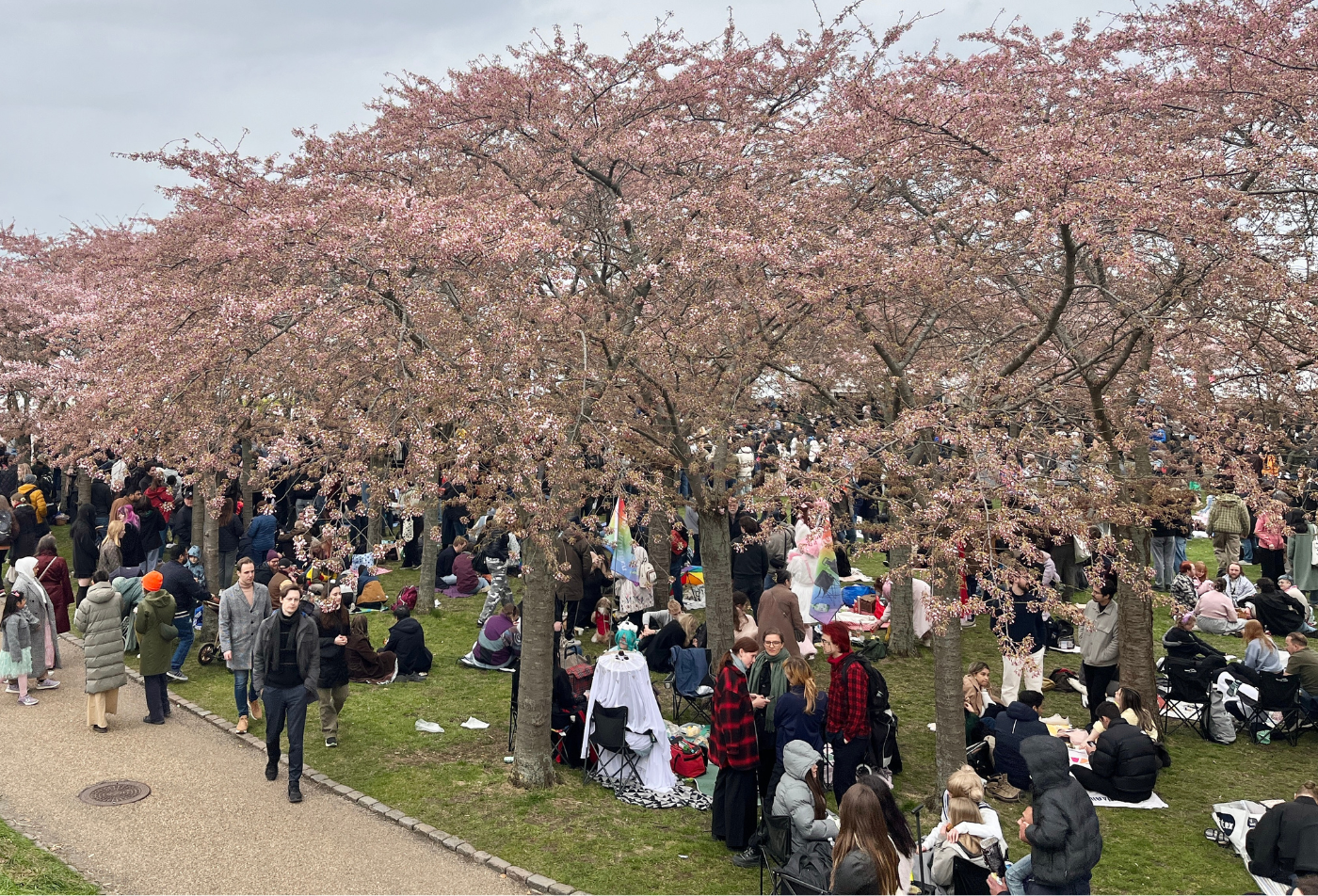
April surprises you in a very nice way when it is your first year of living in Copenhagen. And then every year you eagerly wait for this month. This is the time when Copenhagen slowly comes alive after a long, dark, freezing, and often soul-crushing winter.
The sun shines more often and longer, bushes go green again, and flowers of all colors start blooming all over the city. And right in the middle of so many colors, when the cherry trees blossom, their delicate white and pink petals create a stunning contrast against the lush green grass and the clear blue sky.
This was quite surprising for me during my first year here. I always pictured Denmark as people biking through the streets, taking icy dips in the sea, and sipping coffee with Danish pastries in cozy cafés.
But cherry blossoms? That was something I never expected.
This was one of the sweetest surprises that Copenhagen, the world’s happiest city, and my home for the last four years, has given me. I’ve traveled to over 20 countries, some just once, others many times, but Japan has always remained a dream. Though I have planned many times, a trip to this country full of beauty, culture, and history could never materialize for me.
I never imagined that I could experience the magic of cherry blossoms or learn so much about Japanese culture, not in Tokyo, but right here in Copenhagen. Now, every year in April, when I see cherry trees near my home full of pink leaves, I excitedly start counting down the days to the Sakura Festival.
Sakura in Copenhagen
The Sakura Festival takes place in Copenhagen’s Langelinie Park, near the famous Little Mermaid statue, which is always crowded with tourists, no matter what season. During the two days of this Japanese festival, if you are near the Little Mermaid and look toward the park, you might just think it’s a mini Japan over there.
This year, the celebration took place on 18th and 19th April, and I was there on Saturday among over 30,000 others.
Hanami (cherry blossom viewing) doesn’t happen only during the festival days. If you visit this park a few days before or after the festival, you will find it full of people (mostly Japanese) taking photographs under the cherry trees, enjoying picnics with family in their shade, sipping tea, and sharing snacks.
But on the actual days of the Sakura Festival, the park transforms. The atmosphere comes alive with music, dance, tea ceremonies, martial arts, origami, calligraphy, and more. While Japanese families picnic with homemade food and tea, visitors like me can enjoy many stalls offering traditional Japanese food and drinks at the festival.
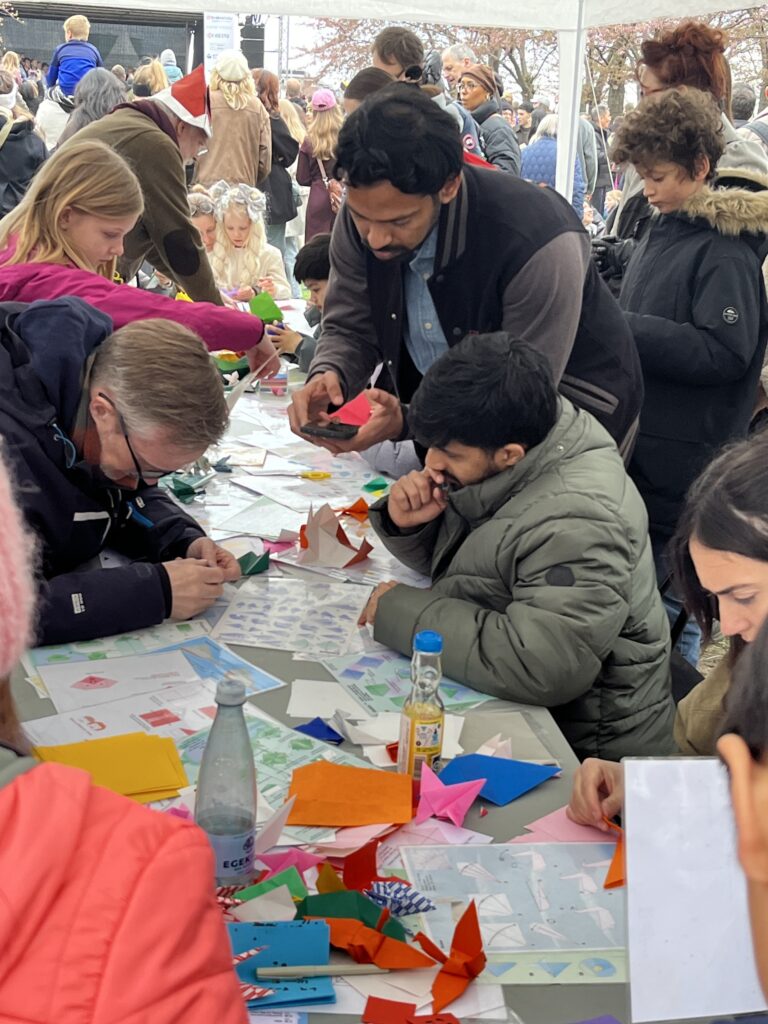
Image credit: Poornima Choudhary
This year, I enjoyed a sweet bun from Andersen’s kiosk, matcha tea from another stall, and teriyaki-dipped salmon from the counter at Sushi & Sticks. My son tried archery, and among many other performances, we enjoyed the martial arts show the most, with K-pop songs in the background. My son and his friends are big fans of K-pop, so this performance actually made his day.
Every year, this festival introduces me to something new and different about Japan that I didn’t know before. It was here that I first tried onigiri and fell in love with this Japanese staple. It’s a popular dish at Sakura, with more than one stall selling it. There are always many stalls selling different varieties of it, and you see people sharing a plate of two or three in groups all over the park.
Onigiri is a triangular rice dish wrapped in seaweed. It may seem similar to sushi conceptually, it’s actually quite different. I generally can’t eat too much sushi because of the vinegar flavor in the rice, but with onigiri, I had no such problem. The rice in onigiri doesn’t have the vinegar tang, which makes it gentler on the palate. And it’s much bigger, easily the size of four to five average sushi pieces put together, so you may be full in just two onigiris.
The first time, when I tried this, I went for onigiri with chicken. Later, I tried the ones with fillings of beef, and even salmon. After all, if you are in Copenhagen, you can’t miss one with salmon.
That moment felt like true cultural fusion — a traditional Japanese rice dish, filled with Danish salmon, wrapped in nori (seaweed) at the Sakura festival in Copenhagen, just a few steps away from the Little Mermaid statue. And me, an Indian experiencing this cultural fusion of two completely different countries from my birth country.
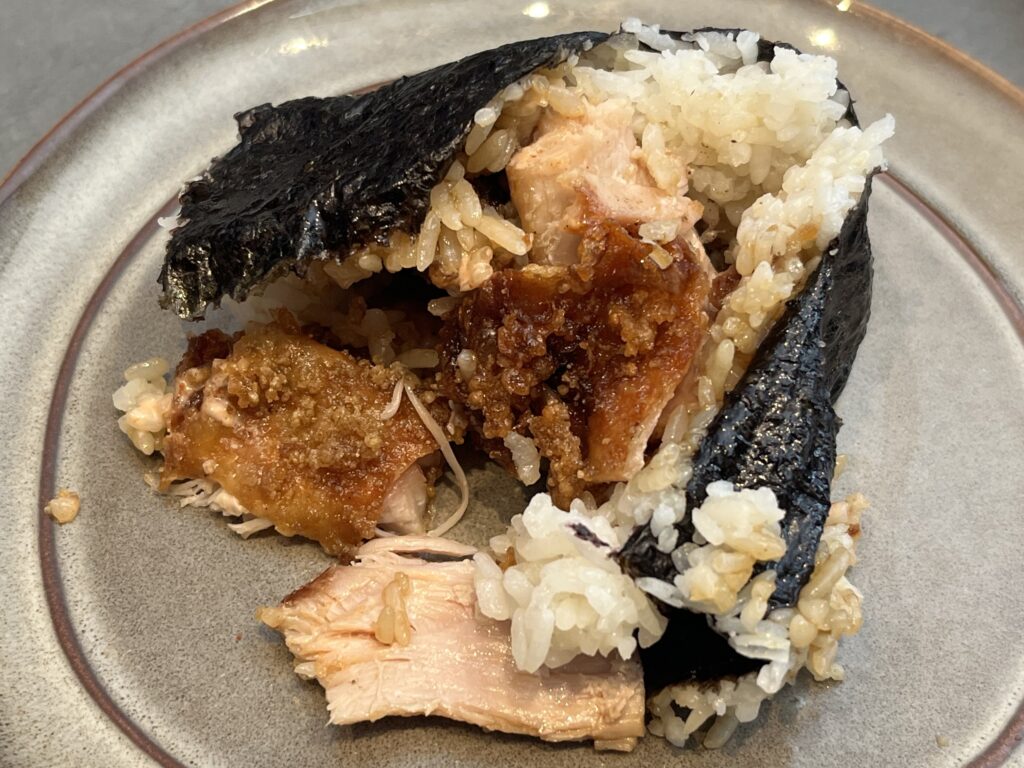
Image credit: Poornima Choudhary
Onigiri was new for me, but it seemed like a common food item at Sakura. I became curious about its history. Something inside me said there had to be a deeper connection between Hanami and onigiri.
Onigiri and Sakura Through the Ages
The history of cherry blossoms and onigiri goes back thousands of years. Cherry trees have been worshipped as trees inhabited by the harvest deity since the Yayoi period in Japan. This was when rice farming was introduced to the Japanese archipelago.
The cherry trees start to bloom as the weather becomes warm. It is believed that rice farming started when cherry blossoms were in full bloom. A good bloom was also seen as a sign of a good harvest to come. Though cherry blossoms were an important part of life and culture in the Yayoi period, the tradition of cherry blossom viewing started in the Heian period. It was initiated by the emperor and slowly became popular among aristocrats.
Interestingly, archaeologists found traces of rice formed into balls during this period, which hints at the origin of onigiri. That’s why it is believed that onigiri was enjoyed by nobles and other high-ranking members of society during this time.
After the Heian period came the Kamakura period. It was during this time that the tradition of cherry blossom viewing with a banquet was born. Grand cherry blossom viewing was held among the samurai and in the provinces where they lived. As the traditions around cherry trees were changing, rice balls also changed. Now they were not just balls of rice and salt but contained umeboshi (pickled plums) and other new ingredients. However, until this time, both onigiri and cherry blossom were enjoyed by the upper class only.
In the Edo period (1603–1868), cherry trees were planted for disaster prevention because the Sumida River was prone to flooding during heavy rains. The trees were planted along the river because it wasn’t possible to build an embankment across the entire area. With this, common people also gained access to cherry blossom viewing, and Hanami slowly became a tradition among the general public, too.
At the same time, onigiri also evolved. A new ingredient, nori (seaweed), was added to stuffed rice balls. This made the dish easily portable, and it became a popular food for the Sakura festival. But that’s not all. There is one more thing common between cherry blossoms and onigiri.
The Deeper Meaning of Sakura and Onigiri
Onigiri and Sakura both have a strong connection with ancient Japanese beliefs about nature, the divine, and the sacred role of rice in daily life.
In old Japanese, “sa” means the spirit of rice, and “kura” refers to the place where the spirit of rice descends. Cherry trees are believed to be “trees in which the god of grain lives”. And when people enjoy a dish made from rice sitting under this auspicious tree, it becomes more than just a meal.
According to another theory, “Sakura” is derived from “Konohana-no-Sakuyabime,” a deity mentioned in Japan’s chronicles. It is said that this god sowed cherry blossom seeds from the sky above Mount Fuji, the sacred mountain where the god resides.
The triangular shape of onigiri is also not by chance. According to the indigenous faith of the Japanese people, Shinto, the gods reside in mountains. The rice balls, which could be made in any shape, slowly became triangular to resemble mountains. So, eating a triangular onigiri made from rice under a cherry blossom is much more than just a picnic.
Copenhagen’s cherry blossoms still welcome you
The Sakura festival is over for this year, but you can still enjoy the cherry blossoms at Langelinie Park. Spring is beautiful, the cherry trees are in full bloom, and Hanami in Hyggeland is an experience worth making time for, no matter where you come from.
The stalls are gone, but you can still buy onigiri and matcha tea from one of many Japanese/Asian restaurants nearby and enjoy them sitting on a picnic sheet under a cherry tree. There are a few on strøget near Rådhuspladsen, mostly they promote sushi and ramen. My favorite is Capi bara, a small cozy place near the round tower. Once you reach there, I am sure you will find Japanese families and tourists doing the same. I often found them there, whenever I visited the park before and after Sakura.
And if by any chance, you see me there, don’t forget to say hello.