

If you ever find yourself at a Danish swimming pool or harbor bath on a dark winter night, you could see a quiet queue of people in towels waiting to get in to a small wooden room where it’s hot and there is a “gusmester” waving a towel in the air and pouring essential oils on hot rocks.
This is saunagus. To an outsider, it can seem like a test of endurance. But for the locals, it’s a necessary weekly ritual, a chance to relax and warm up during the long winter in Scandinavia.

More than just a sauna
The first thing to understand is that this concept of saunagus is much more than just going to a sauna, like it’s well known generally. The word comes from the german Aufguss, meaning infusion, but in Denmark, it has evolved into something closer to performance art.
According to Stine Fuhrmann, founder of Plugin Heat Club in Copenhagen’s Nordhavn district, it is a guided journey in heat, breath, and music. It is far different from a hotel sauna, for example. In a saunagus session, a “master” is in charge of something that can resemble guided meditation. All while using breathwork, storytelling and rhythm. Also an encouraging viking scream from time to time to give that extra adrenaline rush.
“People often leave feeling both deeply relaxed and strangely uplifted, as if they’ve been to therapy, a concert, and an ice bath in one,” Stine explains.
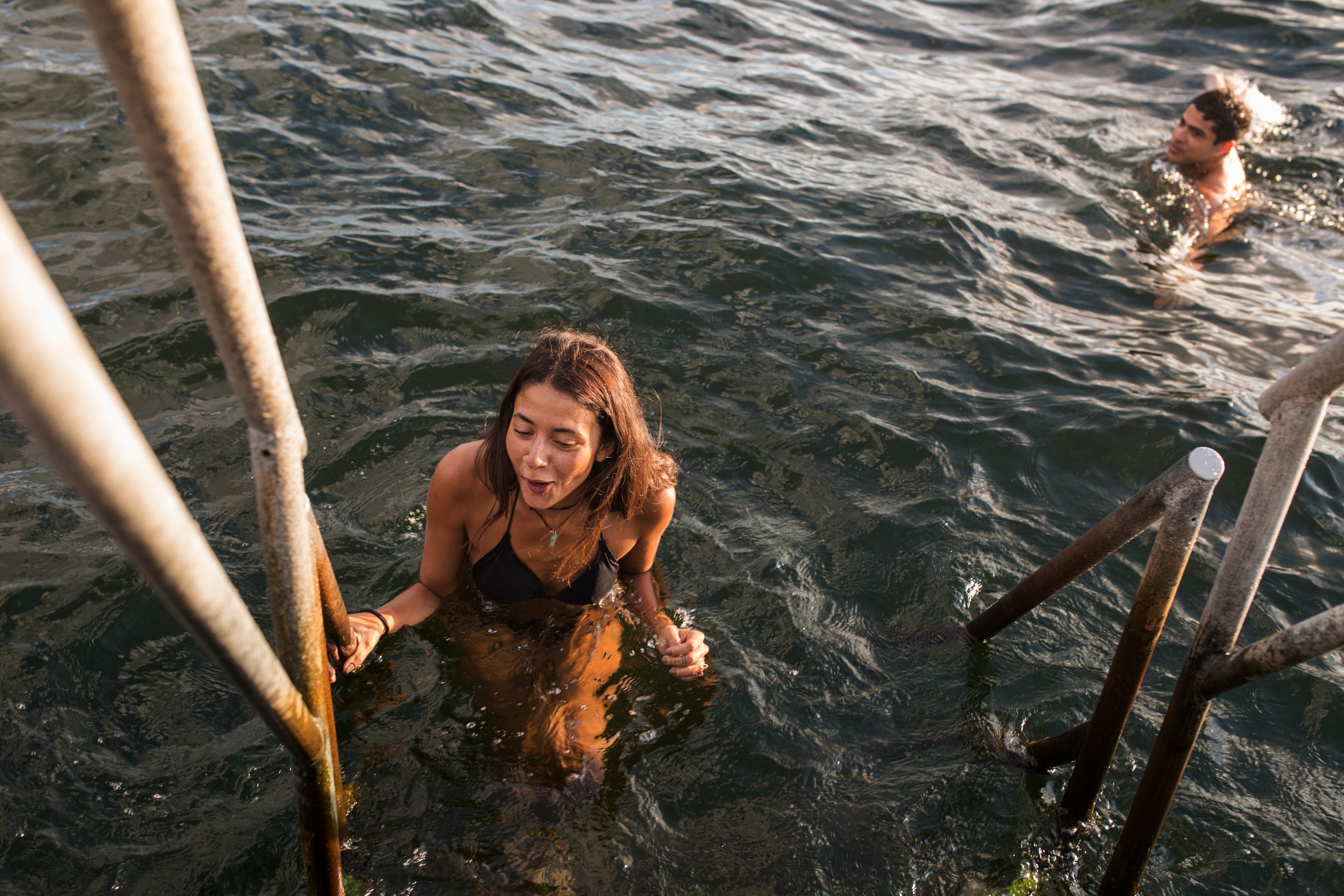
The structure is the same each time and quite rigurous, which is part of the appeal. A typical session lasts about an hour or 75 minutes, divided into three rounds. After each round, the participants can choose to go outside to cool down, often in the freezing ocean or a cold shower, and then back in.
The performance aspect is so central to the culture that it has actually become a competitive sport. The Danish Sauna Society (Det Danske Saunaselskab) hosts the annual “DM i Saunagus“ (Danish Championship in Saunagus).
In such contests, gusmesters are judged not only on how well they perform the heat treatment, but on their techniques when handling their towel, essential oils, and their storytelling skills in delivering the “theme” of their treatment. The top gusmesters in Denmark further proceed to join the World Championships.
Denmark is a country that very much runs on schedules. This applies to work, family time and in this case, going to the sauna. Oftentimes, calendars are booked weeks in advance. This is the perfect example why the saunagus fits perfectly into the Danish mindset, but also on the list of relaxing activities to do.
Christian Kjeldsen, owner of Saunanor, a company that brings mobile sauna experiences to the coastlines, believes this is a major reason why the trend is popular. “Many people in Denmark have very structured workdays and family lives,” he says. “A recurring gus, say every Tuesday at 19:00, becomes an anchor in the week. It’s something you know will reset your system.”
During wintertime, the sun usually sets at 3:30 PM and this structure becomes more vital that you can imagine. Christian calls it a “small controlled winter ceremony.” As a measure to deal with the cold and darkness, paired with daily work and stress, the participants show up for it each time. They dip in the cold harbor water, feel their inner system come alive and return to the safety of the heat. It also can be viewed as a sense of control over the elements.
Marcus Urhammer, the entrepreneur behind Mobilsauna.dk which specializes in pop-up sauna events, agrees, noting that for the modern Dane, who is often stuck in their head planning the next day, the physical intensity of the heat forces a mental break. “You don’t have to perform or explain anything; you just breathe, sweat, and let go,” he says.
Sofie Hedegaard Jensen, from Lübker Resort, views this ritual as an “active choice to slow down” in an otherwise busy life. She notes that in a society that places high value on work-life balance, the gus provides a “socially accepted pause” where self-care becomes a shared, normalized activity rather than an activity you do on your own.
Nicolaj Klitgaard Frederiksen, who runs North Shore Surf & HAVS in the coastal town of Løkken in North Jutland agrees, and notes that the ritual is ultimately about “surrendering a bit of control.” Nowadays, amongst busy days, it’s easy to be locked in and forget to relax. The heat, scents and silence allow participants to stop for a second and remember what life is all about.

Silent intimacy
One of the most fascinating aspects of saunagus is how it contradicts the usual social rules of Denmark. In the common mentality, Danes are very reserved when it comes to social interaction. But, when it comes to saunagus, people sit thigh to thigh, half naked, alongside people they have never met.
Stine points out that this is where the magic happens. “In a country that’s often cold, dark, and quite efficient, saunagus becomes a warm room where people can drop their roles and just be human for a while,” she says.
Nicolaj, takes this definition even further, explaining sauna gus “as a social ritual disguised as a sauna experience,” Nicolaj says. For him, the practice reflects a distinctly Danish value of simplicity. In the sauna, everyone is equal, “phones away, clothes off, titles left outside.” It is a pause from the noise where the only requirement is to be present.
The key to this intimacy is silence. This tackles the common denominator that making small talk or being entertaining while with a group of people is mandatory. Mark, a freelance writer from Denmark, says that this activity creates a unique community and belonging.
“You feel the room breathe together, go through heat and cold together, and respect silence together,” Stine Fuhrmann, founder of Plugin Heat Club adds. “That shared presence creates a sense of trust and belonging, even if you never speak to each other.”
Christian, owner of Saunanor, calls it a “temporary community.” The intense heat becomes a bonding factor. Like in most things in life, small gestures matter. For example moving over to make space on a crowded bench or locking eyes during a particularly tough round.
“Because every gus is a unique experience that only those present will ever fully know, a subtle community forms, often strongest among strangers,” Sofie from Lübker Resort explains. She points to the applause at the end of a session (or the scream I pointed out earlier) as the defining moment of this bond: it is not merely gratitude for the gusmester, but “a collective acknowledgment of having gone through something together.”
The science
While the community aspect is strong, there is also science behind this activity. The feeling of euphoria participants describe, often called the “sauna high”, is biological.
Dr. Susanna Søberg, a leading Danish researcher and author of the international bestseller Winter Swimming, has popularized the science behind this combination of heat and cold. Her research, often referred to as the “Søberg Principle,” shows that alternating between high heat and cold water triggers a release of neurotransmitters. 11 minutes of cold exposure and 57 minutes of sauna per week is enough to achieve this.
The heat stress increases heart rate and blood flow, similar to mild exercise, while the cold shock triggers the release of dopamine, serotonin, and endorphins. It is a strong chemical pair that can leave you feeling calm and alert for hours afterwards.
Going international, more studies can be found. One that stood out comes from the University of Eastern Finland, specifically from Dr. Jari Laukkanen. The doctor followed 2,000 men over a 20 year period. The results after such a long time are pretty reflective of the situation: those who used the sauna 4 to 7 times a week had a 40% lower mortality risk, compared to individuals that went once a week.
While the Danish gus adds a layer of performance, the underlying heat therapy is one of the most scientifically supported ways to extend your lifespan.
Maja Christiansen Cawthra, a local sauna enthusiast, sees it as an escape from the routine. “I think it’s a mix of both relaxation and disconnecting from reality,” she says. Also, for many, it is a way to cope with the “depressive and hectic winter months.”
What to expect if you go
A useful disclaimer is that, if you decide to give it a try, be prepared to experience something that is very different from a spa day. It is not necessarily relaxing in the moment: it is often challenging.
“I’d say it is a sauna with scents, but it’s also a guided experience for your nervous system,” Christian Kjeldsen explains. He warns newcomers that the first time is often just about survival: “The first time is often about figuring out what’s going on. The second or third time, you start to feel why people see it as a ritual.”
Marcus Urhammer advises viewing it as a space between recovery and mental reset. “It sits somewhere between recovery, mental reset, and a shared ritual,” he says.
The rules are simple: listen to the gusmester, respect the silence, and importantly, listen to your body. There is no shame in leaving the room if the heat gets too intense (I was literally on the floor the first time I went), in fact, knowing your limits is part of the culture.
A new Danish tradition?
While saunas have always been part of Nordic culture, the specific rise of the guided gus feels like a modern evolution for today’s world.
An interesting term I would like to use in this context is that of “loneliness of the digital age”. As we advance in all aspects of life, technology, ideology & general foundations of society, we become more and more locked in our own minds. In this way, it’s easy to overlook the small moments of life and really remember to take a step back from time to time.
As Stine Fuhrmann puts it, it is a place where you can be “completely offline and genuinely connected to others.”
If you are struggling with the Danish winter, the answer might be one that you do not expect. Standing in a line in the dark, waiting to sweat alongside strangers, might beat an extra blanket or vitamin D supplement.