

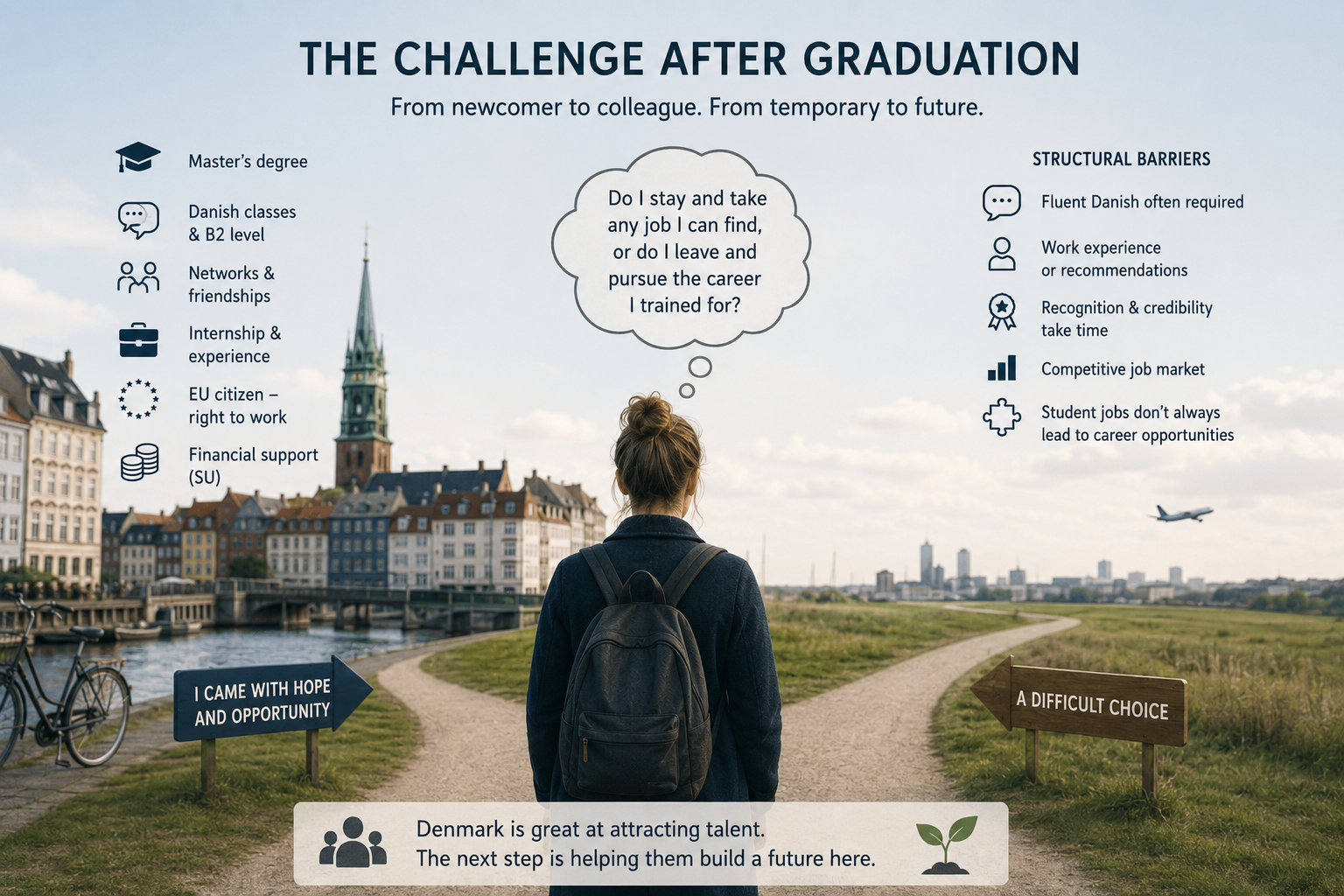
Migrant integration is often measured by whether or not someone manages to enter the labor market. But just as employment alone does not automatically create belonging, not all forms of employment create the foundation needed to stay. My own experience in Denmark has shown me that a country can successfully welcome international students and young professionals while still struggling to retain them.
I came to Denmark from Germany to pursue a master’s degree. Compared with many other migrants, I arrived under exceptionally favorable circumstances. As an EU citizen, I could enter the labor market immediately, find a student job, and qualify for Danish student support (SU). I secured a student internship in my field, had early access to Danish language classes, participated in the university’s Young Professionals in Denmark program, and gradually built both close friendships and a professional network. By the time I graduated, I had earned a Danish degree, reached B2 level in Danish, and genuinely imagined building my future here.
In many respects, my integration was successful.
Yet six months after graduating, that is, after months of extensive job searching and even a voluntary virksomhedspraktik, I find myself preparing to leave. Like many international graduates, I found that securing an adequate full-time job in Denmark proved far more difficult than I had expected when I began my studies. To a great extent, this reflects today’s economy and shifting funding priorities in the sectors I hoped to enter. In theory, these circumstances affect both local and international graduates in my field alike. In practice, however, employers in a competitive job market understandably prioritize candidates who speak fluent Danish and are already familiar through work experience or recommendations. Despite the motivation, qualifications, and experience I had built in Denmark, I faced the same challenge as many international graduates: having to develop within a few years the professional relationships, recognition, and reputation that Danish graduates often accumulate over a much longer period through education, work, and social connections.
For many international students, student jobs represent a hoped-for pathway to building these relationships and gaining professional recognition. Initially, I had also hoped to find a relevant position in a Danish or internationally oriented workplace where I could build my profile and connections for my future career. However, such positions remained difficult to access, often requiring the very language skills and credibility I was trying to build. So, instead, I found myself in a German-speaking call center alongside many other German students. While the job covered my monthly expenses, it did little to advance my professional integration.
This experience illustrates some of the structural barriers identified in the Career Compass policy report. The report argues that many young migrants are not held back by a lack of motivation but by interconnected conditions that make the transition to a stable and fulfilling career significantly harder. Over time, these barriers can become discouraging in themselves.
Importantly, my experience represents a relatively privileged case. I arrived voluntarily, with financial support, the right to work, access to education, and a passport that opened doors unavailable to many others. Many young migrants face additional challenges, from recognising qualifications earned abroad to supporting families or navigating uncertain residence statuses. If someone with my advantages still struggles to establish a long-term career, it is worth asking how much harder the journey is for those with fewer opportunities.
For many international graduates, the question eventually becomes simple: do I stay and take whatever job I can find, hoping it will eventually open doors, or do I leave and pursue the career I trained for elsewhere? Among my own friends, I have seen both choices. In the end, I have chosen to continue my career elsewhere.
If the goal is to retain educated internationals, I believe we need to think more broadly about integration. Denmark has become remarkably successful at attracting talented internationals. The next step is to help them cross the final threshold from newcomer to colleague, from employee to professional, from temporary resident to someone who builds a future here.
For European countries facing demographic change and shortages of skilled workers, creating those pathways may be one of the most important investments they can make.