





Every year, thousands of students come to study at Denmark’s world-class universities. Just like its Nordic siblings, Denmark has created a very strong public education sector where students feel supported rather than burdened, and can really thrive. This is why as a Danish university alumni, I would like to bring attention to government ambitions to radically alter the university model.
There is a law proposed, bill LSF 121, seeking to scrutinize international students who come to study in Denmark. And since the Danish media has chosen to ignore this debate, we feel it’s important to get the word out on this overlooked threat to international students in Denmark:
Proposal for an Act amending the Universities Act, the Act on Admission Regulation in Higher Education, the Act on Special Educational Support in Higher Education, etc. and the Immigration Act (Initiatives concerning certain foreign students, access to PhD education, special educational support for students in vocational master’s degree programs, etc).
Let’s talk about the repercussions of this bill if it becomes law for enrolled and prospective international students in Denmark, why this bill is a genuine concern, how we got here and what you can do to counter-act the proposed law.
How international admissions are changing
What will this draft change in practical terms? The bill introduces a three-stage hardening of policies: at entry, during studies and after graduation.
At the admission stage, international students will now be subject to not only on-paper grades, but also entrance exams to assess their commitment and language proficiency. Refundable deposits will be replaced by expensive non-refundable processing fees, with at least one year’s tuition fee required upfront.
During a student’s studies, a strict academic threshold will potentially be introduced, such as completing at least 40 ECTS credits per year and at least 15 ECTS credits in the first semester; failure to meet this specific study activity requirement risks the direct loss of your residence permit.
Additionally, Bachelor’s and Master’s students will no longer be able to easily claim family reunification; meaning international students are expected to live alone in Denmark and apart from their spouses and families.
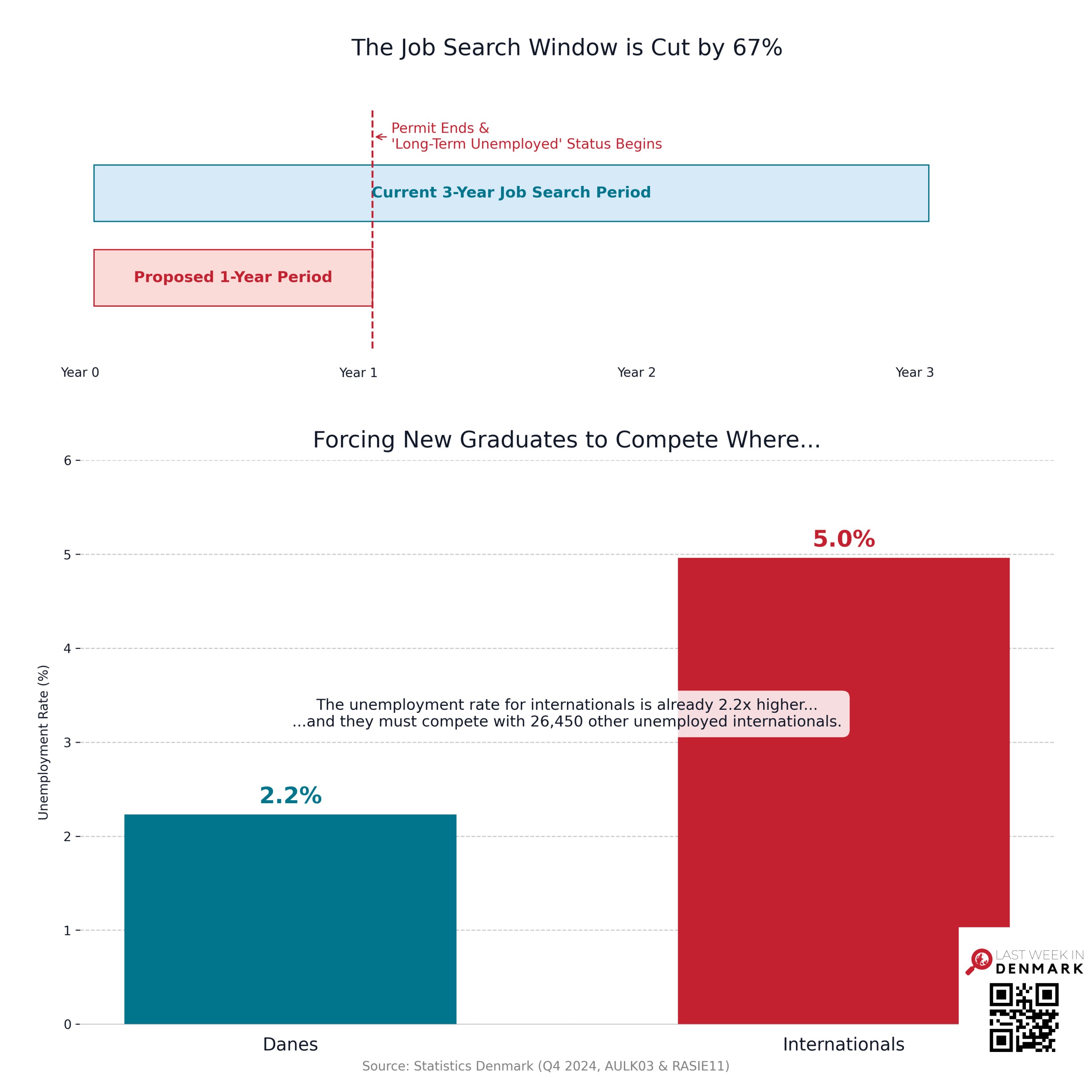
But the real blow comes after graduation: the current 3-year job-seeking period is being reduced to just 1 year. The system is shifting from a “come, study and maybe stay” model to a “come, study, but don’t get too settled” mentality. And I would like to highlight the “post-graduation” clause, because this could potentially cause genuine distress.
Why the bill is unfair: setting students up for failure
There’s one part of the bill that is concerning for all international students: the post-graduation clause. When an international student has completed their studies, they must transition to the labor market if they want to stay in Denmark (with rare exceptions). No job? No reason you should stay in Denmark, and the Danish system will try to get you to return home. And let’s be honest, it’s not easy to find an entry-level job as a fresh graduate.
The current system assumes that it can take an international student months or even years to find a job in Denmark. And that’s why graduates are given a generous 3-year job search period, allowing for part-time work and internships until they can land contractual, full-time employment.
If we run the numbers, the proposal to shorten the search period to 1-year would be devastating for the international student community. This is because internationals already face a tougher job market. In Denmark, long-term unemployment refers to 52-weeks of job seeking without a job, or precisely 1 year of job seeking. According to Q4 2024 data from Statistics Denmark, the long-term unemployment rate for individuals of Danish origin was 2.2%1. For those of foreign origin, the rate was more than double, at 5.0%2. Internationals already experience significant hurdles in finding employment, not to mention that recent graduates are facing unemployment rates as high as 13% per Uniavisen. In short, a one-year job-seeking limit will only increase the pressure on international students.
1: Statistics Denmark, “Full-time unemployed persons by region, time and country of origin (AULK03),” March 12, 2026.
2: Statistics Denmark, “Labour force to calculate unemployment rates by ancestry, time and country of origin (RASIE11),” March 12, 2026.
Why stricter rules for international students?
Equity and empowerment are values that have made Nordic and Danish higher education a real global success. I cannot downplay just how much Denmark has become a land of opportunity, in particular for nationals of the European Union. Under free movement every year hundreds of European students come to study in Denmark. If they choose to return home, they return feeling inspired; if they choose to stay, they become some of the most sought-after professionals in Denmark.
With that in mind, an attentive reader might notice that the bill is in many ways bypassed by free movement. Take for example, the rule on family reunification. A German student can still, under free movement, bring their partner to Denmark, as long as the partner has EU citizenship. Reading between the lines, this bill does not target all international students equally. If anything, the bill seeks to deter European students but outright marginalize third-country students from outside of the EU/EEA.
Already, non-EEA international students are faced with certain restrictions. Despite free public education in Denmark, non-EEA students often have to pay a substantial tuition fee. And so, the bill’s overhaul of university admission fees is directly targeting non-EEA students. Education in Denmark is thus moving from inclusive to wealth-based access.
The government makes no secret of this in their parliamentary debates and rhetoric. They cite a significant increase in applications from non-EEA countries like Bangladesh and Nepal and these students’ dropout rates. It is portrayed as though student migration is a route that has become a form of disguised labor migration. Thus, the issue is not just a general “foreigners” issue; it is a much more selective and strict reassessment of who Denmark will open its doors to, under what conditions and who will be allowed to remain in the system.
One of Last Week in Denmark’s reporters from South Asia, Kalpita Bhosale, gave us some words on student fraud:
Unfortunately, there is some truth to what the government is saying. We see this in our networks and communities, there are many international students from non-EU countries coming to Denmark on proxy marriages. And then those couples can also stop attending classes/college lessons and instead jump straight into the labour market where they get paid less than average and are subjected to hard labour – they’re willing! Because the pay is preferable to their home country, and they might tend to ride the system for its loop holes.
Having said that, students who are sincere and are genuinely here for studies unfortunately get affected by these policy changes and reconsiderations. Let’s not forget that the job market for a new graduate is also as tough as any job opportunity for an experienced international.
Meanwhile many students and recent graduates see this attitude as too harsh and harmful to Denmark’s competitiveness. To quote a group of students I spoke with:
– Classic Danish politics. Because some people have used loopholes in the system, some feel that means we have to punish everyone!
– That’s true, and they will think ‘We used the loop holes when we were kids so now we have to make sure no one else does!’”’
– It’s called ‘Pulling up the Ladder’
– Our politicians make decisions like this and then ask why international students are leaving Denmark?
What can you do?
Of course, this bill is not written to purely shut down international programs; it also includes positive provisions that open paths to doctoral studies through some short master’s programs. This is another reason why the situation is so critical. This reform bill could also benefit internationals if we raise our voice in the ongoing debate.
All things considered, remaining silent is the worst response, accepting a potentially more hostile policy for internationals. After the first hearing on March 17, 2026 the bill was passed to the relevant parliamentary committee: Uddannelses- og Forskningsudvalget – UFU, marking the beginning of more technical and political negotiations.
The real window of opportunity for internationals to act is now. Instead of complaining on social media, we have the right to make written submissions to the parliamentary UFU committee, to request a hearing and to shift the language from “Denmark as a victim of education fraud” to “Denmark as an exemplar of the ideal education system”.
We have to start somewhere, and the insufficiency of a 1-year job search is something we can resist with concrete data. This proposal would in many cases set up graduates for failure and that’s a loss of investment for Denmark just as much as the student body. From there, we should guide the conversation around how this cut will hurt Denmark’s educational competitiveness and translate to a decline in talent.
We have the power to make a solid argument that the bill should be revised with talent and opportunity in mind, rather than with fraud and fear. It’s time to spread the word!



I would like to thank my colleague Oray, from the Turkish edition of Last Week in Denmark for first making me aware of this issue.
You can read his coverage in Turkish over here: https://lwid.dk/tr/hos-geldiniz-ama-fazla-kalmayin-danimarka-uluslarasi-ogrenci-politikasini-degistiriyor/
Update 11 April 2026:
Currently the bill has been dropped. Not because it was unpopular, but due to the snap elections in March. We ran the story anyway, because sooner or later when a government is formed the bill will most likely re-emerge.
I fully support Danish laws, why should Denmark accustom to internationals.
I think if internationals want to come to Denmark, should meet all of the requirements.
The Danish system is built around trust, and yes everyone can get the trust but if you abuse it than system will do something about it.
I am international, but I think it is fully reasonable change.
I want to support others but I also think you should feel privileged that you are able to be in EU and Denmark, not just abuse the system and than leave.