




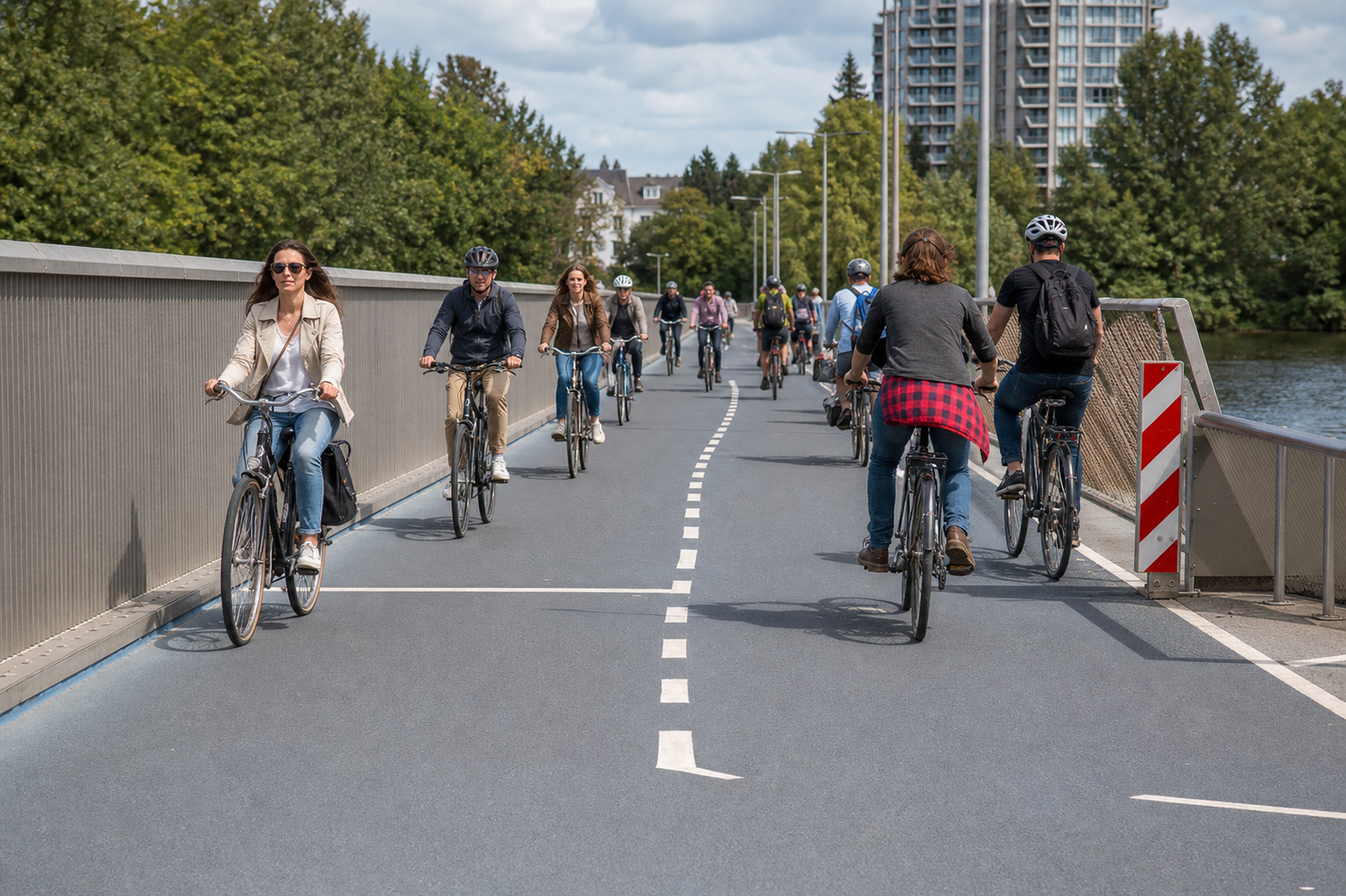
Arriving in Copenhagen means recalibrating your definition of traffic. The morning rush hour in the bike lanes moves with incredible speed and density. For an international resident stepping into this system for the first time, one visual stands out immediately. Despite the pace and proximity to other riders, thousands of local commuters choose to ride without a helmet.
I came from a place where cycling means dodging cars and hoping for the best. So my instinct was simple. Get a helmet, keep my head on. Here, the infrastructure functions as a high-speed transit system. The tension between personal safety gear and local social norms is something almost every newcomer has to navigate.
The immediate shock of seeing bareheaded cyclists usually fades once you actually enter the lane. The infrastructure itself provides a psychological shield.
Journalist Richard Steed recently documented his own transition to Copenhagen cycling. He noticed the shift in his mindset on day one.
“I felt automatically safe,” Steed notes. “There were designated bike lanes, and I had the right of way. It blew my mind that a bus or a car would wait for me to cross a road before turning left or right.”
He put the London comparison plainly. “In the UK, the cyclist is at the bottom of the food chain,” he says. But seeing how educated drivers are in Denmark changed his perspective. “I realised quickly that the cyclist is the king and queen of the roads. So no helmet felt completely natural.”
Urban mobility expert and cycling advocate Mikael Colville-Andersen argues that this infrastructural safety is exactly why helmets should not be the focus. He points out that according to the city of Copenhagen, a cyclist would have to ride for roughly 3,000 years before experiencing an injury.
Colville-Andersen views aggressive helmet promotion as a culture of fear that scares people away from cycling. “When I designed the Copenhagenize Index, ranking the world’s most bicycle-friendly cities, one of the measurement parameters involved the percentage of people wearing helmets on bikes,” he explains. He assigned higher scores to cities with lower helmet rates, viewing the lack of safety gear as a clear indicator that the population inherently feels safe in their environment.
When the physical environment feels secure, safety gear quickly becomes an optional accessory. For many daily commuters, that accessory is simply annoying.
Lisbeth Sahl Bauditz, Senior Project Manager at the Danish Road Safety Council, sees this reflected directly in their data. She notes that the main barriers keeping adult utility cyclists from adopting a helmet are rooted in convenience. People forget them, they feel the ride is too short, or they just do not want to ruin their hair.
“Some adult cyclists still find helmets inconvenient, uncomfortable, or annoying to carry around,” Bauditz says. “There is also a strong sense in Denmark that cycling is an ordinary, low-threshold everyday activity.”
Steed agrees with the convenience factor from a newcomer’s perspective. “Nobody wants to carry a helmet around all day or arrive somewhere with ruined hair,” he says.
This creates a subtle social pressure. Internationals often drop the helmet simply to look like a native cyclist. Colville-Andersen considers this assimilation as a positive embrace of Copenhagen culture. He prefers this over treating a daily commute like a high-risk sporting event.

The changing landscape
The image of the universally bareheaded Danish cyclist, however, is becoming outdated. The cultural landscape is shifting fast. The Danish Road Safety Council began tracking urban helmet use in 2004. Back then, only 6 percent of urban cyclists wore a helmet.
“In 2025, helmet use in urban traffic was 54.8 percent,” Bauditz explains. “This is the highest level of helmet use ever recorded in Denmark.”
Campaigns focusing on parents setting a good example for their children have slowly created a new generation of riders who view helmets as completely normal. Steed noticed this generational divide in his own neighborhood. “If you have a family of your own you are going to protect yourself, to set a good example, and because you need to make sure you are around,” he says.
Even with perfect infrastructure, the physics of cycling remain the same. Car collisions are rare, but other accidents are highly common.
“Many serious cycling injuries happen without a car being involved, for example, in solo falls, collisions with other cyclists, slippery surfaces, curbs, obstacles, or sudden braking,” Bauditz says. The council’s data shows a stark reality. Out of the cyclists who are seriously injured in Denmark, 8 out of 10 are involved in solo crashes.
The modern bike lane is also evolving. Heavy cargo bikes, fast electric bikes, and unpredictable riders now share the same narrow space. The decision to wear a helmet is no longer just about avoiding cars.
Just a few days ago, I was overtaking on the left side of the bike lane during a green light. A tourist on a rented bike suddenly steered left, right in front of me without looking. I hit the brakes hard, and we only slightly touched. Heavy car traffic was moving right next to my left shoulder. It could have ended badly. The infrastructure here is excellent, but it cannot fix human error. You can only look after your own safety, because you cannot influence what others do in the lane.
What I’d tell a friend
I asked Richard the most practical question for any newcomer. If a friend just moved here, should they buy a helmet?
His answer was the most useful thing anyone has said to me. “Copenhagen in 2010 and Copenhagen today are two very different cities on a bike,” he said. “Today, there are food delivery bikes, faster electric bikes, and cyclists who seem not to understand the etiquette of the road.”
His rule was clear. “If you are going somewhere local with proper bike lanes, then probably no. If you are biking, for example, 10 kilometres a day to and from work, wear a helmet. Not because of cars but because of other crazy cyclists out there.”
Mikael takes a totally different approach, but reaches a similar conclusion. “Do whatever you want as long as you are fully informed about the subject,” he said.
That’s where I’ve ended up, too. Fitting into Danish cycling culture doesn’t mean copying the head next to you. The thing that keeps you safe in the lane is predictable riding, knowing the etiquette, not surprising anyone. The helmet is a separate call, and it’s yours to make.
I wear a helmet each time I go out the door. You never know what can happen, and if a bad hair day can make the difference between life and injury, I would love to have bad hair daily.
What did you do when you moved here, helmet or no helmet? Has your perspective changed with each passing day and cycle?


Interesting article. This reminds me of a common Dutch perspective: a helmet treats the symptom instead of the cause.
I think there is some truth in that. Wide, predictable, educated cyclistspainted and fully separated cycling paths probably prevent more injuries than helmets.
I haven’t cycled much in Copenhagen, but from my experience in Aarhus, there’s still room for improvement.