




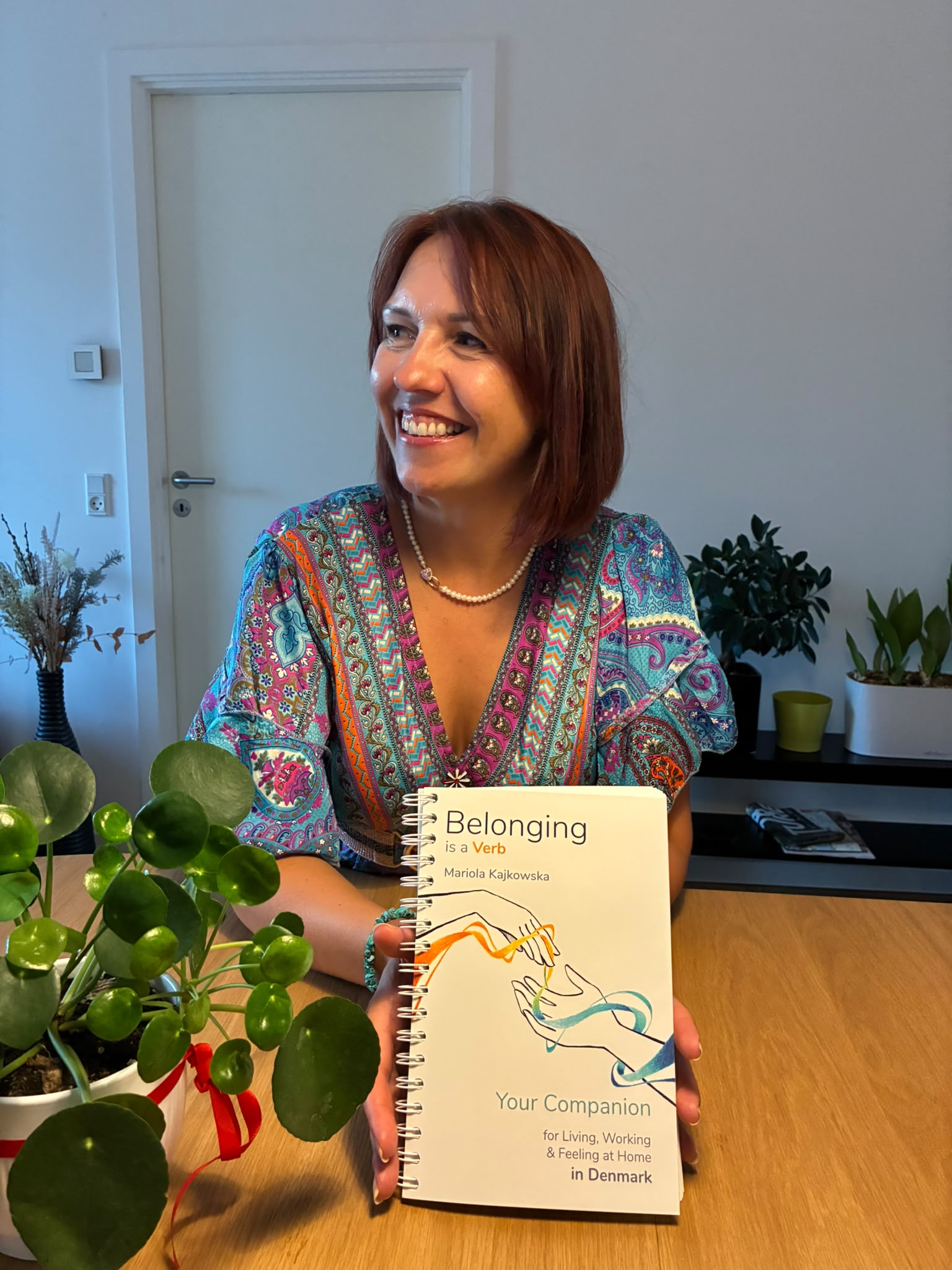
When you’re a newly arrived international, there’s a wealth of content out there on how to belong in your new country. LinkedIn posts, articles, videos, events, courses, paid coaching sessions: it can quickly feel completely overwhelming. You can start to feel you know nothing at all and everyone else around you knows everything. Belonging feels further away than ever.
“I came to Denmark by accident”
Mariola Kajkowska knows this situation acutely. For the past decade, she’s worked with hundreds of internationals new to Denmark, as a career coach, community organiser and volunteer. Now she’s written a book based on her experience, ‘Belonging is a Verb’. But it’s actually more of a practical self-help companion, she points out. What she’s learned most over the years is that new internationals need small steps, practical advice and reassurance. “And there’s absolutely nothing like that out there,” she says.
It feels like both five minutes and five hundred years since I was one of those wide-eyed, slightly shell-shocked internationals, sitting down with Mariola as I attempted to adjust to my new life in Denmark. The title of her book makes me smile: Mariola has always been very much about action and doing. I remember how she gently, skillfully persuaded me to take the small steps I really didn’t want to: refreshing my CV, creating a LinkedIn profile after years of resistance and applying for a job. I understood afterwards what she already knew. When you feel completely lost and your confidence is on the floor, the small daily steps you take to put yourself out there are important confidence boosters on your journey.
It’s a journey Mariola has experienced herself. “I came to Denmark by accident in 2003, aged just 21,” she laughs. She was a young trainee teacher from Poland looking to study for a year in another European country. When she got the call offering her a place, she knew nothing about Denmark beyond “Hans Christian Andersen, the Little Mermaid, that the weather was cold, dark and snowy. I didn’t even know what language they spoke!” Back then, there was no social media, Google Maps or Google Translate to ease her journey, and very few internationals. “I was this unicorn, very exotic for the people of Esbjerg, in Southern Jutland where I’d moved to.”
From new international to seasoned author
This summer, more than twenty years on, she returned to Esbjerg to speak about ‘Belonging is a Verb’. It felt like a full-circle moment, Mariola says. “I am an example of surviving here and thriving.” An accident turned into a full, rich life, living in different cities in Jutland before settling in Vejle, where Mariola lives and works today. And yes: becoming fluent in Danish! She never imagined she would write a book but, working with so many internationals, she came to realise there was a need for it. She remembers speaking to her manager in an early coaching role she had, working with international accompanying partners.
I went to him and said, “I need some tools. These girls, they cry on me all the time. I don’t know what to do with that.” She undertook coaching education and learned so much, she says: “What happens to an international when they relocate to Denmark, the culture they are meeting, how challenging it is, and how lonely it is for many.”
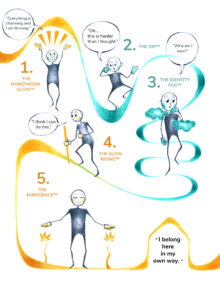
Image credit: Mariola Kajkowska
“You’re not behind. You’re becoming.”
Mariola designed the book as “a companion, walking side by side with you as you experience life in Denmark.” It’s a very honest book, she says. “I want other internationals not to make the same mistakes that I have.” What were those mistakes, I ask? A key one was not being honest about struggling and feeling like she had to have everything figured out. “In the book I say, ‘You’re not behind. You are becoming.’ It’s the sentence I’ve written most often. Many internationals feel no one else feels what they do, and that’s not the case.”
Image credit: Mariola Kajkowska
Going through different stages of belonging is another lesson Mariola talks about in the book. “The journey to belonging is not a linear one. You don’t move from one to five, and then you just remain at five.” Internationals will have good times and tougher times, she says. To struggle doesn’t mean you’re falling behind.
We talk about some world cultures such as the UK, the USA and parts of Asia, where the pressure to constantly move forward and achieve can be intense. Mariola agrees this can be a factor, but as internationals, we all have more in common than we think. “We’re all overachievers,” she says. “We wouldn’t be here, in our new country, if we weren’t. We dared to leave our comfort zone because we’re driven and motivated. That means we have expectations of ourselves: This is where I’m supposed to be because this is who I am, and this is what I should be doing. Then there’s the reality. This is the gap that creates the frustration. And overachievers also tend to consume a lot of content and become overwhelmed.”
Belonging is about the actions you take every day.
So how do we take steps towards belonging in our new country? “Belonging isn’t a life stage,” Mariola stresses. “It’s a set of actions and a process. You can’t sit back and expect it to happen for you.” The book is action-focused, full of practical tips about surviving everyday life in Denmark. “You will hear a lot out there about Danish work culture, Danish values,” Mariola says. “But how do I translate that into my everyday life so I can navigate reality? It’s actually small situations like trying to buy bread that can become a bit of a meltdown experience! You’re standing in the bakery not understanding, without the words to ask for what you want, while feeling shame because you used to buy bread effortlessly in your previous country. We can be so harsh to ourselves and forget how much we’re having to adjust to.”
There is no one way to belong in Denmark, Mariola stresses. That’s another mistake she says she made. “You don’t integrate into Denmark. You integrate into life in Denmark. And life is the reality of daily tasks, daily routines, the people you’re meeting. These are the low level, often boring things that not many people who write and speak about belonging want to dive into because it’s very challenging. I dissect that and translate that into actionable steps that you can use.”
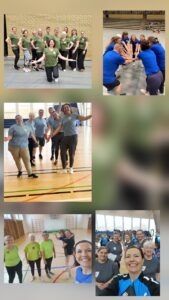
Image credit: Mariola Kajkowska
Volunteering as a social bridge
One of the first chapters in the book is about volunteering. Isn’t that too much to expect of a new international? Mariola disagrees. While in many cultures, volunteering your time for free is a strange concept, she says “in Denmark, it’s integral to society and it’s a social bridge. Danes tend to socialize through activity. They soften, chat, relax and let strangers become part of the team.” She talks about volunteering in dance, one of her biggest passions in life. “It’s been my entry into Danish networks, connections and relationships. I can’t say strongly enough how important volunteering is.” But you can’t just show up once, Mariola stresses. “You have to come again and again, and then people recognize you, and they see you, and one day you’ll find you’re invited to their house, or invited for coffee. It will happen.”
The book is designed so readers can pick it up and get what they need at that moment. “You don’t have to read it from cover to cover. Read a chapter, or even a single page, and then put it back and live your life. Whenever you struggle, you know you have something to come back to. If today feels fragile, start with chapter one!”
Learning Danish: know your “why”
A chapter that many readers will want to turn to covers internationals’ hardest challenge: learning Danish. Again, Mariola says there’s no one method that works for everyone, but she’s proof it is possible! “I think the most important part is to figure out your why. If you don’t know why you’re learning Danish, you won’t complete the education. For me, I wanted to be able to speak with the Danes in my dance class.” The book contains many tips you won’t hear at language school, including sentences to say when you dare to speak Danish and a Dane instantly replies in English, and what to say when your mind goes completely blank. There are also approaches for dyslexic people.
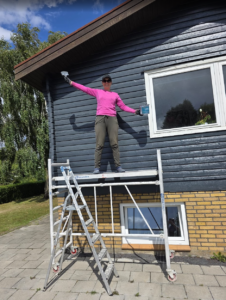
Image credit: Mariola Kajkowska
“When they let you in, you’re in.”
I ask Mariola when she finally felt she belonged in Denmark. She laughs. “I think it’s when you realize there is no finish line,” she says. “You stop chasing a goal and you realise instead you’re becoming a new person and you’ve created a life for yourself in your new country. You have a relationship with that country.” And while it took time to make friends here, she says life has shown her again and again that “the people who show up are Danish. I just bought a house and I’m painting it. A Danish person will say, ‘Need a ladder? I have one. You can just come and pick it up for free.’ Over and over in my life here, I’ve found that when I really need something, it’s the Danes I’ve met who will show up. When they let you in, you are in.”


The personal reflections on ten years of community work provide a meaningful perspective on development from the human side. The emphasis on small steps, volunteering, learning Danish, and building everyday connections shows how belonging can develop gradually through practical actions