

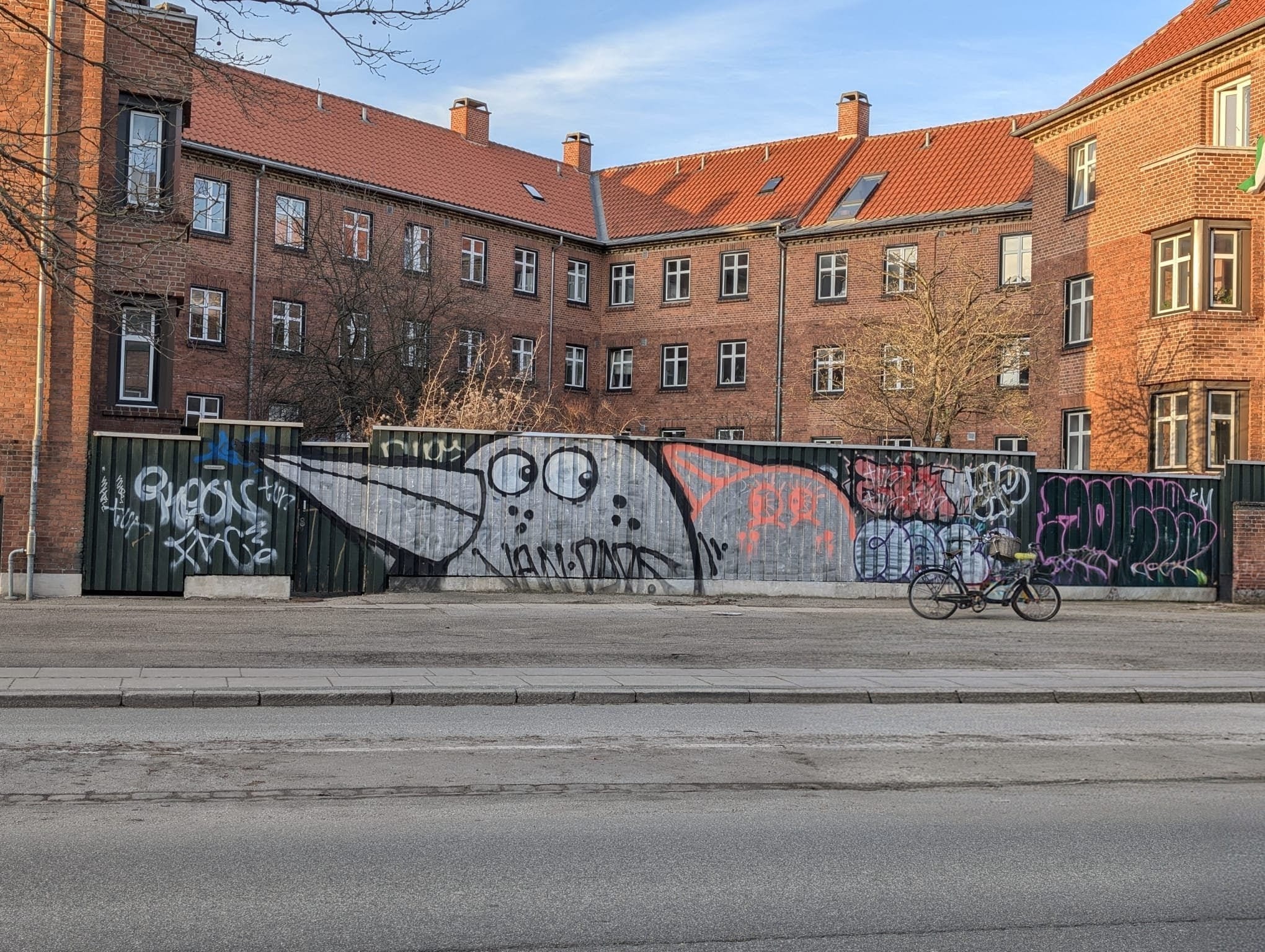
Across Copenhagen, on walls, electrical boxes, bridge pillars, sports fields, and forgotten corners, you start to notice a bird figure painted on in graffiti style. Rounded body, thin legs, triangular beak. Cheerful, almost naïve. No signature. No tag. No claim.
Once you notice it, you begin to see it everywhere.
A 2015 post on Pied-à-terre, a lifestyle and design blog, described the motif as “a happy picture, simple in its design” often placed beside “unsightly features of the city,” transforming overlooked spaces into something playful. The author noted the absence of a consistent tag and wondered whether the birds were the work of one artist or several. The blog described the birds as “small interventions that turn neglected urban details into moments of quiet humor,” suggesting their charm lies less in artistic complexity and more in placement.
Nearly a decade later, that question remains unanswered.
Not Spyo, but often confused with him
Any discussion of Copenhagen street art quickly leads to Spyo. A Copenhagen-based street artist known for provocative, often illicit graffiti interventions across the Danish capital. His work blends social commentary with a rebellious aesthetic, making him a recognizable yet elusive figure in Denmark’s underground art scene. Whose colorful, cartoon-like characters appear across the city.
In an interview with Vice, Spyo described his work as a form of system criticism, using public space to challenge political complacency and consumer culture. He frames his interventions less as decoration and more as disruption, messages placed where they cannot be ignored.
Online discussions frequently conflate the graffiti birds with his work. A Reddit thread titled “Mystery solved?” debated whether the birds were connected to Spyo, but commenters ultimately pointed out stylistic differences, particularly the birds’ minimalism and lack of signature.
Profiles of Spyo emphasize his bold outlines, recurring characters, and recognizable tag, which are features notably absent from the bird motif. As one street art guide notes, his work is “playful, graphic, and clearly branded,” making anonymity an unlikely choice.
The birds, by contrast, seem to resist authorship.
They’ve been around for years
Old forum posts and Reddit threads show people asking the same question as far back as the early 2010s: Who is painting these birds?
Some say they’ve seen them for a decade. Others point out new ones appearing in different neighborhoods. No one seems to agree on an origin.
A long-running Reddit discussion from Copenhagen residents describes spotting the bird across neighborhoods, with one user noting they had seen it “for years” and still did not know who was behind it. Another thread on Danish forums debated whether the motif constitutes art or vandalism, reflecting a broader public ambivalence toward street art. The site Street Art Cities catalogues similar minimalist bird figures in Copenhagen, suggesting the motif has become part of the city’s informal visual language. Meanwhile, Spotted by Locals describes the birds as small urban surprises, the kind of detail that rewards attentive walking and makes the city feel playful rather than purely functional.
Copenhagen’s relationship with street art is no longer limited to informal discoveries. The city now has an official street art route, highlighted by tourism platforms such as OpdagDanmark, which maps murals and urban artworks across different neighborhoods. The route encourages residents and visitors to explore works in districts like Nørrebro, Vesterbro and Refshaleøen, framing street art as a cultural asset rather than a nuisance. This institutional recognition sits in quiet contrast to anonymous motifs like the graffiti birds, works that remain outside official narratives yet continue to shape how people experience the city.
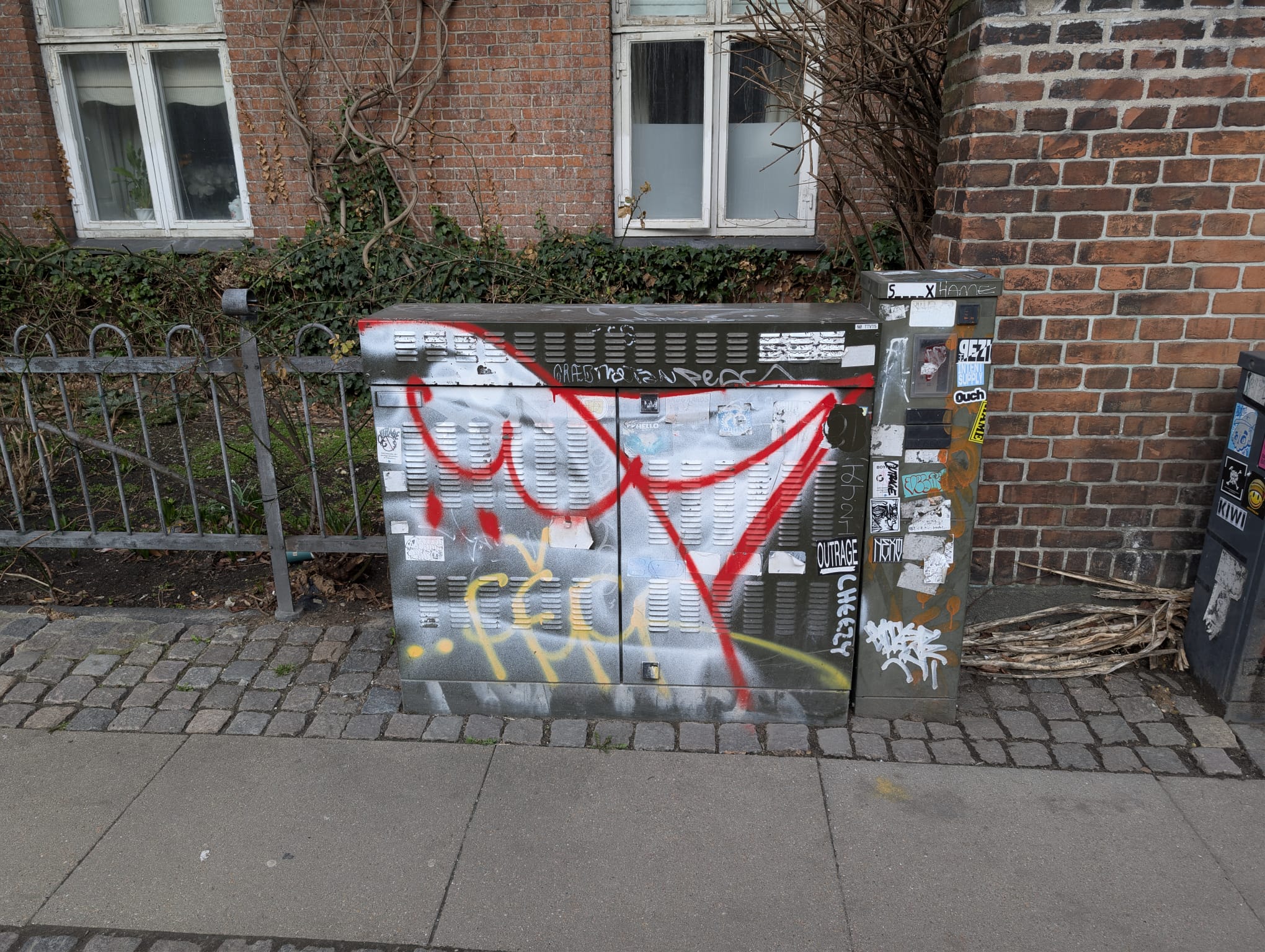
Are they a crew? A copy? A shared idea?
Online discussions offer conflicting accounts. In a recent Copenhagen Reddit thread, several users claimed the motif is linked to a graffiti collective known as “Birds Crew,” describing it as a group with multiple members who paint birds instead of traditional letter tags. Some commenters claimed the crew includes figures such as Spyo, Sneezy, Van, Hack, and Bravo, and suggested ties to Berlin’s graffiti scene. None of these claims are independently verified.
The birds themselves remain simple and schematic. That simplicity leaves room for multiple explanations: several artists may have adopted the motif, the original design may have evolved through imitation, or the birds may function as an open visual meme rather than a single artist’s signature. In graffiti culture, replication is not unusual. A form that is easy to draw travels fast, across neighborhoods, cities, and sometimes borders, carried by memory rather than attribution.
Here is some information currently available online about the members of the crew:
Hack is a recognized writer associated with Copenhagen’s train graffiti culture. His panels have appeared on Danish regional trains and transit infrastructure, sometimes in collaboration with crews linked to bird motifs. His work has been documented on platforms such as Spraydaily and Brask Art Blog, situating him within the city’s active “traffic” scene (graffiti created on moving trains).
Bravo (sometimes seen as Bravovan) is frequently mentioned in connection with recurring bird figures in Copenhagen. Online archives and graffiti photo sites catalogue bird-themed pieces attributed to this tag, though stylistic variations make definitive attribution difficult.
Sneezy is known for small, character-based street art pieces, often wheatpastes or stencils, spotted in dense urban areas like Vesterbro. Social media documentation frequently places Sneezy’s work alongside tags such as Spyo and Bravo, suggesting overlapping circles rather than formal collaboration.
The name Van appears in discussions but remains ambiguous. It may refer to a local graffiti writer, a collaborator within the Copenhagen scene, or be confused with unrelated artists sharing similar names. This uncertainty reflects a broader pattern in graffiti culture, where tags travel faster than verifiable identities.
Taken together, these figures illustrate a scene defined less by fixed membership and more by proximity, shared spaces, and visual dialogue. Whether or not a formal “Birds Crew” exists, the repeated association of these names shows how communities form through overlap rather than official structure.
Why anonymity matters
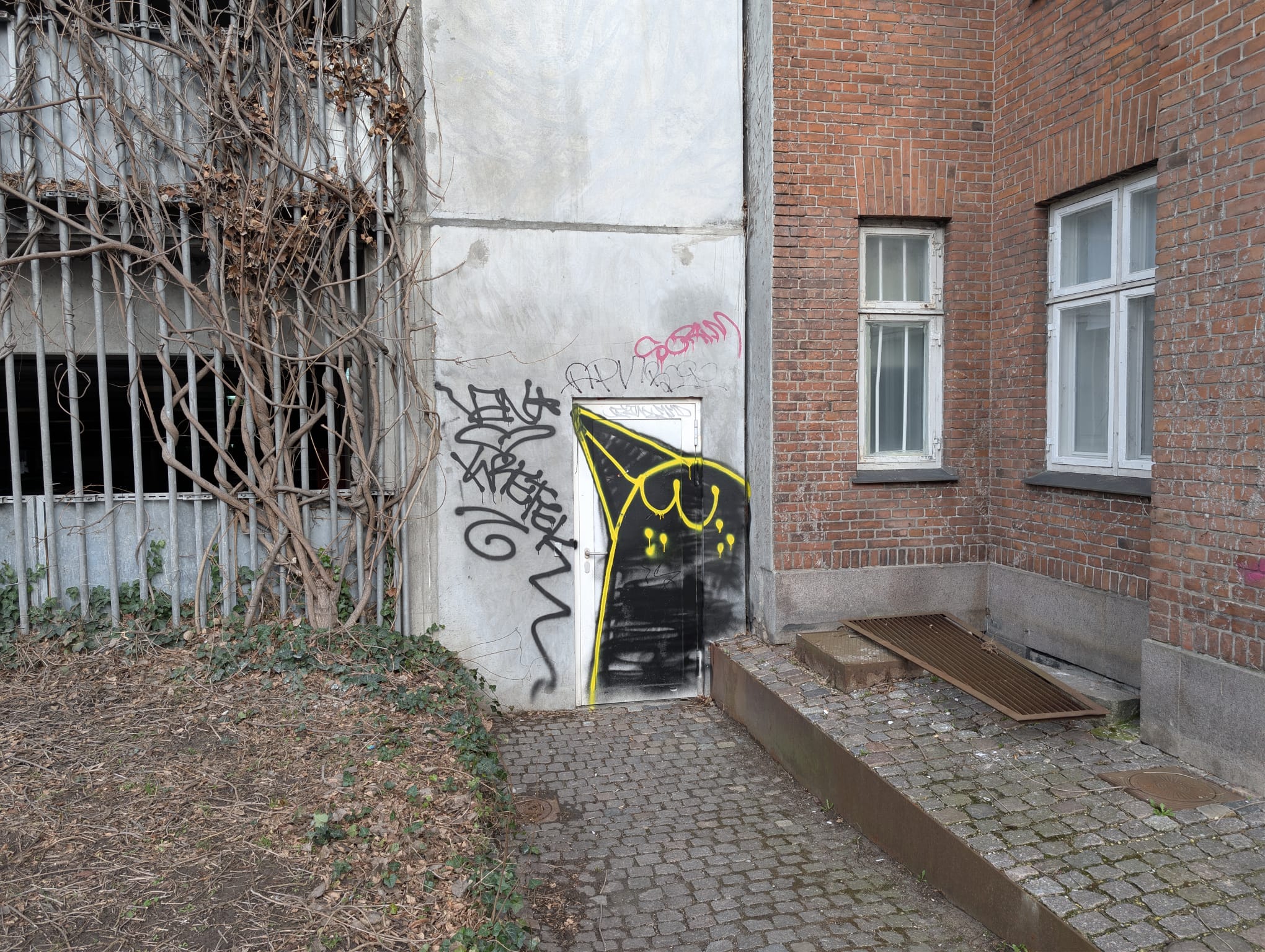
Unlike tagged graffiti, the birds make no claim to territory or authorship. This absence may be part of their endurance and acceptance. Urban art observers note that non-confrontational motifs, small, humorous, or decorative, are often removed less aggressively by municipalities. Without a tag, the birds lack the territorial assertion that typically triggers cleanup.
Their placement reinforces this: they often appear beside infrastructural elements, blank walls, or visually neglected corners, where they soften rather than dominate the environment. As one commenter in a Copenhagen forum observed, the birds feel less like vandalism and more like “small gifts left in the city.”
Several years back, a crew called TagsAndThrows, doing graffiti documentaries, mini videos and shorts, visited Copenhagen and did a video called: “Bombing in Copenhagen”. Bombing in graffiti refers to the act of rapidly painting many, often illegal, tags or “throw-ups” (simple, quick, large-lettered pieces) in high-visibility public spaces. The goal is to maximize visibility and reputation, focusing on quantity, speed, and risk, rather than detailed artistry. It is seen as a way to dominate an area and gain fame within the subculture.
While in the city, TagsAndThrows collaborated with graffiti artists such as Ozone, Vanity and Bravo, known names in the local scene.
Looking for patterns in a new city
I moved here as an outsider. Many of our readers can probably relate to this feeling: when you arrive in a new city, you look for patterns, things that make the place feel familiar. I grew up in the underground culture, being surrounded by electronic music parties, artists of all kinds, tattoos, piercings, and everything in between. I feel it represents me to this day and will do so for the rest of my life. I think that’s also what continues to foster my interest in urban legends such as this one.
Whether created by one artist, a crew, or an evolving chain of imitators, the graffiti birds have become part of Copenhagen’s visual folklore. Not because they’re famous. Not because anyone has explained them. But because they keep showing up, quietly, like a shared secret.
And perhaps that is their power. Offering connection in the least suspecting places.