




As in many countries in Europe and throughout the world, Denmark’s political landscape has undergone vast changes in the last decade. Many new parties have been formed, politicians have changed party affiliation or become independents, and the current government has established a new paradigm, where government is run from the center with opposition parties on either side.
As an international living in Denmark, it can be hard to keep track of all these details. But with the municipal and regional elections in November and a parliamentary election in March, you might want to brush up on your understanding of Danish party politics.
Last Week in Denmark gives you some native knowledge and guides you through the key policies and proposals of the current parties in the Danish Parliament. Each party has a designated letter on the ballots, so let’s take them in order.
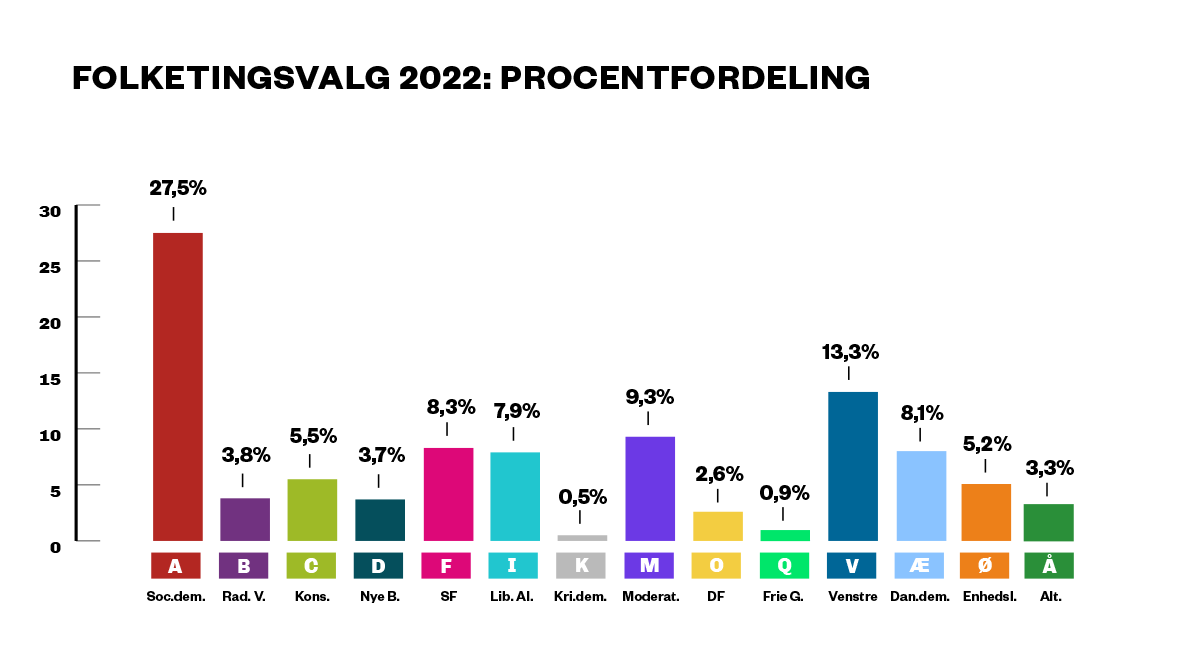
Below you see the percentage distribution of the 2022 election. The electoral threshold in Denmark is 2%, so parties below this threshold do not make it into Parliament. This goes for the Christian Democrats (Kristendemokraterne), which was last elected to Parliament in 2001, and the Independent Greens (Frie Grønne), a left-wing offshoot of The Alternative (Alternativet).
A – The Social Democratic Party (Socialdemokratiet)
The party was established in 1871 as one of the four “old parties”, representing workers. It has frequently been in power and is chiefly responsible for the development of the Danish welfare model. Just like the UK Labour Party or the Democratic Party in the US, they changed course and embraced neoliberalism in the 1990’s. It is currently the biggest party in Parliament with 50 seats, and is regarded by some as the only party who have a credible candidate for Prime Minister, Mette Frederiksen. She leads the centrist government in coalition with The Moderates and The Liberal Party.
Key Policies
- Focussing on the right to an earlier pension for manual laborers
- Have strengthened vocational education, and reduce Master’s degrees to one year
- Adamant in support of Ukraine, and committed to a 5% GDP spending on defence
- Enhancing security by increasing surveillance
- Increasing labour supply by removing a national holiday, Great Prayer Day (Store Bededag)
- Seeking to give international workers better living conditions by increasing the inspection of employer-provided housing
- Adopting a critical stance towards immigration along with right-wing opposition.
B – The Social Liberals (Radikale Venstre)
The party was established in 1905, as another of the four “old parties”, originally breaking off from The Liberal Party. It has been a key centrist party in Danish politics, backing and participating in both Social Democratic and Liberal-Conservative governments. It is ideologically right of center on economic policy, but left of center on issues like the environment, immigration, education and culture. In the last election, they received a historically low number of votes, after which Martin Lidegaard became the new party leader. It currently holds 6 seats in Parliament.
Key Policies
- Will make Denmark more attractive for internationals, including easing requirements for family reunification, lowering the salary threshold for work permits and removing the ceiling on international study places
- Wants Denmark to absorb more CO2 than it emits by 2040
- Wants to create a public-private partnership, implementing the green transition in corporations while helping to strengthen jobs
- CO2 taxes and regulations on agriculture and transportation, including plane travel
- Lower taxes on income and businesses, incl. a 130% deduction (or tax credit) on expenses for research and development
- Will create better opportunities for employee stock options and crowdfunding
C – The Conservative People’s Party (Det Konservative Folkeparti)
The party was officially established in 1916, but formed already around the 1880’s as another of the four “old parties”. Originally called The Right, they historically represented landowners and townspeople. It has often held power in right-wing coalition governments, notably leading the economic reform government of the 1980’s under Poul Schlüter. In 2015, they received a historically low 3,8% of the votes and ever since they’ve fought to regain their former position. After the untimely passing of the party leader Søren Pape Poulsen in 2024, the current leader Mona Juul took over. The party currently holds 10 seats in Parliament.
Key Policies
- Reduce taxes on work, inheritance, cars and housing
- Secure respect for the law with more police and tougher punishments
- More doctors throughout the country and more time for patients
- Ban smoking in schools and increase the price of cigarettes
- Increase competence in schools by academizing the Teacher’s Seminary
- Create a tier system to attract foreign workers by categorizing countries into a ‘traffic light’ system. Greens get a reduced salary threshold at 300.000 kr., yellows get the current threshold and reds get denied
- A green transition that does not cause lower growth or loss of jobs
F – The Green Party (Socialistisk Folkeparti)
The Green Party was established as a reformist socialist party in 1959. It has traditionally not been a governmental party, except for a short time between 2011 and 2014 when they were part of a coalition with the Social Democrats and Social Liberals. They ended up withdrawing from the government due to pressure from their base after the privatization of the state-run energy company DONG (now Ørsted). The party has pursued a role as a party of influence under the leadership of Pia Olsen Dyhr. It currently holds 15 seats in Parliament.
Key Policies
- More personnel for child care (with a maximum of 9 children per worker)
- Free therapy for children and young adults
- Denmark should be CO2-neutral by 2040
- Stop new fossil car sales and speed up CO2-neutral public transportation
- Reduce agriculture in designated ‘nature’ areas, and introduce a CO2 tax on agriculture
- Stricter environmental protection laws
- Reduce inequality with an asset tax and more corporate taxes
- Wants to ease family reunification rules and stop sending refugees back to politically unstable and unsafe countries.
H – The Citizens’ Party (Borgernes Parti) – Lars Boje Mathiesen
The Citizens’ Party was created in January 2025 by Lars Boje Mathiesen, who remains its only member of parliament. Lars Boje was excluded as the leader of the far-right populist party The New Right in 2023, after having led the party for a month. The New Right was established in 2015 and promoted primarily harsh anti-immigration policies, but it began disintegrating after the party leader and founder, Pernille Vermund, left in 2023. She came back the year after to officially dissolve the Parliamentary group and recommend the termination of the party.
Key Policies
- The state should play a smaller role in people’s lives
- It should be easier and cheaper to own a car
- Foreigners should be deported if they commit a crime
- Most of the immigration policies today do not make sense
- Reduce taxes, bans and bureaucracy
- Introduce policies based on the principle of ‘common sense’.
I – The Liberal Alliance (Liberal Alliance)
The party was officially established in 2007 under the name The New Alliance, but its current form, as the most libertarian party in Denmark, developed after Anders Samuelsen’s takeover in 2009. Samuelsen infamously pressured the party into government in 2015, and as a result, only received 2,3% of the vote in 2019. The remains of the party were taken over by the leader of the party’s youth faction, Alex Vanopslagh, who has since helped regain its popularity by utilising social media. They currently hold 15 seats in Parliament.
Key Policies
- Lower taxes significantly and reduce the public sector
- Decrease the sizes and lengths of various social benefits
- By law, every time a law is made, two laws should be removed
- Emphasis on the rule of law and criticism of governmental power
- Deny citizenship to people with anti-democratic opinions
- No prayer rooms in schools and educational institutions
- Lower the salary threshold for work permits
- A commission should look at the possibility of using nuclear energy
M – The Moderates (Moderaterne)
The Moderates were established by Lars Løkke Rasmussen in 2022. Løkke had been the head of the Liberal Party for 10 years and Prime Minister in two governments, but was forced out of the party after an internal power struggle. He claimed that the emergence of far-right populist parties like The New Right had made it impossible to form right-wing coalition governments. Instead, he had proposed a centrist government in a book called The Moment of Emancipation. With a highly improvised team, many of whom were non-politicians, he managed to secure 12 seats for the new party in the 2022 election. Lars Løkke is currently the Foreign Minister in Mette Frederiksen’s government, alongside the Social Democrats and his former colleagues in the Liberal Party.
Key Policies
- Introduced the “top-top-tax”, an additional 5% tax for people making more than 2,5 million kr. a year, in exchange for lowering the previously highest tax bracket for people making up to 750.000 kr. a year from an additional 15% to 7,5%
- Has laid a strategy to strengthen startups through corporate tax reductions
- Wants to attract international workers by removing bureaucratic procedures for employers and introducing a nationwide union contract instead
- Wants a mandatory “civic duty” for all young people, replacing the military draft, where youngsters would work in public institutions for 6 months
O – The Danish People’s Party (Dansk Folkeparti)
The party was established in 1995, when Pia Kjærsgaard led a breakaway from the libertarian anti-immigration party The Progress Party. It had a highly influential role, backing the Liberal and Conservative governments under Anders Fogh Rasmussen in the 2000’s. The party thrives on populist sentiment, particularly concerning Muslim immigration. This resulted in their policy introducing the controversial citizenship test. They have had trouble competing after new right-wing parties have cropped up, and many of their members left for the Danish Democrats after 2022. The current party leader, Morten Messerschmidt, presides over a parliamentary group of 7 seats.
Key Policies
- The borders should be closed to migrants and asylum seekers
- It should be much more difficult to get citizenship
- More police and tougher punishments for crime
- Better conditions for senior citizens, including a higher pension
- Opposes the EU and wants to seek alternatives
- Against “woke” ideology and cancel culture
V – The Liberal Party (Venstre)
The party was established in 1870 as the final of the four “old parties”, originally representing farmers. The party has usually been leading right-wing coalition governments, but has experienced many internal struggles and leadership issues in recent years. Two main factions of the party have split into other parties, taking a portion of voters with them, namely a pragmatic wing (which became former party leader Lars Løkke Rasmussen’s Moderates), and a rural, farming-based wing (which became Inger Støjberg’s Danish Democrats). Nevertheless, it is still the second largest party in the Parliament with 23 seats, and it forms part of the centrist government with party leader Troels Lund Poulsen as Defence Minister.
Key Policies
- Have secured free access to fertility treatment for a second child
- Have lowered taxes on work to increase the incentive to work
- Wants a “working duty” for foreigners to either work or study
- Seeks tougher punishments on crimes committed by foreigners
- Suggests massive investments in green growth
- Seeks more freedom of choice for elderly people, kids and entrepreneurs
Æ – The Danish Democrats (Danmarksdemokraterne)
Established in 2022 by Inger Støjberg, former Minister of Integration for the Liberal Party under Lars Løkke Rasmussen. Støjberg developed harsh anti-immigration positions, and was ultimately excluded from her party after she was impeached and convicted by the Supreme Court for illegally separating couples of asylum seekers where one party was under 18. After being punished, she established a new party with her own name in the title. Many MPs elected for the Danish People’s Party have switched to the Danish Democrats, which is now the 3rd largest party in Parliament with 16 seats.
Key Policies
- Keep the lower social benefits for asylum seekers and immigrants
- Tougher punishments for gang-related crime
- Seeking to improve conditions in rural areas
- Is strongly critical of a CO2 tax on agriculture
- Opposes the government’s establishment of solar power in Jutland
- Emphasizes rural districts against the big cities
Ø – The Red-Green Alliance (Enhedslisten)
The Red-Green Alliance was established in 1989 as a union of the Left Socialists, the Danish Communist Party and the Socialist Workers Party. It has historically been a protest party without governmental influence, but has backed Social Democratic governments and generally had a more reformist line in recent years. The party has a rotational principle that ensures that MPs cannot sit for more than 8 years in a row. It also does not have a formal party leader, but the de facto party leader is their political spokesperson, which is currently Pelle Dragsted. The Parliamentary group has 9 members.
Key Policies
- Wants to decrease inequality by lowering taxes on low incomes and raising taxes on large wealth, inheritance, stocks and real estate
- Wants climate neutrality by 2040 with a high CO2 tax
- Strengthen public transport and stop fossil car sales
- Stop privatization of welfare services
- Remove most hindrances to moving to Denmark, including the 24-year rule for family reunification and the citizenship test
- Raise the lowered social benefits for unemployed immigrants
- Wants a pluralistic mixed economy with more direct ownership of corporations by employees
Å – The Alternative (Alternativet)
The Alternative was established in 2013 in an experimental spirit by the former Social Liberal Uffe Elbæk. The main thrust of the party was to break the so-called bloc politics – where left and right coalitions had become the only alternatives – in favor of a more pluralistic parliamentary culture, where working across the aisle was commonplace. After Elbæk left as party leader in 2019, the party has struggled with leadership and gone through a few iterations. Today, the party is left of center, with a strong environmental focus and with an inherited experimental culture. Franciska Rosenkilde has been the party leader since 2021. It currently has 6 seats in Parliament.
Key Policies
- Wants a universal basic income due to globalisation, workplace automation and the changing job market
- Wants to legalize cannabis to combat organized crime
- Improve conditions for asylum seekers, including a de facto residence permit after 18 months of residence
- Increase taxes on real estate and financial transactions
- A differentiated corporate tax with incentives for sustainable development
- Has been leading in the demanding action on climate policy
North Atlantic Seats
The North Atlantic countries each get two seats in the Danish Parliament in accordance with the Constitutional amendment of 1953.
For Greenland it’s Naleraq (Greenlandic independence), and Inuit Ataqatigiit (socialistic).
For the Faroe Islands it’s Sambandsfokkurin (liberal-conservative) and Javnaðarflokkurin (social democratic), both with a focus on staying in the Danish Realm.
Independents
Five people in the Danish Parliament are currently outside of political parties, either because they defected or were excluded from their former parties. They include Peter Seier (co-founder of the terminated New Right party), Mike Fonseca (excluded from the Moderates following a scandal involving an underage girl), Teresa Scavenius (excluded from The Alternative due to personal differences), Jon Stephensen (excluded from the Moderates due to allegations of sexual misconduct), and Jeppe Søe (co-founder of the Moderates, defected from the party, allegedly due to poor working conditions, a sexist culture and failure of leadership, famously calling the party “a sexist clown bus”).


F – The Green Party (Socialistisk Folkeparti). Is that right? I had understood the Green Party is called De Grønne, with a desperate party called The Socialist People’s Party. I’m not too familiar with the legion of Danish parties but are these 2 the same thing?
Hi Alan,
Impressive that you know about ‘De Grønne’ as they used to be the MAIN Green Party for a couple decades. However by 2014, they were disolved with members defecting to other parties.
F (or SF) is an older party that started as a socialist party but through a particular turn of events has shifted to an ecosocialist party. This is best seen at the EU level, where F sits with the Greens–European Free Alliance.
In fact many members of F are adamant on calling the party the ‘Green Left’ in English, as ‘Socialist People’s Party’ has a very negative connotation in especially in Eastern Europe.
Hope this helps 🙂