
It usually starts with something small (almost forgettable) in isolation. A quick question at the supermarket that doesn’t quite land. A letter from the kommune that takes three reads and a translation app to understand. A phone call you let ring out because you’re not ready to piece together what’s being said on the other end. For many internationals in Denmark, navigating Danish is about more than acquiring a new skill — it’s closely tied to independence, confidence, and feeling fully present in your own life here.
That’s a core part of what makes Liam Jon Pilmore’s story so compelling. Not because Danish is his mother tongue, but because it isn’t. He’s from Nottingham, England — a fact that still catches people off guard, given how closely he’s associated with his second language. His path to creating a life in Denmark, originally sparked by a passion for Danish music and eventually leading him into the world of teaching, wasn’t built on shortcuts but on consistency – the kind most learners would recognize as time-intensive, even monotonous.
“I don’t have some magical pill that I took, and I got good,” he says. “Instead, I got up at 6 am for a year to practice.”
There’s something disarming about that honesty, particularly in a space where language learning is often packaged as frictionless and endlessly enjoyable. Liam resists that framing: “I think people like to say, we make language learning fun, but it’s actually not very fun most of the time. It’s hard work.” Because for many adult learners, frustration often doesn’t come from difficulty itself, but from the sense that they are somehow failing when things don’t fall into place quickly. Removing that expectation makes space for a more sustainable kind of progress.
This mindset runs through the evolution of DanishTube, the platform Liam built not as a formal intervention in language education but as an extension of the way he naturally approached learning. “I was already being creative in my learning,” he says, describing how writing short stories became a way to internalize the language. Video became a natural outlet for that instinct. Over time, that approach has evolved into a broader ecosystem, from courses and private lessons to group sessions designed to meet learners at different stages.
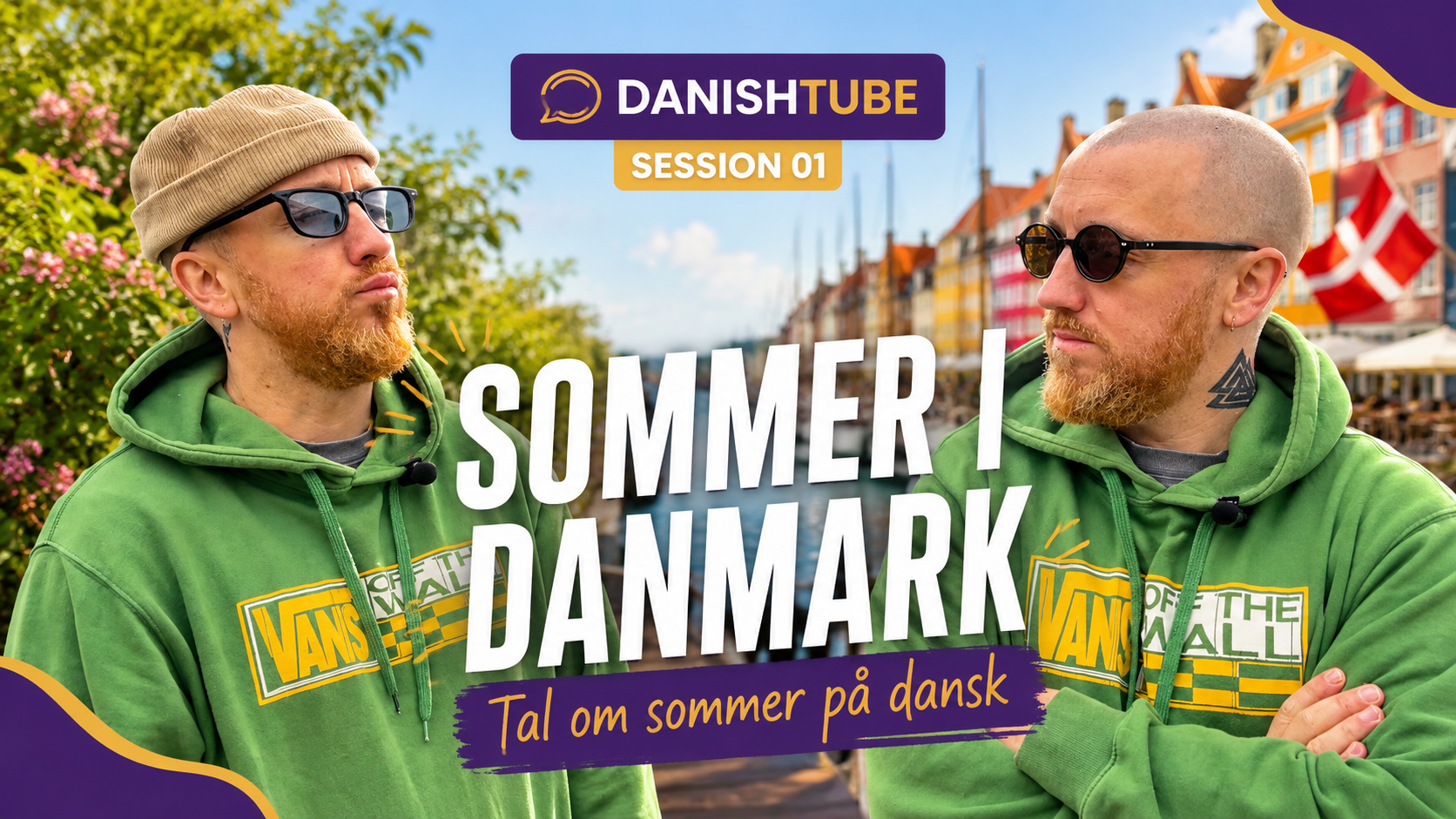
Photo credit: Liam Jon Pilmore
At its core, the idea remains the same: learning should feel connected to real language, not just theory. That balance feels particularly relevant for internationals navigating Denmark’s formal language system. The sprogskole model is often the first structured point of contact, and Liam is careful not to reduce it to its shortcomings. Instead, he highlights what it does well: it provides a framework. However, when learning is too contained — too removed from the unpredictability of real conversation — it can create a gap between competence and confidence. “That boxiness of the language school sometimes might feel a little bit too robotic,” Liam says. And so, he proposes an alternative: “Let’s try to have a conversation. Get to know each other. Talk about daily life, talk about things that are relevant to you.” It’s a shift from correctness to connection; from being rehearsed to genuinely responsive.
Why Danish feels so hard
If one idea underpins his approach, it’s a rejection of the idea that Danish is uniquely difficult. “There’s kind of been a culture out there the past few years, especially Danish teachers love saying Danish is difficult, but I feel like it’s the wrong attitude to have.” According to Liam, what’s most challenging is not the complexity, but the identity that forms around it. “Grammatically, it’s not actually that difficult [for English speakers],” he notes. The real barrier is pronunciation. “You’ve got to practice. How the hell do I make that sound?” It’s not just about understanding, but rather about retraining how you physically speak. He breaks sounds down into something tangible; for example, exactly where in your throat you reach for the sound of the Danish ‘r’.
Beyond pronunciation, there’s also a cultural shift. Danish communication favors clarity. “Less is more,” he says, “Not feeling like you’ve got to be freaking Shakespeare or something.” The instinct to overcomplicate — to sound intelligent rather than effective — often gets in the way.
Stripping language back to its essentials allows learners to participate before they feel ready. Confidence, in this sense, isn’t fluency; it’s staying in the conversation even when you feel out of your linguistic depth. “If you can get really good at asking people simple questions, like, ‘Can you repeat that? What do you mean? What does that mean? How do you say that?” he says, “Those should be your best friends throughout your entire journey.” These are simple but powerful tools. “Rather than reverting back to English because you don’t know, you’re still in Danish.”
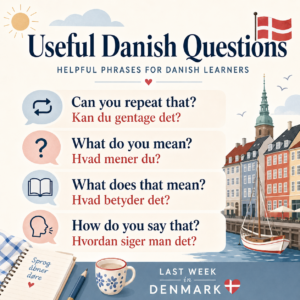
Graphic: ChatGPT created for Last Week in Denmark, based on concepts shared by Liam Jon Pilmore.
That emphasis on speaking is central to how DanishTube operates today. Alongside one-on-one lessons, learners can join group sessions focused on conversation, or more informal formats that create space to practice without pressure. As Liam describes it, these sessions offer opportunities for both structured discussion and more relaxed small talk. A membership model also gives access to a broader range of materials and ongoing sessions. Even minor changes contribute to that progress, like changing your phone’s settings to Danish, which can have a cumulative effect: over time, exposure becomes familiarity, and familiarity makes the language more intuitive.
Language, belonging, and what comes next
Beneath all of this is something more fundamental: belonging. “You will never have the same experience in Denmark if you don’t learn Danish,” Liam reflects, even in a country where English is widely spoken, “the first language will always be Danish.”
It shapes connection, identity, and participation in ways that go beyond practicality. “It can open a lot of doors for you,” he says, not just professionally, but socially and culturally. It can be the difference between observing life here and fully participating in it. Often, people notice the effort itself. “Danish people are often surprised, asking, ‘Why the hell would you want to learn this language?’” For all the structure and strategy involved, progress is often marked by smaller moments than formal milestones. “If you can understand someone on the phone,” he says, “that’s huge.”
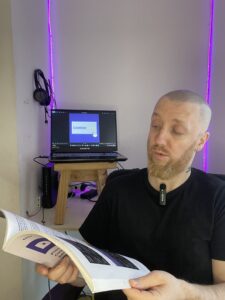
Photo credit: Liam Jon Pilmore
Looking ahead, Liam is focused on expanding access to this way of learning. “I would really love to bring other people into my world who are also interested in teaching,” he says. “I would like to pass that on to other people.” It’s grounded in what he has seen work: “I’ve seen that it’s effective, that it’s working for people.” He also continues to develop new courses and flexible learning options for people who want to engage with Danish on their own terms. For him, the goal isn’t to make learning feel effortless. It’s about reaching the point where you’re participating, responding, and gradually finding a deeper sense of home in Denmark.
Get in touch with Liam
To explore DanishTube’s podcast, courses, and membership options — or to join group sessions and one-on-one classes — visit danish-tube.com.