

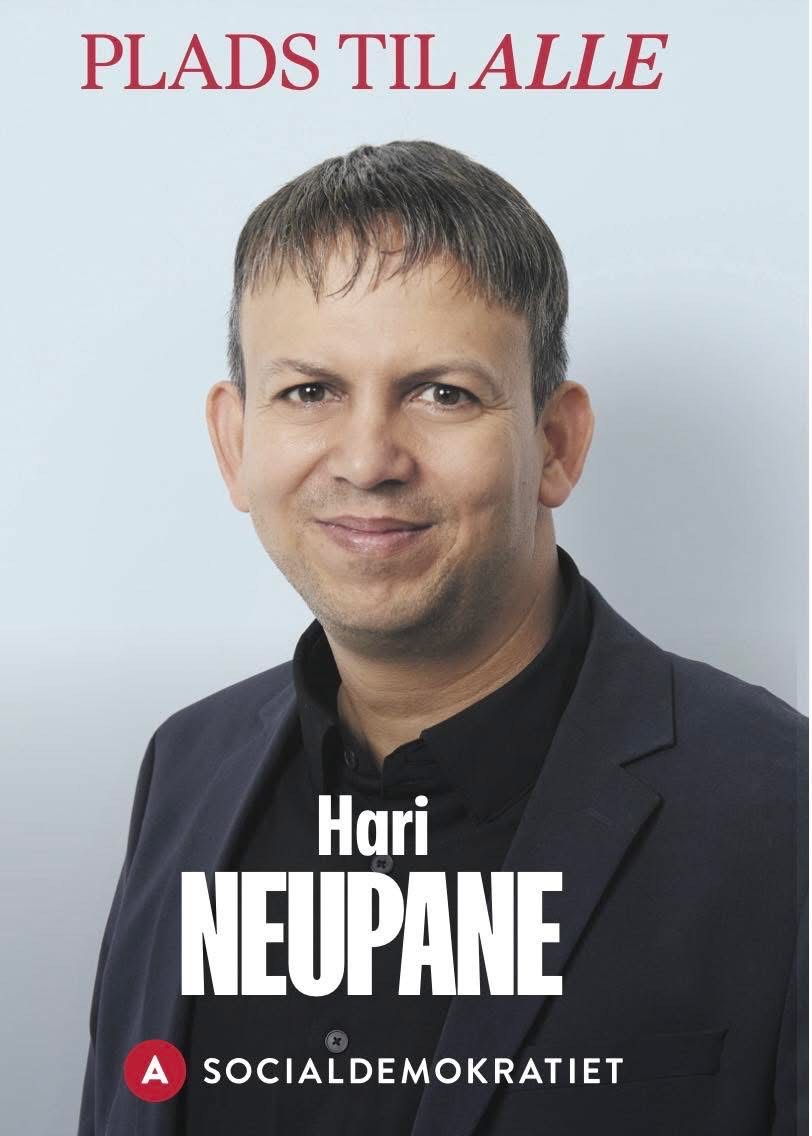
Party: Social Democrats (Social Demokratiet)
Candidate for:
- City council: Copenhagen Municipality
- Regional Council: Region Østdanmark (East Denmark)
I had a chance to communicate with Hari Neupane over the past few months. We have been in conversation for the #VOTEHOME Season 2 podcast – you can listen to it here. Through my exchange, I have come to know Hari, who has always spoken with careful precision. He is the epitome of someone who has mastered his way of navigating two distinct worlds. A college teacher and political candidate, Hari has spent the past 16 years building a life in Denmark, and now he’s running for office in the upcoming local and regional elections with a simple but ambitious goal: to ensure that everyone, regardless of their background, feels they are truly included as part of the larger community.
Hari’s journey
Hari’s journey into Danish politics began halfway around the world, in Nepal, a country of dramatic mountain landscapes and ancient traditions. In 2009, he made the decision to leave his homeland for Denmark, carrying what he describes as “big hopes and a curious mind.” It was a leap of faith that would reshape his entire life trajectory.
“I wanted to learn, grow, and contribute to a society that values equality, democracy, and respect for every individual,” he recalls of those early days. “It was not always easy in the beginning, but I slowly built my life here – learning Danish, teaching at the college level, and getting involved in community work.”
The challenges of starting over in a new country are familiar to many internationals living in Denmark: language barriers, cultural adjustments, the slow work of building professional credentials and social networks from scratch. But Hari approached these obstacles with conviction, seeing them as stepping stones to a longer successful journey.
Over the years, something profound shifted in Hari’s relationship with Denmark. What began as a practical decision to seek better opportunities evolved into something more deeper and personal. “Over time, Denmark became more than just a place to live; it became my home,” he says. “The warmth, fairness, and opportunities I’ve found here have shaped who I am today.”
This sense of belonging didn’t happen overnight. It emerged gradually through his work as a college teacher, through his engagement with local communities, and through his growing understanding of Danish society’s core values. He found himself drawn to the Danish emphasis on equality, democratic participation, and social welfare: principles that resonated with his own beliefs about how a just society should function.
As his roots in Denmark deepened, so did his sense of responsibility to contribute meaningfully to his adopted homeland. Teaching became more than just a profession; it became a window into the experiences of others navigating similar journeys of integration and belonging.
Hari’s community work would prove transformative, not just for those he helped, but for himself. As a college teacher, he found himself in daily contact with international students and families navigating Denmark’s complex social landscape. Their stories began to reveal patterns, systemic challenges that couldn’t be solved through individual effort alone.
“I met many international students and families who shared their struggles from language barriers to feeling unseen in society,” he explains. These weren’t isolated incidents or personal short-comings. They were structural issues that affected entire communities of people with international backgrounds.
The conversations in his classroom and community meetings revealed a gap between Denmark’s ideals of equality and inclusion and the lived reality of many international residents. Hari began to see how policies and decisions made at the local government level directly impacted the lives of the people he worked with every day.
“I realized that many of these issues could be addressed through active participation in local democracy,” he says. This realization marked a turning point, when Hari understood that true change required moving beyond community organizing into the formal structures such as politics.
Entering politics
This realisation pulled him from the classroom into the political arena. His entry into politics wasn’t driven by personal ambition or a desire for power, he insists, but by a growing conviction that representation matters in tangible, practical ways.
“I didn’t enter politics for personal gain, but to represent those who often feel unheard,” he explains. “I wanted to help build bridges between newcomers and Danes so that everyone can feel they truly belong.”
The metaphor of bridge-building is central to his political vision. He sees himself not as an advocate for one group against another, but as someone who can help create connections, foster understanding, and build the kind of collaborative relationships that strengthen communities. In his view, integration is not a one-way street where newcomers simply adapt to Danish norms, but a mutual process of learning, adjustment, and growth.
This approach reflects his own experience of integration, a process of adding Danish language, culture, and civic engagement to his identity while maintaining the values and perspectives that shaped him in Nepal.
Hari’s campaign
The decision to become a candidate crystallized when Hari recognized a stark absence in local government. “I decided to run as a candidate when I saw how few people from international backgrounds were represented in decision-making spaces,” he says. “I felt that if we want change, we need to be part of the conversation.”
His decision to run also carried a symbolic dimension. “I wanted to show that it’s possible that integration is not just about living in Denmark, but also about contributing to it,” he explains. By stepping forward as a candidate, he hoped to model a form of active citizenship that goes beyond paying taxes and following laws to include direct participation in democratic governance.
“Becoming a candidate was my way of giving back to the country that gave me so much and to inspire others to take part in local democracy,” he reflects. The phrase “giving back” shapes his political philosophy.

Hari’s campaign platform centers on four interconnected priorities for a more integrated and inclusive Denmark. First, he emphasizes “strengthening opportunities for education and employment for internationals,” arguing that economic opportunity is essential for meaningful integration. Without access to quality education and fair employment prospects, newcomers remain on the margins of society regardless of how well they speak Danish or understand local customs.
Second, he advocates for “creating stronger collaboration between Danes and people from international backgrounds,” highlighting that integration is a two-way process requiring mutual engagement.
Third, he focuses on “empowering young people to become active citizens and future leaders,” seeing the next generation as key to Denmark’s future. By investing in youth leadership and civic engagement now, Denmark can build a more inclusive democracy for decades to come.
Finally, he champions “promoting equality, fairness, and shared responsibility in our local communities,” establishing the moral foundation for his work.
“My campaign this year is about inclusion, opportunity, and empowerment,” Hari summarizes. “I want every person no matter their background to feel that they belong and have a fair chance to succeed.” His hope is to inspire people with international roots to believe their voices matter.
Final thoughts
Whether voters will embrace that message remains to be seen. Danish politics around immigration and integration have often been contentious, with debates sometimes generating more heat than light. But in a political landscape often dominated by discussions about what divides Danes and newcomers, Hari Neupane is betting on what might unite them: a shared investment in community, opportunity, and the belief that democracy works best when everyone has a seat at the table.
Win or lose, his candidacy itself makes a statement about the possibilities of democratic inclusion in modern Denmark.