

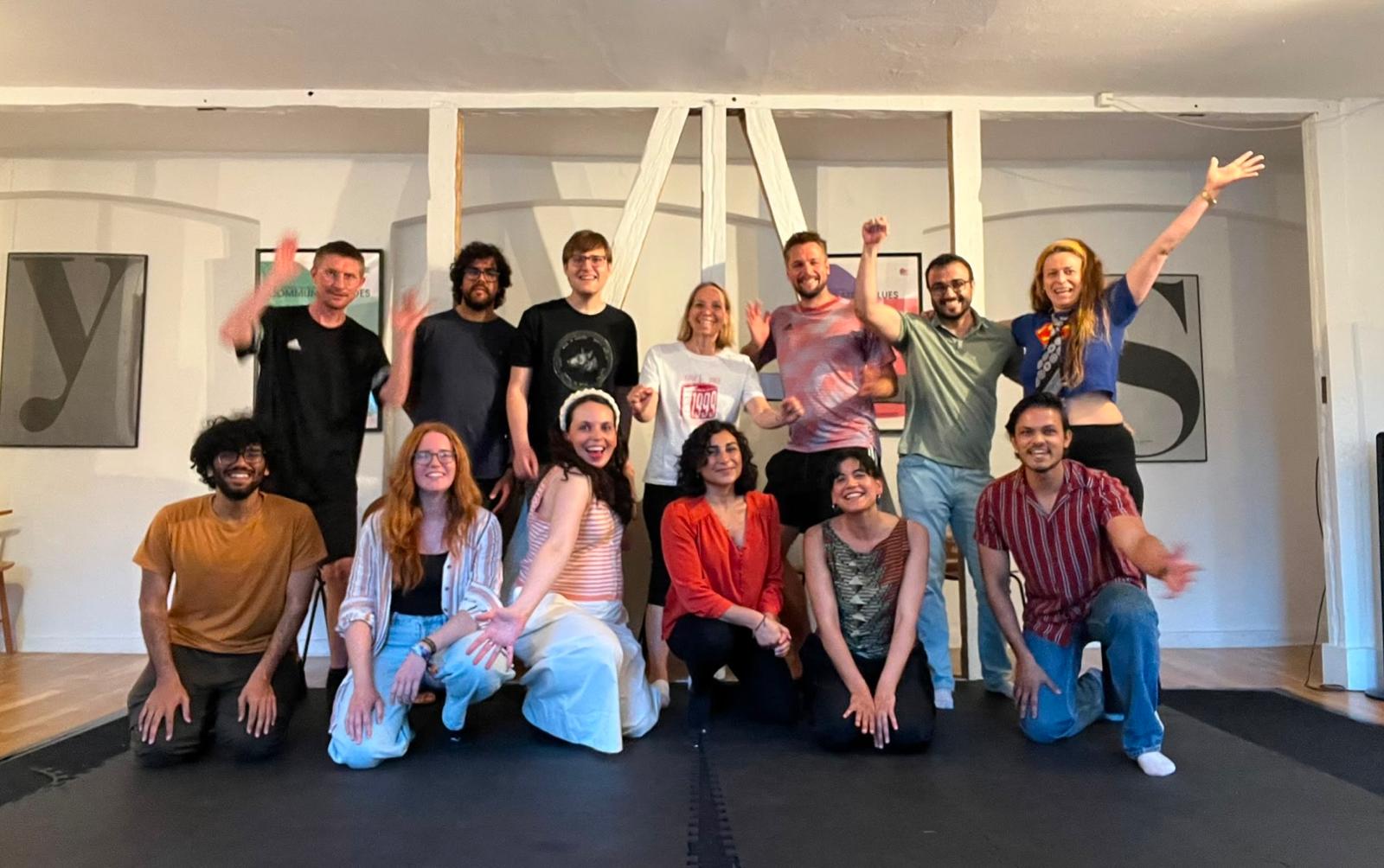
I have been intrigued by improv since reading comedy legend Tina Fey’s memoir Bossypants. Fey writes: “Life is improvisation. All of those improv classes were like church to me. The training had seeped into me and changed who I am.”
It’s a bold statement. Could improv really have that much of an impact?
Over the years, conversations with friends and colleagues who had tried improv kept nudging the idea closer, but I hesitated. Improv sounded exciting, but also a little scary — like it was code for being witty on command in front of strangers.
Then I moved to Denmark, and something shifted. Building a life in a new country changes your litmus test for what counts as outside your comfort zone. Suddenly, you are already improvising daily as you settle into a new life, language, and culture — at the supermarket, on the phone, at the doctor’s office. I figured I was already using these muscles, and so I booked a free intro class at Improv Comedy Copenhagen.
Better known as ICC, it has become a home for English-language comedy and improv in the city. It offers shows, free intro workshops, and longer courses, including an eight-week beginner class in English focused on active listening, body language, and communication. This year, ICC is also preparing to celebrate its 10-year anniversary, so it feels like a fitting moment to look not only at what improv can create on stage, but what it can teach us outside the classroom.
What surprised me most was that the intro class was much less about “trying to be funny” and much more about being in the moment. It was about listening, accepting, responding, supporting, and staying open to possibilities. It was about giving and taking. It was about learning how to be a good scene partner. In other words, the class was not only about what happens on stage. It was about how we move through life.
As a bonus, it is also one of the spaces in Copenhagen where I have seen the most Danes and internationals in the same room, playing, laughing, and creating together. In a city where social circles can sometimes run in parallel, that felt special in its own right.
I felt invigorated after that first taste of improv – buzzing with spontaneous and creative energy. So I signed up for the 8-week course and the rest, as they say, is history.
The power of saying yes
One of the first ideas you learn in improv is “Yes, and.” Accept what your scene partner offers, then add something of your own. Do not block the scene.
It sounds simple until you realize how often we do the opposite in daily life. We correct, hesitate, look for the perfect response, or try to steer the conversation toward the version we had in mind. Asking questions can also sometimes become a form of control. Questions are not inherently bad, of course; they are often necessary and generous. But if you only ask questions, you may be placing all the responsibility back on the other person.
In improv, we’re encouraged to take the idea and contribute something ourselves: a detail, an emotion, a small piece of the world you are building together. “Yes, and” creates possibilities. It asks you to stop waiting for certainty before participating.
Bring a brick, not a cathedral
Angela Alzina, who has taken three levels of classes at ICC so far, shared her experience:
“One of my teachers said in the first class: ‘Bring a brick, not a cathedral.’ Just bring the first idea and trust that you’ll be able to build something with it, without having the whole thing fully formed — and that people will meet you where you are. The other person will bring another brick, and you’ll bring another, and by the end of the scene you’ll have something. But you don’t need to have that at the beginning.”
Our lives are often shaped by the pressure to arrive prepared. Have the plan. Know the answer. Understand the system. Start the business only when the strategy is fully formed. Begin the creative project once you know exactly where it’s going.
Improv offers a braver and more inclusive alternative: just go for it. There is enormous freedom in that. A brick is enough. A first sentence is enough. A small offer is enough. You do not need the cathedral before you begin.
Of course, this only works if the room feels safe enough to risk being ridiculous. Silje Balsnæs, my teacher at ICC, brings a decade of improv experience to the classroom, beginning at Det Andre Teateret in Oslo in 2015 before expanding into clowning, physical theatre, and music, and joining ICC in 2018. She says creating a nonjudgmental environment is central to making creative risk possible.
“What moves me as a teacher is witnessing the transformation in people,” Silje shares
“Seeing someone arrive to their first class with a shaking voice and self-consciousness, and then watching them step into their bold, playful, and ridiculous self. That change doesn’t come from talent; it comes from taking risks in a safe space.”
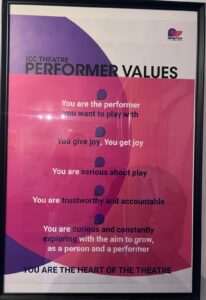
It can be tempting to think confidence comes first, and action follows. Improv shows that it’s the other way around. Confidence is built through small acts, repeated in a room where people are not waiting for you to fail. Silje says, “When people feel safe, their creativity opens, and they begin to trust themselves in a new way. The silliness people express when they feel free is so joyful for me to witness.” Here, playfulness is not trivial – it’s a key ingredient to imagination and letting the magic unfold.
Trying on another version of yourself
Angela also described improv as a testing ground for the parts of ourselves we don’t always feel comfortable expressing.
“If you’re a more reserved person and don’t want to take up space, improv gives you a chance to embody a very annoying character. If you’re someone who disappears in a group setting, take up space. Be the first one that goes on stage. It can also be the other way around. Maybe you’re always the life of the party. Try not to be. You can support someone else’s spotlight.”
This is one of the most interesting parts of improv: it lets you practice range. You can be louder than usual, quieter than usual, younger, older, braver, stranger, more decisive, or more vulnerable. You can experiment and notice what feels uncomfortable (and even lean into it). You can feel what happens when you stop disappearing, or when you stop filling every silence.
And because it’s play, the stakes are lower. The character gives you cover. The scene gives you permission.
Being a good scene partner
Another lesson from the class: improv is deeply collaborative. You are not there to deliver the perfect line or chase the punchline. You are there to keep the story going together – and that means listening actively. Being available. Jumping in when someone is struggling. Not letting your teammate carry the scene alone.
It also means noticing when someone has given you a gift. A word, a gesture, an emotional shift, a tiny detail — all of these can become the beginning of something. In the class, we were encouraged to nurture those gifts rather than rush past them. To savor the setup and give the moment time to land.
That may be one of improv’s most useful lessons for everyday conversation, especially in a world where many of us are trying to be quick, capable, impressive, or in control. Improv asks for something different – presence. Do not think too far ahead. Do not spend the whole scene planning your next brilliant line. Trust that something will come. And if nothing comes, make a sound, move your body, stay available. It is all part of the scene.
A language of play
For Silje, improv has become much more than performance.
“Improv has, for me, given me a deep sense of confidence, not just on stage, but in how I move through the world. It gives me the confidence to create meaningful moments with strangers, the confidence to go to any event alone, knowing I will be able to make new connections, the confidence to take risks at work and support my friends’ crazy ideas, the confidence to stay in discomfort because I know that’s where growth happens.”
That confidence — the kind that stays with you after class — may be why improv seems to make such loyal converts.
“Improv is a language.”
Silje says. “Improv is a language rooted in playfulness, curiosity, and collaboration. In a world that often leans toward fear, control, and disconnection, improv invites the opposite. It teaches us to listen, to support, and to build something together from a place of joy. I think this is why people who try improv want all their friends and family and coworkers to join too, because imagine how the world would be if we all had a mentality like that!”
Yes – let’s imagine a world where people listened more carefully; added instead of blocked. Supported instead of competed. Risked small moments of ridiculousness. Let awkward silences breathe. Brought one brick and trusted that someone else might bring another.
Curious? Start here
ICC offers free two-hour intro classes in English for anyone who wants to experience improv. No previous improv or performing experience is required — only a willingness to show up, be present, and see what happens. You can get a feel for ICC’s world by watching their introduction below.
ICC is also marking its 10-year anniversary with a one-night celebration at Cirkusbygningen on 2nd September. The evening brings together performers from across ICC’s history for an unscripted celebration of the formats, shows, and moments that shaped the theatre. Learn more and buy your ticket here.
If watching a show makes you wonder what it might feel like to step into the room yourself, start with the free intro class.
Bring a brick. Leave the cathedral for later.