

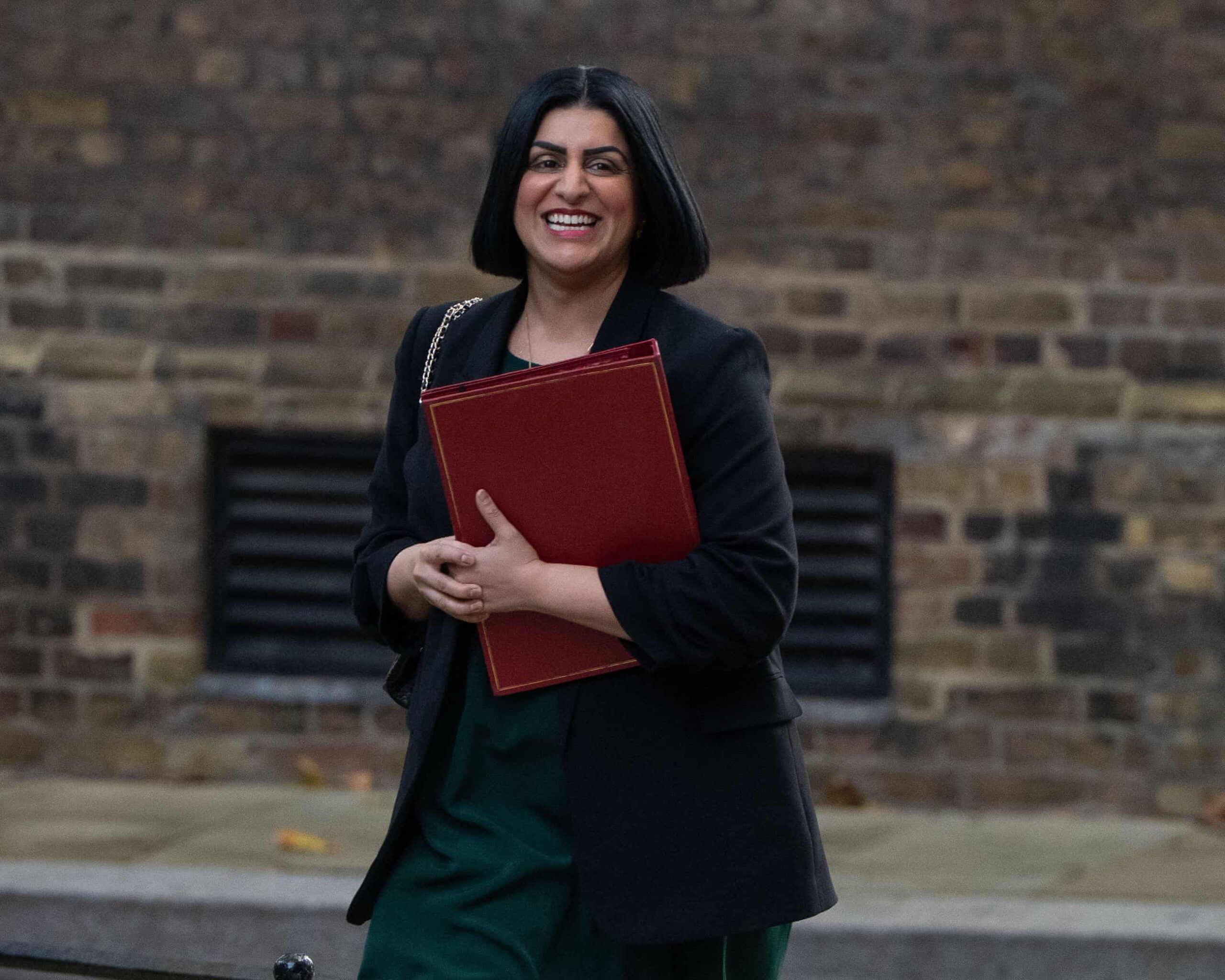
Shabana Mahmood, the Secretary of State in the UK, recently announced the UK’s plan to emulate the Danish asylum and immigration system. The Danish model has long been regarded as one of the strictest in the world, with the nation being described as “a pioneer in restrictive migration policies,” by Marie Sandberg, Director of the Centre for Advanced Migration Studies (AMIS). Pioneer is certainly one word to describe it. Over the past decade, Denmark has passed wave upon wave of legislation tightening its borders.
In 2017, Inger Støjberg, former Danish Foreigners and Integration Minister and now chairman for the newest political party, the Denmark Democrats, made the national news when she shared a photo of herself in front of a cake, celebrating the 50th law she passed cracking down on immigration in Denmark. In 2019, that number had increased to over 100 laws.
Denmark has even gone beyond legislation, such as at the height of the 2015 European migrant crisis, where the government placed advertisements in Lebanese newspapers, warning potential arrivals on the strict migration rules. Susi Dennison from the European Council on Foreign Relations explains that “It’s all been about reducing any incentive to come to Denmark,” with Denmark going “further than most European governments.”
Denmark not only focuses on contentious issues, such as immigration’s links to welfare and crime, but is also openly explicit in its pursuit of a zero-asylum seekers policy. Additionally, Prime Minister Mette Frederiksen and the UK joined seven other European leaders in calling for a reinterpretation of the European Convention of Human Rights, to make it easier to expel foreign nationals with criminal records.
With the UK seeking to align itself more closely with the Danish model, these developments raise interesting questions about the direction of British migration policies, and how such shifts might be felt by people with first-hand experience of these systems. To explore this, I was lucky enough to sit down with Danish-born Henriette and get her insights from many years living abroad in the UK, witnessing these changes both from the inside and outside. Her insights offer a grounded, human perspective on immigration policy — not as a theoretical battleground, but as a lived experience shaped by privilege, language, and the invisible hierarchies of Europe.
A Story About Privilege and Double Standards
Henriette first moved to London in 2005 for what was meant to be a six-month gap year. After a brief return to Denmark to study graphic design, she moved back to London in 2008, drawn in by the energy of the city. She ultimately made a life there for the next fourteen years, returning to Denmark in 2022 with both Brexit and the Corona outbreak weighing heavily in her decision. Yet even now, she describes herself as straddling two identities.
“I have two homes,” she tells me. “I felt like I was moving home to my family…but I’d also moved away from my home and network in London…and now in Denmark I don’t feel 100% Danish either.” These shifts, she explains, have reshaped her sense of self: “I’ve changed a lot. And I think when you live in a city like London, it’s difficult not to change. So, even though Aalborg feels like a bigger city than it was when I moved away, it still feels tiny to me.”
London is often described as one of the most multicultural cities in the world — a tourism hub, a business center, a place where people from all over converge. But even a city like this is not free from double standards. For Henriette, she was welcomed despite her not being originally from the UK.
“People were curious more than anything,” she says. “They wanted to know about Denmark, about my background.” Her background even helped her in job interviews: “Looking for jobs I had several people say to me, ‘Oh you’re Danish! They’re good workers.’”
But that curiosity, she realized, was not evenly distributed: “I had people complain to me about Polish workers ‘taking jobs,’ but then they’d say, ‘Oh, but you’re Danish, that’s different.’ There’s a hierarchy. Being from a wealthy Nordic country gives you status. You’re seen as compatible.”
The double standard is subtle but pervasive: Henriette being seen as a desirable cosmopolitan; while individuals from Eastern European or beyond are labelled as a migrant, as a burden or an unknown. Henriette recognizes that her whiteness, fluent English, and minimal accent shielded her from such scrutiny.
“No one ever called me a migrant,” she tells me. “People assumed I was British. Or they said I was basically British because I’d been there so long.”
When I ask her why she thought that was, she explains the significant role language plays when it comes to integration. In Denmark, the early emphasis on English education and a cultural familiarity with Anglo-American media makes it far easier for Danes to integrate into English-speaking countries. But the reverse is not true. For someone else, she pointed out, adapting to Danish society may require a degree of ‘cultural translation’ that many Danes underestimate.
“You might need someone to actually explain what Danish society is,” she says. “What the norms are. It’s not as culturally adjacent.”
This is where she sees a gap in empathy: an expectation that integration is a one-way process, with little recognition that these countries might also need to meet newcomers halfway.
“It’s interesting how people are so afraid of cultures that are different,” she says. “Yet they spend money travelling, they spend money on eating out and trying restaurants and foods…listening to K-pop. People want the culture, but not always the people.” Henriette found that Danish culture in particular was admired.
“It was maybe in 2015 or 2016 that the concept of hygge became a thing, and books were written about it, and all of a sudden it was…like you had to be as hygge as possible. All the Danish crime shows, Forbrydelsen, Broen, they were all shown on the BBC and everyone was really into the Scandic noir. I think that’s where the idea of Danish culture as enviable or cool came from.”
When I ask Henriette whether she feels that Danish culture carries a certain status in the UK, she agrees. “I think that’s the whole wealth thing, right? That perception of cool that comes from wealth.”
Brexit and the UK’s Strategic Turn
But even the perceived status and being an ‘exception’ did not mean Henriette was not affected by the shift in atmosphere around immigration, amplified by Brexit that made undercurrents explicit.
“I felt it,” she tells me. “Even though no one was saying, ‘Get the Danes out.’ It was still like — if you don’t want me here, why am I paying taxes to fix the roads of a country that doesn’t want me?”
This feeling of being tolerated rather than welcomed shaped her decision to leave.
“It must be amplified for people who didn’t choose the country they ended up in,” she adds. “If you’re in a detention center, not allowed to work, waiting for a decision from people who are angry that you’re there…it must be so isolating.” She stresses how privileged her decision was: “I’m not a forced migrant. I chose to move. I’m white. I’m fluent in English. That’s a huge difference. The scrutiny you get depends on who you are.”
When discussing the UK’s new admiration for Danish-style immigration policies, Henriette says, “Strategically, it’s smart. But that doesn’t make it morally right.”
She argues that Sir Keir Starmer’s approach mirrors the Danish Social Democrats’ shift toward stricter policies in order to win over centrist and conservative voters. This is a growing trend, not limited to just the UK or Denmark. Across the European continent, parties of both the center right and center left have begun adopting similar rhetoric that was normally associated with the far right to retain electoral ground. Even in the UK, Labour leader Sir Keir Starmer faced criticism for warning of the risk that Britain could become “an island of strangers.”
I ask Henriette about her thoughts on the recent Danish elections, showing a growing divide similar to the UK’s post-Brexit landscape: multicultural cities leaning left, rural areas voting for parties promising stricter controls.
“In big cities like Copenhagen, people live with multiculturalism. They like it. They benefit from it,” she tells me. “But often the people making the strictest decisions are the ones with the least exposure to diversity.”
She notes that recent local elections hinted at this divide, with the Social Democrats losing power in Copenhagen for the first time in more than a century, being overtaken by further left parties: “It’s not just migrants voting. It’s everyone who lives around them, works with them, becomes friends with them.” The population of Copenhagen is estimated to be about 20% international.
Consequences for Denmark and the UK
While Denmark’s strict migration strategy has been effective, with asylum applications in Denmark at their lowest level in over forty years (since May 2025), this hard line has not been without domestic unrest and consequences. This can be seen in ongoing laws and debates targeting “parallel societies”, allowing states to demolish or sell housing in areas where at least half the residents have a “non-Western” background. The Social Democrats framed this as integration, while critics argue it is ostracizing citizens with migrant heritage, reinforcing the idea that they are not “pure” Danes. This hostile environment could have dimmed any sort of attraction that Denmark has for non-Danes. For Henriette, this is similar to how Brexit has lessened the appeal of the UK.
“It feels different now,” she says. “I don’t think people look at the UK the same way. The appeal isn’t what it used to be…I feel like it’s put a dark mark on them.”
This begs the question: Should the UK be copying Denmark?
According to Michelle Pace, immigration scholar and professor in Global Studies at Roskilde University, the UK “should think twice” before doing so. In her forthcoming book Un-welcome in Denmark, she highlights how a major shift began in 2015, when changes to the Aliens Act allowed authorities to revoke refugee status if conditions in someone’s home country were deemed to have improved, even when such improvements were fragile. Between 2017 and 2018, approximately 900 Somali refugees lost their residence permits. In 2019, parliament introduced what has been widely called a “paradigm shift” in asylum policy, leading to reassessments of Syrians with temporary protection. By 2022, nearly 400 Syrians had left Denmark, fearing the loss of their status. Many had their residency revoked, but could not be deported, due to the lack of diplomatic relations with the Assad government, and were instead placed in restrictive departure centers. Having spoken to some of these Syrians, Pace describes how it was a “non-life — seemingly designed to push them to leave voluntarily.” Not only does this illustrate the brewing social unrest within Denmark, but the country has also faced criticism and backlash outside of Denmark. Just last year, the European Court of Justice accused Denmark of racial discrimination for its mass housing evictions.
As the UK looks toward Denmark as a model, it risks importing not only the policies, but also the fallout. The Danish system has undeniably succeeded in driving down asylum applications to historic lows, but with the dire consequences of creating a socio-political climate of fear and uncertainty for those who live with the system. It has also amplified social divisions within the society. Any government who seeks to emulate this approach would benefit from looking beyond the statistics and considering the lived experiences of the people whose futures are decided by these policies. As Pace writes: “Denmark’s story is a reminder that migration policy is not just about managing numbers — it is also about the lives that are shaped by those policies.”