
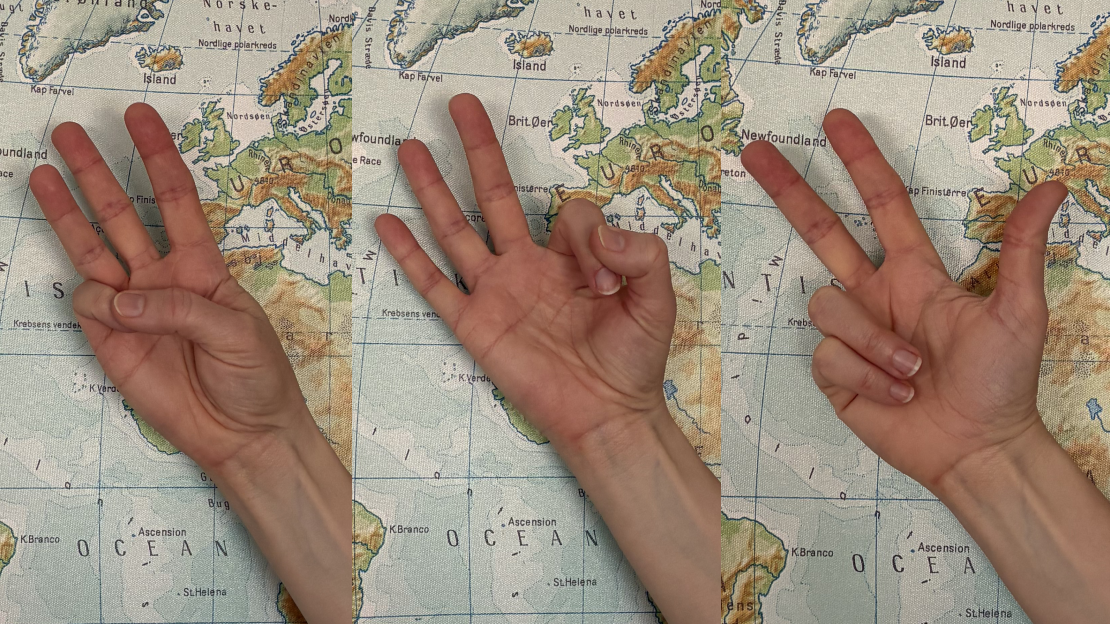
If you’ve seen the film Inglourious Basterds, you likely remember that Michael Fassbender’s counting betrayed that his character wasn’t a German officer, as he’d claimed (watch the scene here). Unlike North Americans and Brits, who typically count to three using the pointer, middle, and ring fingers, Western Europeans generally use the thumb instead of the ring finger. And that’s not the only difference between numbers and counting across oceans and countries.
Growing up in Canada, I thought including a dash in the downward stroke of a 7 was a fancy, potentially snobby way of writing it. Turns out many Europeans need that small line (technically, it’s a serif) to distinguish between the written numbers 1 and 7. I noticed this particularly in Switzerland, with its fondness for paper forms and physical bureaucracy. When we first moved from Copenhagen to Zurich (okay, probably for our entire four-year stay), I struggled to read handwritten numbers. I often needed to check and double-check the swoopy-ness of the downward stroke and the presence of a crossbrace to determine if a digit was a 7 or a 1.
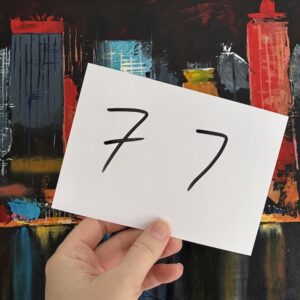
Image credit: Laura Matheson
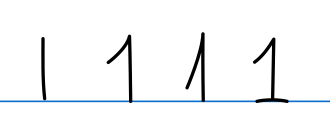
Image credit: Daranz on Wikipedia Commons
The number 4 was also sometimes a problem, but I could never quite put my finger on why. Maybe it looked a little too much like 9 sometimes? Honestly, the clarity of typed numbers is somewhat miraculous — I was super happy returning to Denmark’s digital-ness! (Although I admit to having a soft spot for physical letters and cards.)
Coming from an English-language background, grasping counting in other languages can also feel like something of a miracle. As with German, Danish numbers give the ones digit first, followed by the tens (this is taking me back to kindergarten math, where we learnt that tens come before ones!), use ‘and’ as a connector, then squish it all together without any spaces or dashes. So twenty-two is zweiundzwanzig (two and twenty), just like toogtyve.
Danish doubles down on the difficulty level by throwing in halvtreds (50), halvfjerds (70), and halvfems (90). There’s a complicated reason for this break in linguistic logic that I’m not certain I can wrap my head around. Suffice to say, I keep a note on my phone with my CPR and telephone numbers (both of which have more 50s and 70s than I’m comfortable with) written out in case panic sets in and I completely forget how to say them out loud.
The potential for confusion isn’t limited to double-digit Danish numbers beginning with 5, 7, or 9. During our first stint in Denmark, I picked a phone number with two sets of repeating digits: 501 501. Super easy to remember and kinda fun. But when I’d say “Fem hundrede og en, fem hundrede og en”, people looked back blankly. Danish speakers seem to only understand numerical sequences in two-digit chunks. “Halvtreds, femten, nul-en” would work, but even providing the digits one by one (“fem, nul, en, fem, nul, en”) caused confusion.
At least there’s a system for remembering Danish numbers. For the entirety of our two years living in England, my phone number (or any phone number, really) refused to settle into my brain. Like Canadian phone numbers, UK ones begin with a geographic or standard code. But unlike the consistently three-digit Canadian area codes, British ones might be three or four numbers long, and the 0 at the start might be resolutely necessary or completely frivolous depending on where you’re calling (locally, in-country, internationally). UK telephone numbers vary in length (I’ve seen them from 7 to 11 digits, not including the country code), and the way they’re broken up makes absolutely no sense to me. (Seriously, the history of telephone code misconceptions in the UK is madness.)
While I quickly gave up memorizing the 11 haphazard numerals of my British telephone number, I’m far more intent on integrating with Danish customs. If numbers must be provided in two-digit chunks for them to make sense to native Danish speakers, then non-rhyming couplets I shall speak! (To be fair, I remembered my new Danish number nearly immediately; the system clearly works.)