
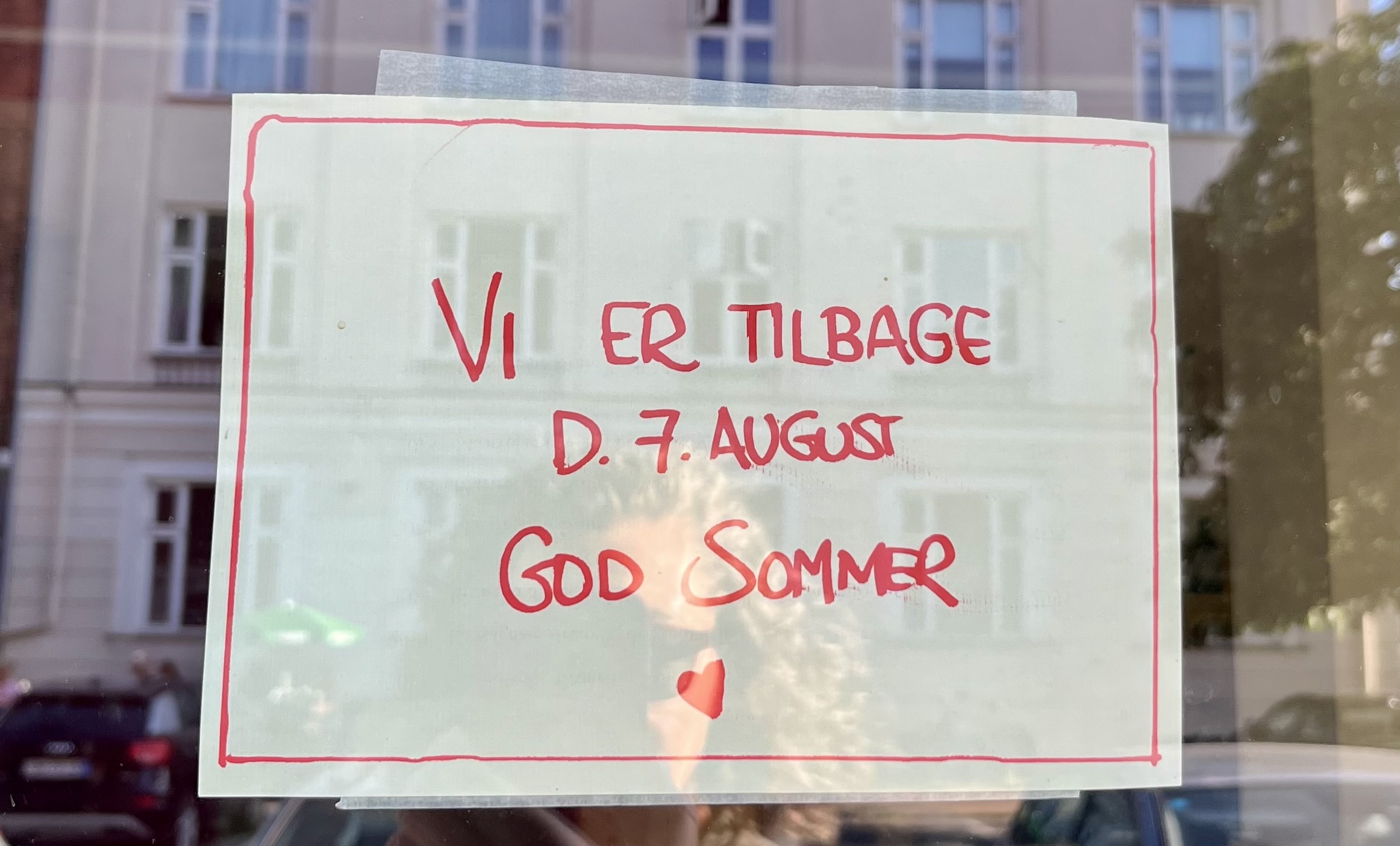
“August is the soonest available. You know, with vacations and everything…”
“July in Denmark is quite something, isn’t it?” I said.
“Really, it’s a lot of nothing,” the receptionist responded.
This exchange is likely familiar to anyone attempting to schedule just about anything over the Danish summer break. For a stretch in July (and sometimes into August, too), it feels as though the whole country is on holiday. Children are out of school, offices are running on a skeleton staff (if they run at all), cities are nearly empty of residents (but potentially filled with tourists), many small shops are shut, even some medical offices are closed for anything but urgent care. Specifically, weeks 29 and 30 represent a nation-wide unplugging. (Side note: have I mentioned my appreciation for referring to weeks by number? It provides a delightful precision utterly lacking from ‘the last two weeks of July’, which leaves open the question about whether the week that’s partially in August is included. I suppose that’s another surprising thing I’d missed about Denmark.)
Somehow in six years living away from Denmark, I had forgotten the realities of this collective Out of Office.
Despite roughly nine weeks of summer holidays for schools in my home country of Canada, a shared rest period would be unthinkable to Canadians (and likewise inconceivable for our southern neighbors in the US). That might be due to many North American employers offering a scant two weeks of annual leave as a baseline, but this widespread vacation isn’t all that common in Europe either.
Although I’ve heard friends joke that half of France takes off July and the other half August, it isn’t a countrywide break. Juilletistes (French for people who vacation in July) and aoûtiens (you guessed it, those who vacation in August) don’t have a consensus on which vacation timing is best — and the debate means that at least half the population maintains their usual lives while the others go on holiday.
While I got used to Sunday closures while living in Switzerland (most grocery stores, shops, and restaurants aren’t open seven days a week), those weekly pauses didn’t translate to a longer mass exodus. In fact, the Swiss more commonly seemed to take extended vacations outside of the summer months.
From working in the UK, I’ve seen many employers value office time over results, which doesn’t lend itself to lengthy vacations and discourages overlapping holidays with colleagues. Perhaps that focus on having ‘butts in seats’ at work is behind the UK’s trend towards shorter mini-breaks and packaged holidays.
Compared to other European countries (as well as Canada and the US) Denmark has shorter school holidays, but this doesn’t mean the country skimps on giving pupils (and teachers and school staff) a pause. While parents often aren’t off for summer for exactly the same time or duration as their kids, the common two-week hiatus encourages families to spend time together. Reflecting on differences between summer holidays in the UK and Denmark, Helen Russell (author of The Year of Living Danishly) observes that this collective two-week break “creates a kind of national rhythm, allowing families to fully unplug”.

And, as Sigga Hansen notes, Denmark’s national love affair with summer houses creates less pressure to jet off to foreign destinations, which can lower holiday stress levels. While many Danes do travel abroad during the summer, a great number enjoy disconnecting from their everyday lives and reconnecting with friends and loved ones without a long distance trek. Thankfully, there are as many ways of spending this nearly nationwide summer vacation as there are possible combinations at a good ice cream shop. (If you have a sweet tooth and haven’t yet sampled the uniquely Danish marshmallow-y substance that is guf, I suggest you seek it out as soon as possible!)
But the general assumption in Denmark is that everyone takes a summer break.
This time of year, “So, where are you going on vacation?” is a standard small talk component. My response that I’m not going anywhere has been met with puzzled looks and general confusion. It’s as though holidaying in the fall is outlandish, which I suppose it is for many people in Denmark.
While I may not have participated in the great national holidays over week 29 and 30 this year, I deeply appreciate the commitment to a collective rest. It’s all part of the balance that contributes to the Danish way of living and makes me delighted to be resettling here.