
After the bustle of December and the start of the new year, January and February tend to feel flat. February often feels to me like the most tedious, darkest month, even though it’s the shortest on the calendar and longer days are returning in the Northern hemisphere.
As an antidote to the realities of winter, here are seven things I do to stave off the start-of-the-year-blues, get through the last cold months, and keep the magic of living in Denmark alive.
1. Glance into people’s homes
In the least creepy manner possible, I delight in peeking into strangers’ windows and getting a glimpse at how they live. This time of year is perfect for stealing short looks into other people’s residences, with the Danish fashion of eschewing curtains making well-lit homes beacons in the evening darkness. The glowing interiors are ripe for spotting fancy light fixtures, well-hung art, and the occasional surprise of saturated color on the walls (white paint is definitely the norm here!).
The near endless variety of lighting is perpetually fascinating for me. While Swiss and Canadian households tend to have functional ceiling-installed pot lights or white-shaded lamps, Danish homes prefer architectural woven or paper shades, statement shapes in metal or glass, or versions of the iconic artichoke pendant with its rectangular leaves arranged in a dozen rows. Unlike the cramped hodgepodge of many British living rooms (the UK tends to have more rooms per residence, but less square footage), Danish design leans towards minimalism and simplicity — all the better for spotlighting a standout chair, beautifully crafted ceramic vase, or meticulously assembled LEGO set.

2. Continue to enjoy the sparkling lights
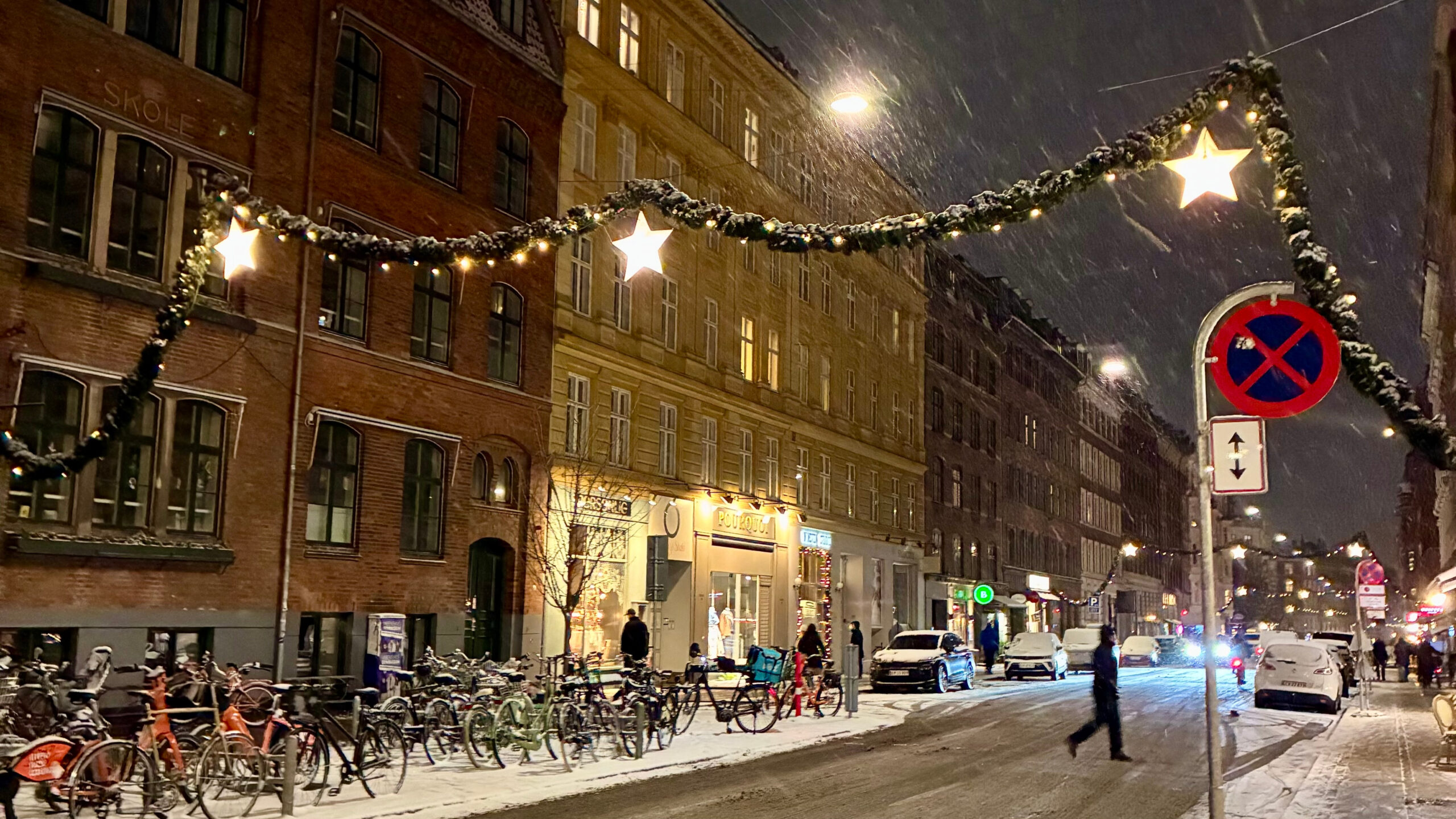
Most municipalities, businesses, and residences keep their twinkling decorations lit into the new year, perhaps recognizing the lift they can bring to still dark days. In other places I’ve lived, Christmas lights tend to come down (or at least not be illuminated) in the early days of January. The one winter we lived in Calgary, Canada (typical January temperatures are around -7°C, with lows often below -20°C), I was shocked to see homeowners brave the cold to unwind strings of lights from snowbound trees. In Denmark, people seem much more willing to keep the sparkle going, electricity prices be damned!
3. Keep an eye on sunrise and sunset
In unspoken agreement about sustaining that holiday sparkle, our paper star lights continue to turn on 15-minutes before sunset. A couple times a week, I’ll grumble about the early onset and bemoan how the Earth’s axial tilt and elliptical orbit cause dramatic day length swings closer to the poles. While sunrise and sunset don’t vary much around the equator, day length changes markedly throughout the year as you move north or south, with winter solstice (December 21) marking the longest night in the Northern hemisphere and summer solstice (June 21) the longest day. Copenhagen is the furthest north I’ve lived at 55° latitude. In comparison, my hometown of Vancouver, Canada is at 49°, Calgary is 51° (the same as London, England), and Zurich, Switzerland is at 47°.
The good news is that when daylight starts returning, it comes fairly quickly. By the end of January, Denmark gains almost 4 minutes a day, with sunset shifting from 15:47 on the first of the month to 16:41 on January 31. To keep it in perspective, poor Zurich sees day length increase by only 2 minutes and 46 seconds at the end of January.
4. Marvel at winter wear variances
Danish residents can interpret the brief on dressing for the cold very differently. I’ve spotted someone wearing a seal-fur coat and a few instances of seal-skin mittens. Fuzzy fake fur and lustrous real fur. Tiny kerchief-type scarves tucked into jackets and massive woven ones that refuse to be constrained by a coat. Full-body quilted snowsuits appear on adult women as well as children, though generally the kids’ versions are far more colorful.
There was a Santa hat one day and reindeer antlers another (Christmas cheer continues!). Of course, young adults tend to shiver in light jackets without gloves or hats (I admit to once sharing this youthful idea that winter gear is profoundly uncool and thus unnecessary), but I’ve seen many sporting puffy jackets and touques (the Canadian word for a woolen hat).
Unlike fall outerwear in Denmark, which seems to be nearly all black and Gortex, cold and snow seem to bring more creativity in clothing.
5. Wrap and unwrap and re-wrap layers
My own outerwear philosophy is a pile on, with time-honed techniques for clothing order. Ear-covering or toque goes on before the big red parka I’ve held onto since living in Calgary. If it’s cold enough to merit a fleece layer under the parka, that must be donned before the scarf. Mittens are to be snugged under the parka’s cuffs, sometimes requiring a third-party. (A group of friends once had an informal rota for tucking in my mittens on a winter trip. Super endearing.)
If the weather is wet or particularly blustery (the Danish wind is a true phenomenon), the layering shifts slightly to accommodate a waterproof shell and protective trousers.
And if I’m going by bike, everything changes again as the parka’s furry hood dramatically limits my peripheral vision, and braking requires greater dexterity than allowed by giant mittens.
It’s a lot of outerwear options to keep track of, but as Scandinavians are fond of saying: there is no bad weather, only bad clothing choices. My LWID colleague Paulina puts it perfectly, to survive the Danish winter, you’ve got to make peace with the elements.
6. Ponder hibernation
Some days, though, staying indoors feels like the right move. I have no doubt hygge warms the soul, but candlelight doesn’t produce all that much heat, and sometimes something physical is necessary. When we lived in a drafty English house (seriously, why are windows so bad in the UK?), I was introduced to the concept of a living room duvet. Since then, our sofa has been adorned with a single-sized down quilt in a brightly patterned cover that doesn’t match any of our other bedding.

Most days, I snuggle under the living room duvet at least once (it’s the perfect place for a morning coffee or watching TV in the evening), delighting in the idea of staying there until spring. Four-legged guests love it, too!
7. Smile at strangers
When you do brave the cold (even just to get groceries or pick up a package), try beaming a smile at someone you don’t know. It can boost dopamine and reduce feelings of social disconnectedness. Canada has an initiative to encourage residents to Talk to a Stranger over a week in November, but given Denmark’s reputation for aloofness, smiling seems more accessible than actually saying ‘hej.’ And just making eye contact can also make people feel more connected.
I’ve found plenty of Danish residents blossom into their own smiles if I offer one. I’d say my success rate hovers at about 60%, with dog walkers and children generally more inclined to return a smile. It certainly brightens my day when they do and appears to make others happier, too — and that’s a powerful way to get through these last months of winter.
But if you accidentally make eye contact with someone while glancing through their window as per tip 1, immediately look away! Do not smile!