
If you’ve moved to Denmark, you might feel like Christmas starts early and never really stops. It’s a busy month. And sometimes it can feel like everyone knows exactly what to do, except you. To understand why, I spoke with Anne-Mette Marchen Andersen from the National Museum of Denmark. She knows the history of these traditions, where they come from, and why they matter.
Why Christmas in Denmark is a Season
When you look at the sheer volume of rituals, the reason for Denmark’s long Christmas month becomes clearer. None of these traditions alone would make December feel overwhelming. But together, alongside the darkness and the emphasis on community, they create a season that stretches out across the entire month.
It’s not just that Danes are trying to make Christmas longer; they have built a culture where the preparation is just as important as the day itself.
“Most of the way we celebrate Christmas today is something that developed in the 20th century. They are new traditions in a Danish context,” Anne-Mette explains. Yet, despite the modern layers added to December, the core purpose goes far back. “Sitting down together for a meal on Christmas Eve, that we know goes way back. And lighting candles.” That simple picture, gathering in the dark winter night, sharing food, lighting candles, is the heart of the Danish Christmas month.
A Cultural Approach to Darkness: Why It Lasts a Month
I asked Anne-Mette why everything is packed into a single month, rather than being spread out. Her answer reveals a lot about the Danish approach to the seasons. In a country where the sun sets at 3:30 PM in December, the “Christmas Month” (Julemåneden) serves a specific function: it is a structured rebellion against the dark.
“You prepare yourself for the celebration, and you take traditions from many places and make them your own,” she says. “It becomes a reason to see your family, a reason to see your friends, a reason to count down for Christmas.”
Unlike the frantic commercial rush seen in some countries, the Danish December is designed to force you to slow down daily. The traditions are repetitive by design. Whether it is lighting a calendar candle every evening or watching a daily episode of a show, the rituals require presence.
This obsession with lighting is backed by data. Meik Wiking, CEO of the Happiness Research Institute and author of The Little Book of Hygge, notes that Danes burn more candles per head than anywhere else in Europe, approximately six kilos of candle wax per person, per year. As Wiking writes, “No recipe for hygge is complete without candles.” In this context, the “Christmas Month” is essentially an active effort to keep spirits high during the greyest time of the year.
For people who love Christmas, this anticipation is the main event. Anne-Mette adds: “We do eat a lot. There’s a need for sugar. For some people, these small traditions become part of hygge.”
And, for people who love Christmas, the preparation is part of the celebration.
The Danish December, Step By Step
December 1st & The Advent Sundays The season officially kicks off with two simultaneous countdowns. First, there is the Advent Wreath (Adventskrans). Families light the first of four candles on the first Sunday of Advent, a tradition that gained traction in the 1930s and now signals the start of the festive season.
Running parallel to this is the Calendar Candle (Kalenderlys), which is usually lit on December 1st. This is a single candle marked with numbers from 1 to 24. It is lit every day, often at the breakfast or dinner table, burning down just slowly enough to reach the next number. It is a literal slow-burn countdown that sits side-by-side with the Sunday wreath, offering a visual representation of time passing.
The Daily Ritual: The TV Julekalender While many countries have chocolate calendars, Denmark takes the concept to the screen. The “TV Christmas Calendar” is a cultural phenomenon, a 24-episode series broadcast daily. It is a shared cultural touchpoint that gathers families (and often adults without children) around the TV at the same time every night. It sparks conversation and nostalgia, serving as a daily anchor point in a busy month.
December 13: Lucia Day Mid-month brings a moment of pure light. On Saint Lucia Day, processions of girls and boys in white robes walk through schools, hospitals, and care homes carrying candles and singing the Santa Lucia song. While it was an imported tradition adopted in the 1940s, it has become a beloved December moment. It is particularly special for the youngest generation; nurseries (vuggestue) and kindergartens (børnehave) often spend weeks preparing for the celebration, practicing the song and procession to perform for their families.
The Julefrokost: While the family home is about cozy preparations, the workplace is about letting loose. The Julefrokost (Christmas Lunch) is the most awaited social ritual of the year for employees. These are traditionally rough parties involving heavy amounts of food and schnapps. As Anne-Mette explains, “Having Christmas lunch as a workplace concept is something that developed after the Second World War,” but today, it is essential for social bonding in Danish work culture.
But for newcomers, the shift in atmosphere can be shocking. In The Year of Living Danishly, author Helen Russell notes the stark contrast between the usually reserved Danes and their Julefrokost alter-egos, describing the season as the one time of year when “Danes lose their inhibitions (and their dignity)” in a way that is culturally sanctioned. It is essential for social bonding, but it is not for the faint of heart.
December 23: Lille Juleaften The “Little Christmas Eve” is not an ancient holiday, but it is deeply rooted in modern families. This is the practical finish line. Families use the day to decorate the tree, iron tablecloths, and often make the rice pudding that will be used for the dessert the following day. It is a day of anticipation, where the stress of work is replaced by the rush of the final setup.
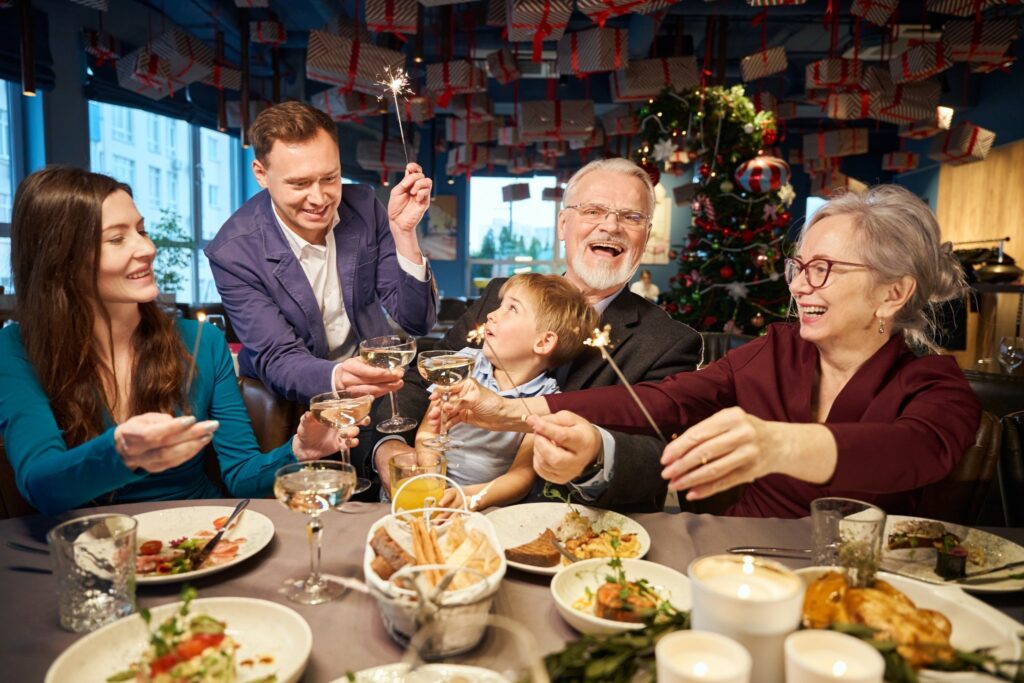
December 24: Juleaften The climax of the month is the evening of the 24th. The dinner is heavy and traditional, usually roast duck or pork with caramelized potatoes, followed by Risalamande, a cold rice pudding dessert with hot cherry sauce. But the moment that defines the night happens after the meal.
Anne-Mette notes that this is the part international visitors find most surprising: “A lot of families join hands and walk around the tree while they sing. For many newcomers, especially relatives from abroad, this is very odd.” To make matters even more confusing for the uninitiated, this is often done with actual candles with live flames clipped onto the branches. For many non-Danes, holding hands and singing while circling a dry pine tree covered in open fire is a culture shock all on its own.
Kay Xander Mellish, author of How to Live in Denmark, frequently warns newcomers about this specific hazard. She points out that while the Danish fire department is indeed busy on Christmas Eve, Danes refuse to swap the “levende lys” (living light) for electric LEDs. The risk is considered part of the tradition.
December 25 & 26: The Quiet Days After the intensity of the 24th, the 25th and 26th act as a national exhale. Almost every store is closed. Families stay inside, eat leftovers, and rest. Many Danes consider these silent days the reward after a full month of activity.
What newcomers find strange about Danish Christmas
I asked Anne-Mette how internationals react to their first Danish December. She shared a few things that repeatedly surprise people:
1. The singing: “Danes love to sing, and not everyone is used to that,” Anne-Mette says. She is putting it mildly. As Kay Xander Mellish notes in her podcast How to Live in Denmark, this can be a terrifying experience for the uninitiated. She describes the shock of attending school events where hundreds of parents suddenly stand up and belt out traditional songs from memory. “I just stood up and hummed along,” she admits. In December, this communal singing (fællessang) happens constantly, around the tree, at lunch, and in church, and participation is rarely optional.
2. The dancing: Especially around the Christmas tree. It often involves holding hands in a tight circle and physically running around the house singing high-speed songs like “Nu er det jul igen.” For foreigners used to a post-dinner food coma on the couch, mandatory cardio while linking hands with distant relatives right after a massive meal can be a lot to process.
3. The Danish flag in decorations: “The use of our national flag on Christmas trees and decorations is regarded as a bit odd.” For Danes, the flag represents celebration. For newcomers, it can feel a bit uncommon.
However, Helen Russell, author of The Year of Living Danishly, clarifies that this is a classic cultural misunderstanding. She explains that for Danes, the Dannebrog is less of a political symbol and more of a “happiness super-brand” used to mark any celebration, from birthdays to Christmas. Kay Xander Mellish backs this up, writing: “The Danish flag is not really a statement of nationalism. It’s a statement of joy.” So when you see the flag on the tree, it’s not a political statement, but just the Danish equivalent of tinsel.
Advice for newcomers experiencing it for the first time
When asked what guidance she’d give to internationals navigating their first Danish Christmas, Anne-Mette kept it simple: “Be open-minded and join in.”
And with full Danish honesty: “Be aware that you have to lose a lot of weight in January, because we eat a lot. There are a lot of sweets and a lot of food.”
This is a sentiment echoed by Helen Russell in The Year of Living Danishly. She describes the Danish December as a caloric marathon where “pastries are not a treat, but a punctuation mark.” Her advice aligns perfectly with the curator’s: accept that this is a season of indulgence, buy trousers with an elasticated waistband, and worry about the gym in the New Year.
For newcomers, Danish Christmas might feel like “too much” at first, too many events, too many candles, too much food. But underneath the packed schedule is a simple idea: surviving the winter together.
This echoes the core philosophy of Meik Wiking. He argues that while the sheer amount of candles and calories might seem excessive to outsiders, they are essentially a “social survival strategy.” The goal is to build enough community warmth to last through the cold.
As Anne-Mette advises those navigating it for the first time: “Every family will have their own understanding of what the ‘true’ Christmas is. There is not one way. There are many ways. And you don’t have to participate in everything.”
So, buy a calendar candle, watch an episode of a show you don’t fully understand, and enjoy the light.