A while back I was on a call with a marketing mentor, Mike, who runs a coaching and consulting practice in the USA. We were half catching up, half working through an idea for my book I was stuck on. Then he asked me a question I have not been able to put down since.
“What are the human skills middle managers got away without developing until now, but won’t be able to avoid anymore in the era of AI?”
I sat with that one for weeks. It is the kind of question that rearranges the furniture in your head.
Here is what I know: a generation of technically strong, delivery-focused managers has been able to skip the harder half of the job. The influence, the difficult conversation, the work of motivating people who do not report to you. They skipped it because the system never made them pay for the skip. And nobody ever wrote it into a job description.
The system is making them pay now.
The half nobody ever measured.
In March 2025, I stood on stage at the Passion for Projects congress in Stockholm and asked the room where they used AI-powered tools in their project work – 148 people answered.
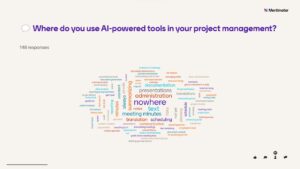
Look at what they typed: documentation, presentations, administration, meeting minutes, summarizing, scheduling, translation.
Every one of those is the visible half of the week, the half a middle manager can point at on a Friday and say that is what they did. And the biggest word on that screen, eighteen months ago, was “nowhere”.
The other half never showed up in a report: it is the relationships you keep alive across three teams. It is reading a Nordic meeting room well enough to notice that the silence just got heavier, and naming it without breaking the trust. And it is walking a colleague back from a career-damaging mistake over coffee, so gently that they never realize what you did.
That second half is where the value was. Nobody measured it, so nobody thought to protect it.
The “management” layer got cut, and it got cut in the middle
This part is not my opinion.
Between May 2022 and May 2025, the number of managers fell 6.1%. That figure comes from Live Data Technologies, reported by CNBC (I shared the link and all the sources at the end of the article). Executive roles fell 4.6% over the same period, so the cut landed hardest in the middle. Whoever stayed picked up the load. Gallup has tracked span of control since 2013, when the average manager had 8.2 direct reports. By 2025, it was 12.1.
It is also not coming back as layers. Revelio Labs puts middle-manager hiring down about 43% since 2022. Gartner predicted that through 2026, one in five organizations would use AI to flatten structure and remove more than half of their current middle-management positions.
And the bill is arriving somewhere else. DDI’s 2025 forecast puts trust in immediate managers at 29%, a fall of 37% since 2022.
Read that sequence again. There are fewer middle managers, each carrying more people, and no route back to the shape the org chart used to have. Meanwhile, the visible half of the work, the half most of us were promoted for doing well, is being handed to a tool that does it in 40 seconds for the price of a subscription.
If that makes you angry, it should.
What is left is the half we were never trained for
On 10 June 2026, I ran a live workshop with a room of Nordic middle managers and put the same diagnostic to them one gap at a time. Thirteen people answered the question on accountability.
Nobody chose “they match”. Not one person in that room said their authority lined up with what they were held responsible for.
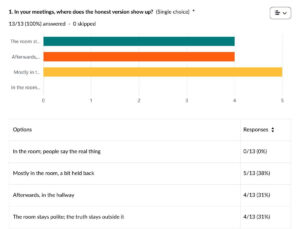
The trust question came back the same way. Nobody said the honest version of the conversation shows up in the room. Every one of the thirteen put it in the hallway, or in a room that stays polite while the truth sits outside it.
Then I asked about feedback.
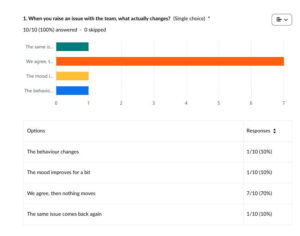
Seven out of ten. We agree, then nothing moves. And when I asked how often the same issue comes back after they have already talked about it, not one person said rarely.
These are working observations from the field, not polished conclusions. The rooms are small. But I keep finding the same six gaps in every growing organization I walk into, and they run in a chain.
Clarity breaks first, when “figure it out” becomes the whole handover. Then Alignment stalls, because effort stops turning into outcomes. Accountability follows, when responsibility outpaces authority. Trust goes next, once people learn that speaking up costs more than staying silent. Feedback disappears, so the same issue returns quarter after quarter. Then Influence collapses, and that is the one that matters most now, because results depend on cooperation you cannot mandate.
Every one of those is judgment work, done in a room, with other people. They will be solved by a better prompt.
Soft skills were never soft.
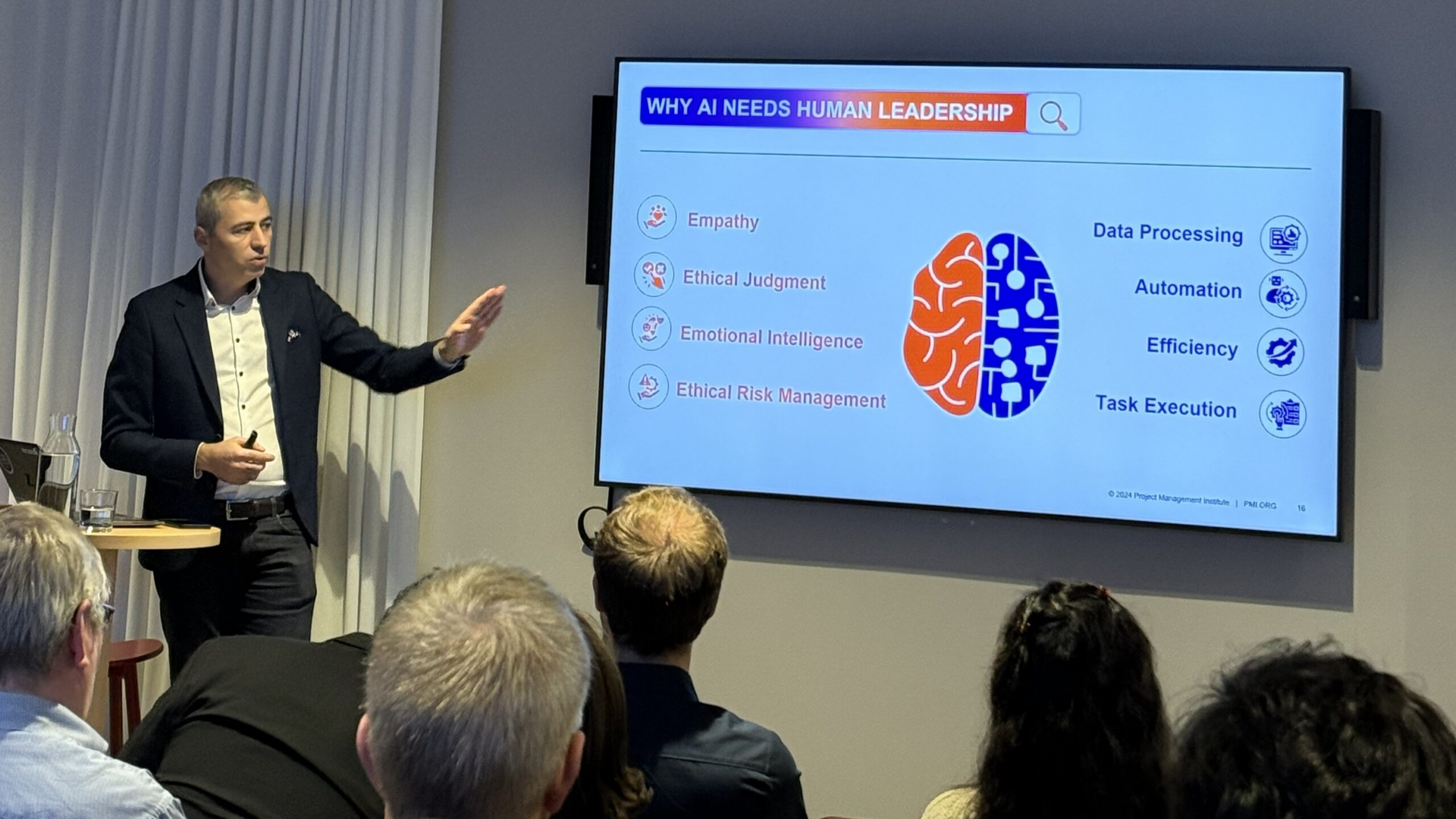
The room in Stockholm already knew this, by the way. In the same session, I asked which power skills would matter most in an AI-driven world, and the answers arrived in an order I have never seen a room get wrong.
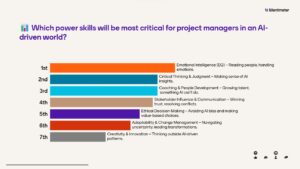
Emotional intelligence came first, then critical thinking and judgment, then coaching and people development, with stakeholder influence and communication fourth.
So the knowledge is not the gap. Every project professional in that hall could already name the skills that would matter. They just had no time, no template and no obvious reason to build them, because the technical half of the job was still the half being measured.
I dislike the phrase “soft skills”. It was built to make us underinvest in them. Soft suggests optional, something to get to once the work is done. These are the load-bearing ones. (Here is how I see it: the soft skill is the thing that, when you do not have it, nothing else you are good at quite compensates for.)
Soft skills are not only personality traits, and none of them ask you to become someone you are not. All of them can be learned inside normal working hours, but nobody teaches them by accident, and the system that carried the previous generation through their careers will not carry you through yours.
Which leaves the question I have been circling since that call with Mike. I put it on a slide in Stockholm before I had a good answer to it, and I still do not think I have the whole one.
If the coordination half of the job is being handed to a tool, what makes a project manager, a product owner, or a team lead irreplaceable in the AI era?
So I would rather ask you. What is the part of your work that no tool could take from you, and when was the last time you deliberately made it stronger?
Write to me at florin@florinlungu.com. I read every reply, and I am collecting these for the book.
Florin
P.S. That is the exact question we are going to try to answer together on Thursday 10 September, 15:00 to 17:00 CET. A free online session for the people in the middle. Two hours, live and interactive, and I will not show you a single prompt. Seats are available here: florinlungu.com/replaced
Sources
Live Data Technologies, reported by CNBC, July 2025. https://www.cnbc.com/2025/07/15/laid-off-managers-are-fighting-for-shrinking-pool-of-jobs.html
Gallup, Span of Control: What’s the Optimal Team Size for Managers?, January 2026. https://www.gallup.com/workplace/700718/span-control-optimal-team-size-managers.aspx
Revelio Labs, via ATD, Middling Returns, March 2025. https://www.td.org/content/td-magazine/middling-returns
Gartner, Top Predictions for IT Organizations and Users in 2025 and Beyond, October 2024. https://www.gartner.com/en/newsroom/press-releases/2024-10-22-gartner-unveils-top-predictions-for-it-organizations-and-users-in-2025-and-beyond
DDI, Global Leadership Forecast 2025. https://www.ddi.com/about/media/global-leadership-forecast-2025
Mentimeter results, Passion for Projects congress, Stockholm, March 2025. Zoom poll results, Trapped in the Middle live workshop, 10 June 2026. Both my own sessions.