
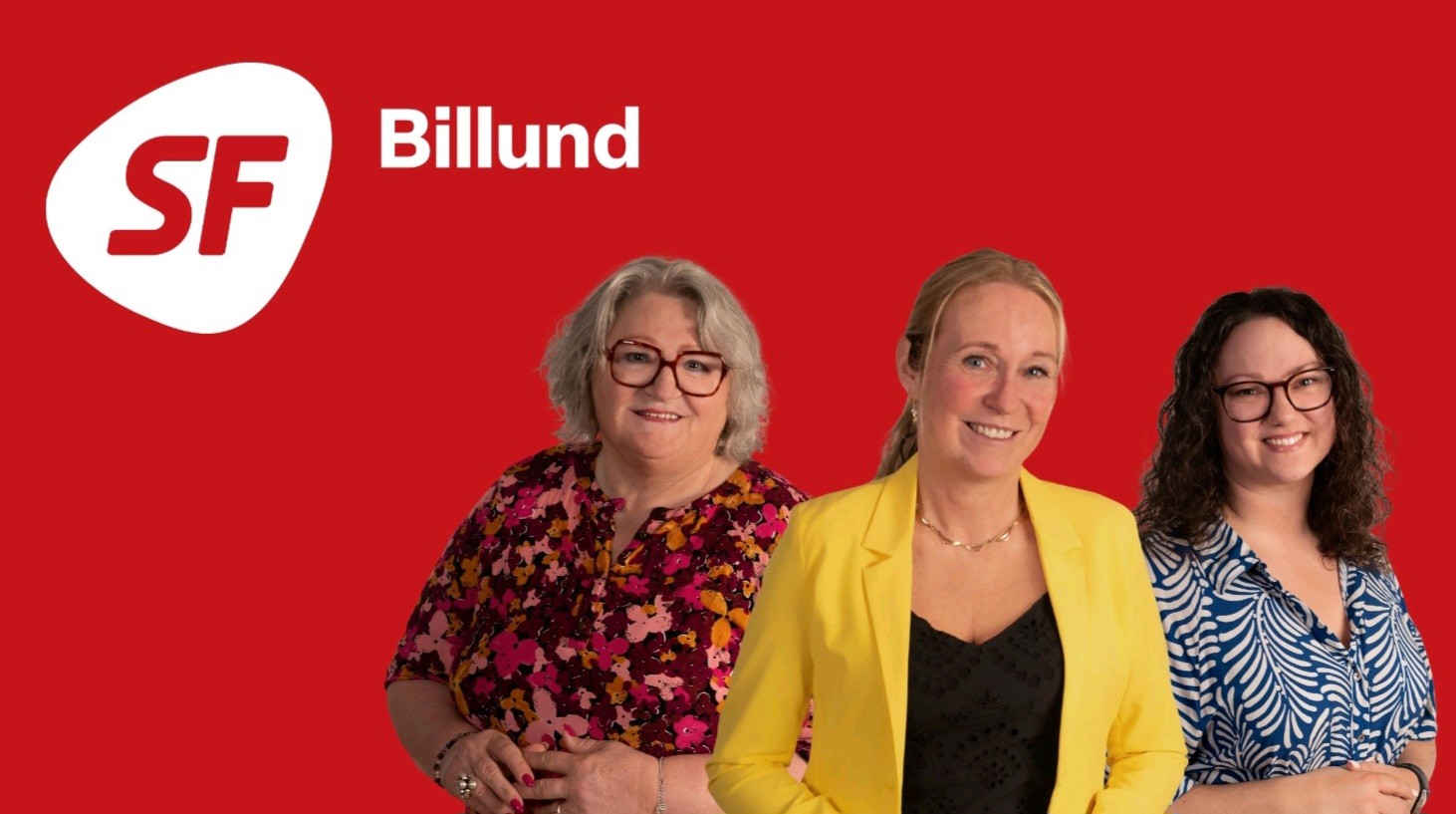
Party: The Green Party/Socialistisk Folkeparti (SF)
Candidates for: Billund Municipality, Southern Denmark
About Susanne and Monika
Both Susanne and Monika, two of SF’s three candidates in Billund Municipality in the south of Jutland, have lived in the area all their lives. Rie Køppen, their lead candidate who already holds a seat in the council, is unable to join us today but Susanne and Monika are keen to stress the three are running together as a united force.
We are one municipality and everyone has to be convinced we are here for everyone. It’s just a coincidence where we as candidates happen to live.
“We don’t think about it in terms of Billund and Grindsted,” says Monika. I’ve lived all over the municipality. I don’t think in terms of, ‘I’ll only fight for Billund’. I’ll fight for all the cities.”
“It’s very important that people know that,” Susanne adds. “We have to think more broadly. We are one municipality and everyone has to be convinced we are here for everyone. It’s just a coincidence where we as candidates happen to live.”
Susanne has lived in Grindsted her entire life. “In Denmark we call it being a hjemmefødt,” she says, “When you are born in a place then stay there!” Monika grew up in Billund but has lived in all areas of the municipality. Both women have deep knowledge of the community and the huge changes it has seen since The LEGO Group, the municipality’s principal employer, became an international company. Today, the municipality has nearly as many internationals as a percentage of the population (16%) as Copenhagen.
Monika and Susanne are acutely aware of the challenges different international groups face when they come to the area. This makes sense: both have had long careers in roles focused on improving everyday lives for ordinary people. Susanne spent many years as a leader with the charity Headspace, supporting young people from 12 to 25 facing barriers causing them not to thrive. She also worked at Cafe Jydepotten, a social cafe in Grindsted where adults in need of support can come and help others while receiving help themselves. “I was there for 14 years and when I left they called me an institution!” Susanne says. She has been involved in politics “on and off” over the years and served on the local council between 2009 and 2013. Now, she feels she has the time to commit to politics fully again.
Monika, who works as a shipping assistant for local company Modulex by day, has spent half of her life volunteering with trade unions. She currently volunteers for the labor union 3F, where she has been a board member for 12 years and has also been an organiser. She is the union rep and health and safety representative at her day to day job as well. “My work has mainly been focused on improving working environments and salary negotiations. That’s how I came into the political scene,” she says. “Unions are always political and that awoke my interest. My son is older now so I feel I can get more politically involved.” Monika is also trying to arrange an evening event with unions and internationals. “It can be hard for internationals to find out what unions actually stand for in Denmark,” she says. “They get so many mixed messages, and I personally know internationals that would have benefited from getting the proper help from a union.”
Entering politics
The changing profile of Billund Municipality is of significant interest to both women for these elections. They were both very surprised to find their small municipality on the national news recently after the country’s first ever international civic list announced their intention to run in the local elections in Billund. Soon afterwards, the municipality announced that Denmark’s first international council will be established there, advising the local council on matters relevant to the municipality’s international residents, who make up nearly 17% of its 27,000 inhabitants.
All the media coverage of Billund lately is a good way of telling people: you need to vote, you need to participate. You can actually make change if you want to.
“I found it really good that people are starting to look at smaller towns as international cities because usually we think about Copenhagen or Aarhus as being where the internationals are,” says Monika. “The national attention is showing that internationals can participate in democracy and maybe Billund can become a sort of national star here. All the media coverage is a good way of telling people: you need to vote, you need to participate. You can actually make change if you want to.”
Susanne points out that there are various factors underlying the historic low numbers of international voters in Danish elections: “If you start by looking at the Danes, who were born here and are used to how our democracy works, a large number do not participate in local and regional elections. Then you have internationals, some of whom are not used to elections at all. For them, it probably feels unsafe to speak your views aloud. They don’t trust that their vote will genuinely be kept secret. And then a lot of internationals are just busy settling down, trying to make everything work, dealing with their kids. In this area, not all international kids will think this is Wonderland. You can’t go to LEGOLAND every day and if you’ve come from a big city, especially one outside Denmark, it’s a huge adjustment.”
Susanne and Monika speak about a man they met at a local election event for internationals a few days ago. “He was in his 40s and had come from China. It was his first time voting,” says Susanne. “I can understand why he finds the process both exciting and scary. If he is not met with love and open arms and properly guided through the process, it will be more scary than exciting.”
Their campaign
Unsurprisingly, SF’s campaign in Billund Municipality is focused on greater social equality, community and improving the lives of society’s most vulnerable: children, the elderly and those facing barriers. “SF is a very old party in Denmark and we have always been known for behaving properly towards everyone including those who weren’t born here,” says Susanne. “It’s very important to make sure that everyone has a right to participate and possibilities to join in in the way they want. I can’t remember who said it but there is a famous quote: You know a society by the way they treat the most vulnerable members.”
There is a famous quote: ‘You know a society by the way they treat the most vulnerable members.’
Despite living in the area for their whole lives, both women show insight into the challenges facing internationals and are clear about why internationals should vote for SF. “They should vote for us because we are there to listen,” Monika immediately says. “That’s one of the principles we run on. If you have an issue, come to us. We might not agree with you but we will listen and if we can do something about it, we will definitely try.” Long before the Civic List was established in Billund, SF decided they would publish their campaign materials in English, Monika adds.
“We’ve always tried to encourage internationals to vote, and we also have international members,” Susanne says.
One of the key groups they want to reach is women accompanying partners. “It’s a stereotype but what we often see in this area is men taking jobs at LEGO, bringing their partner, who’s generally a woman, and then she struggles to find work,” says Susanne. “Accompanying partners also have a right to lead their own, successful lives. We have an obligation to make sure there are possibilities to do that in different ways.”
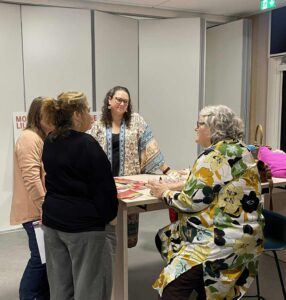
Internationals should vote for us because we are there to listen.
“I’ve been thinking a lot about what changes we can make here,” Monika adds. “I see lots of spouses here who are very highly educated, whereas lots of the jobs we have in the area are in the service industry. But my own company, for example, is often looking for a specific profile of applicant and an international could fit that, but they would be unlikely to find that job if they were searching themselves. If we had a better way of matching internationals with the local companies, that would be great.”
More broadly, Susanne and Monika want to make it easier to attract international workers to the area to fill jobs not found at LEGO. “Not having enough workers is a huge issue in Denmark, probably the first thought on every politician’s mind when they wake up in the morning,” says Susanne. “Very soon, we will see that we have a crisis in teacher numbers and nursing staff to care for the elderly. We need internationals working, so how do we make sure we are offering work possibilities that are attractive and how do we support them by offering the education they might need to get those jobs?”
Both would like to see municipalities like theirs lobby the Danish government to change the “one size fits all” Danish language requirements that can often act as barriers to employment for internationals. “One size doesn’t fit all,” says Susanne. “We have to change the ways we try to integrate people in our society. Integration is about work, possibilities, what you do in your leisure time, but learning to speak the language is a very good way to start, so what can we do to make that easier? Everyone should be able to learn and use Danish in the way that is important for them. We should have more tailored language courses for different employment routes.”
Learning to speak Danish is a very good way to start to integrate, so what can we do to make that easier?
SF would also like to see community bonds strengthened, particularly between Danes and internationals. “We haven’t been good at inviting internationals in,” says Susanne. “I don’t know many Danes who have international friends and I definitely don’t know any Danes with friends from non-Western countries such as Syria or Ethiopia and that is something we’re not good at talking about.”
They see volunteering as a way of opening doors and fostering connections. “You can integrate more easily and meet Danes who are more open when you volunteer,” says Monika. “The community is something SF really stands for, so that local people have spaces to volunteer, do sports, do creative activities. That’s a way that international children can mix with Danish children too.”
“It’s also very important to us to talk to children and young people about how they are thriving and the possibilities for them,” Susanne adds. In the local Facebook groups, we often see posts from international parents looking for activities that we don’t offer here because we are a small place. We could be much better at finding places where young people and their parents could meet and join in activities together, both Danes and internationals.”
Final thoughts
“You know, we think a lot as politicians about what we are going to do to make things happen but we also have to ask you what you actually want,” says Susanne. “What is the key that matters most to you. And then policies can grow outwards from there.”