




The Danish government is considering extending the current ban on face coverings in public places to educational institutions, based on recommendations from Kommissionen for den glemte kvindekamp (the Commission on the Forgotten Women’s Struggle or Movement).
The current ban (implemented in 2018), which falls under the law related to crimes against public order and peace, states that fully or partially covering your face in a manner that is likely to prevent identification is punishable by a fine. It covers public places (e.g. roads and public transport), but currently does not explicitly apply to educational institutions, which the Commission notes are effectively open to the public.
The current law on face coverings: some context
The Danish government’s main rationale for the ban is to reduce the likelihood of terrorism by preventing people from hiding their identities. While the government has been careful to note that the ban does not target specific religious groups, the Danish law (and similar bans in France, Switzerland, Austria, the Netherlands, and other European nations) is seen by many as targeting Islamic head coverings. Human Rights Watch has spoken out against such laws, noting that “Denmark’s ban is part of a worrisome trend that only marginalizes Muslim women in Europe and penalizes them for expressing their beliefs”.
Those in favor of the ban argue it encourages integration into Danish society and prevents Muslim women and girls from being coerced into wearing full-face veils. Some also believe veiling is inconsistent with Danish values like gender equality. In 2010, the then Prime Minister, Lars Løkke Rasmussen stated “the burqa and the niqab do not have their place in the Danish society. They symbolize a conception of the woman and of the humanity to which we are fundamentally opposed and that we want to fight in the Danish society”.
The Danish Ministry of Justice has also indicated that banning full-face coverings helps “promote and facilitate social interaction and coexistence, which is crucial in society, because it contributes to letting people in Denmark meet one another in a proper way –
with trust and respect, face to face”.
Those against the ban contend it risks isolating women who veil and will encourage increased intolerance and fuel rising Islamophobia in Europe. This may, they argue, lead to more verbal and physical attacks against veiled Muslim women. Some also claim bans on veiling violate individual rights with Amnesty International indicating: “Whilst some specific restrictions on the wearing of full face veils for the purposes of public safety may be legitimate, this blanket ban is neither necessary nor proportionate and violates women’s rights to freedom of expression and religion”. In 2014 the European Court of Human Rights upheld French legislation banning face veiling, indicating that the 47 justices did not consider the law discriminatory.
Islamic head coverings: why are they worn?
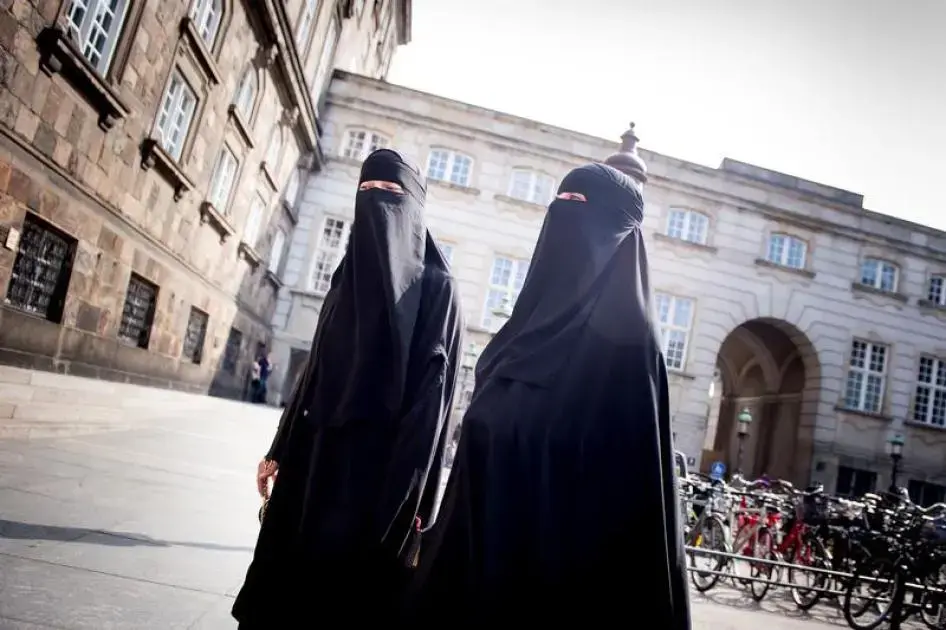
While the language used in Danish law does not specifically prohibit face coverings for religious or cultural reasons, it effectively prevents people wearing
the niqab (a face-shielding veil with an opening for the eyes worn along with a headscarf) or the burka (which includes mesh over the eyes to conceal the entire face).
Roughly 4.4% of the Danish population is Muslim and most Danish residents will be used to seeing Islamic head coverings like the hijab, but veils are far less common. A University of Copenhagen study estimates between 100-200 women in Denmark wear the niqab, which equates to around 0.1–0.2% of Muslim women in the country. These estimates are consistent with other European countries.
A lot of personal, social and religious factors contribute to women wearing veils or headscarves. Many Muslim women say it strengthens their faith, to themselves and others. A number also say face coverings and veils signify their adult status in their community and makes them feel safer. Islamic dress may also be worn as a political statement or to showcase the wearer’s fashion sense.
There are varied interpretations of whether calls for modesty in the Quran (the Muslim holy text) and the Hadith (the statements associated with the Prophet Muhammad) mean that veiling is required, suggested, or applies to only the prophet’s wives. Muslim women do not veil when around only immediate family, meaning hijabs, niqabs, burkas, etc. are usually not worn at home.
Other recommendations from the Commission

Kommissionen for den glemte kvindekamp (the Commission on the Forgotten Women’s Struggle or Movement) was established by the Danish government in
2022. It was tasked with making recommendations on how girls and women from immigrant communities can be better supported and empowered to take control of their own lives. The commission published nine recommendations in August 2022, including prohibiting headscarves in schools. The headscarf-related recommendation prompted substantial discussion, but was not pursued by the Danish government.
Between then and March 2024, the Commission was largely dormant. In March 2024 it was revived and in January 2025 13 recommendations were published.
- Purposefully confronting honor culture across the public sector and civil society, including strengthening rights for people exposed to honor-related violence and negative social control
- Ensuring trust in public authorities by people impacted by honor-related violence and negative social control, as well as upskilling frontline staff
- Educating all young people about honor-related violence and negative social control, alongside targeted education on these topics in certain schools
- Actively combatting honor-related violence and negative social control in educational institutions, which includes extending the current face-coverings ban to schools and universities
- Increasing information and support for young women from minority ethnic backgrounds who want to leave the family home
- Strengthening associations and organized leisure activities that build bridges between people from minority ethnic backgrounds and groups with different backgrounds
- Having recognized religious denominations explain their communities’ views on marriage and divorce and removing recognition if they practice or contribute to honor-related violence and negative social control
- Banning marriage between first cousins and clarifying existing legislation to criminalize dowry repayment and other pressures to prevent divorce
- Helping women experiencing intimate partner violence receive support and feel safe they will retain their residence permit if they leave the relationship
- Providing better post-shelter support and housing placements for women from ethnic minority backgrounds
- Increasing action around involuntary trips abroad (e.g. re-education trips) including preventing such travel, assisting those already out of the country, facilitating reintegration into Danish society, and holding people who actively contribute to sending others on these trips responsible
- Treating honor-related and negative social control motivations as separate aggravating circumstances in criminal cases, as well as prioritizing such cases
- Creating and disseminating a governmental data and analysis strategy on honor-related violence and negative social control, as well as ongoing initiatives/legislation evaluations and further studies and research into the topic.
What’s next?
While the Danish government has not yet signaled an intention to revise the laws around face coverings, they are looking to align with Sweden and Norway in banning first cousin marriages.
The discussion around whether religious attire is compatible with Danish culture and values and if veils represent security concerns is likely to continue, especially with ongoing political focus to prevent ‘parallel societies’ in and government initiatives to prevent negative social control.
Last Week in Denmark is keen to speak to anyone affected by the issues in this article. You can send us a direct message on Instagram @last_week_in_denmark or email lastweekdk@gmail.com. We are happy to publish your views and experiences anonymously if you prefer.


With all those concerns about women’s well-being, I am wondering when Denmark will ban high heels. Some women are coerced to wear them daily, and suffer from short-term discomfort and long-term health issues with their feet.
As for the face-covering ban for “security reasons”. Have there been any cases, where the ban would have helped preventing anything? Because, it sounds like nonsense.
Also, I have an impression that women who are forced to cover their faces by their spouses might not be allowed to leave the apartment at all. I would like to know, whether this ban has improved these women’s lives at all or just alienated certain communities…