
It often begins with quiet optimism. You arrive in Denmark with a job title that once carried weight elsewhere, a CV that has opened doors before, and a reasonable assumption that things will fall into place. You’ve done this before: you’ve built a career, navigated systems, proven your value. The logic feels transferable; at first, there’s no reason to question it. You tailor your cover letters. You send out applications. You wait.
The responses trickle in, then stop altogether. The rejections, when they come, are polite but vague – often with the familiar line: “We’ve decided to move forward with a candidate whose experience is more closely aligned with the role.” Weeks turn into months, and you begin to second-guess approaches that once felt tried and tested – your wording, your experience, your professional background. A more uncomfortable question begins to take shape – what if the issue isn’t what you’re doing, but something you’re not yet seeing?
The scale of that disconnect is not insignificant. Internationals now make up roughly 12% of Denmark’s workforce, with more than 350,000 foreign workers contributing to the labor market — a group that has driven over a third of total employment growth since 2013. And yet, a deep gap persists: international workers are nearly three times more likely to be unemployed, with an unemployment rate of around 5.3%. Highly skilled, non-Western, and female professionals often face some of the greatest barriers to securing relevant roles.
The system within the system
So how can internationals adapt to this reality? That question sits at the center of my conversation with Leslea Petersen, founder of English Job Denmark — a platform supporting professionals in Denmark with career strategy, CVs, LinkedIn and the navigation of the Danish job market — a market where finding a job isn’t only about qualifications, but about understanding a system that operates quietly beneath the surface.
Leslea understands this personally and empathizes with job seekers. “I arrived 18 years ago to marry a Dane. So that’s why I ended up in Denmark. It was so difficult to find a job; I thought it would be easy. I arrived at the end of 2007, and then, of course, 2008 was the financial crisis. I was a native English speaker working in comms at a senior level, and I got nothing at all,” she says. What followed wasn’t a short adjustment period. “Honestly, for about two years, I did the odd two weeks here, two weeks there, but could not get a job.”
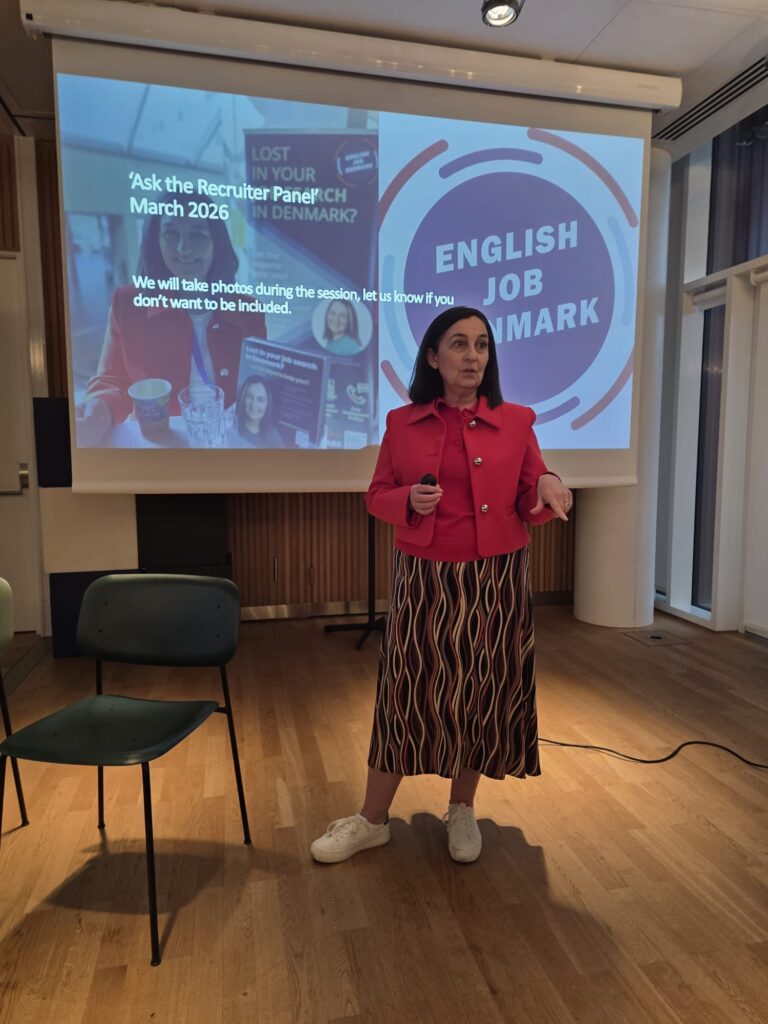
Image credit: English Job Denmark
It’s a pattern many internationals recognize; not a lack of effort, but a lack of response from hiring managers. How do you refine your approach when there’s no clear signal of what needs fixing? That process — learning how the system actually works — is what led her to found English Job Denmark in 2019. What became clear quickly is that the Danish job market isn’t simply competitive — it’s structured differently. “It is a very trust-based society. [Danes] know each other,” Leslea explains.
This reality reframes almost everything. In many countries, job searching follows a set path: you apply, you’re assessed, you move forward, or you don’t. Here, there’s something less tangible shaping outcomes. Once you begin to see it through that lens, a lot of the friction makes sense (including why highly qualified professionals often find themselves in roles below their experience level). The gap is not always about capability, but about translation of experience, context, and perceived fit.
“Just applying through the old CV route is actually getting smaller and smaller,” she says, before adding that what replaces it is slower, less linear, and harder to quantify. “It’s not just about knowing somebody, it’s about building relationships, building that trust, getting to know people.” It’s not a secondary strategy; it is the strategy.
Reframing networking and communication
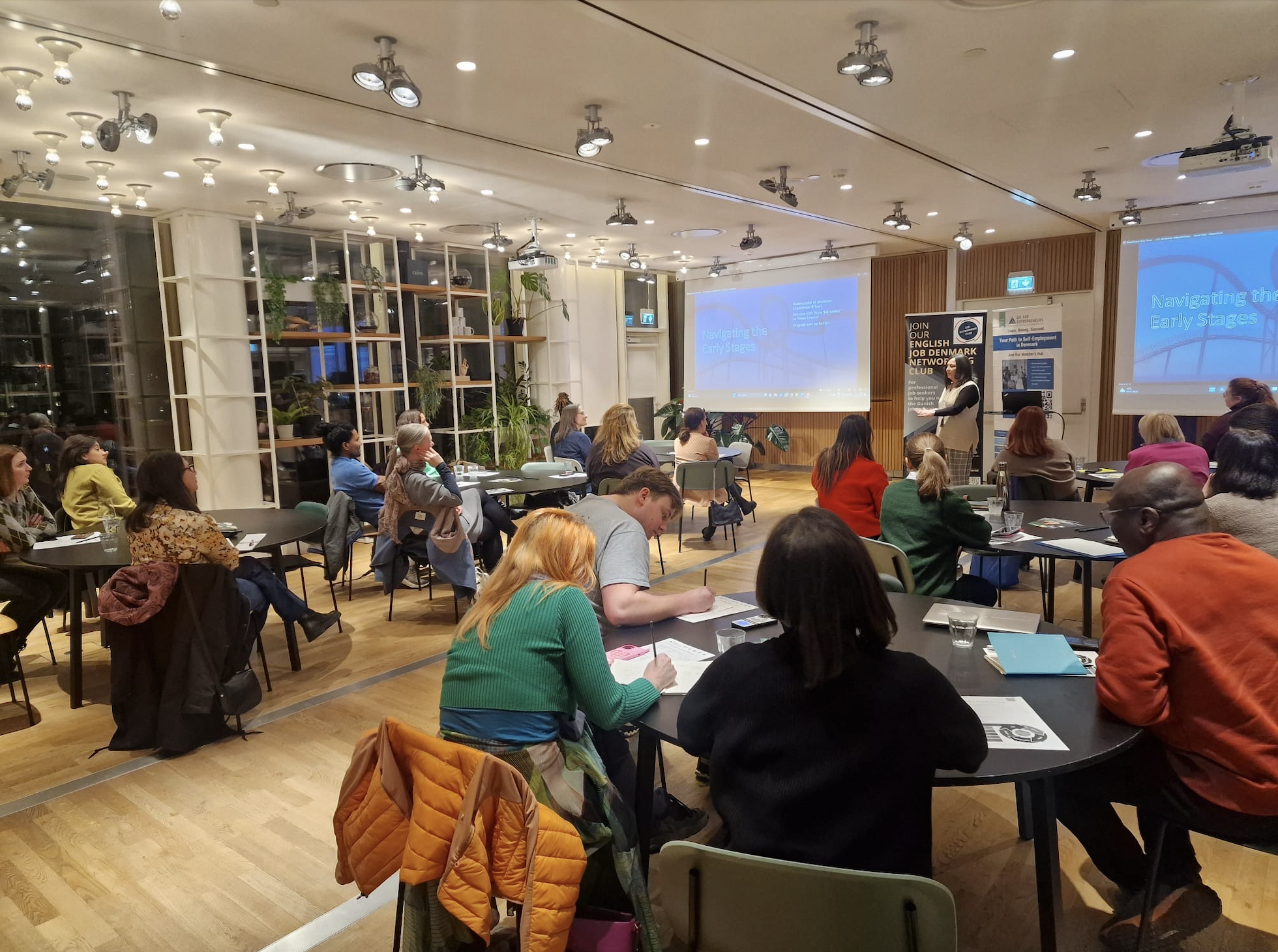
I saw this play out clearly in her recent workshop on networking. From the outset, Leslea encouraged participants to share their LinkedIn profiles in the chat and begin connecting, reinforcing that networking is active, ongoing, and rooted in everyday interactions. It is not a transactional exchange or a shortcut to a job, but rather a longer-term process of building reciprocity.
There is also the balance of adapting without erasing yourself, and this is where many internationals waver. In practice, it shows up most clearly in communication. “I think you need to be polite. Danes are very polite, but also direct and quite functional.” It sounds simple, but it requires unlearning habits that, elsewhere, are seen as strengths, “Just get to the point. Danes get frustrated, because we tend to be a bit long-winded.”
That same clarity applies to how you present yourself professionally. In the workshop, we spent time refining elevator pitches — not as rehearsed scripts, but as flexible tools. The idea wasn’t to memorize something perfect, but to have versions that could be adapted naturally depending on context: a formal introduction, a casual conversation, a quick exchange at an event. For those less comfortable with networking — particularly introverts — Leslea suggested preparing a “cheat sheet” of questions. It wasn’t about performing confidence, but about lowering the barrier to participation.
That emphasis on participation extends to LinkedIn, which she returns to repeatedly, both in the workshop and in conversation. “I always describe LinkedIn as your best friend,” Leslea says. “You’ve got to be visible. And being visible doesn’t just mean having a LinkedIn profile. It means being active.” This plays out in specific actions — commenting, engaging, reaching out, asking for recommendations. Emphasizing consistency, she adds, “If you’re constantly posting content, commenting, and being insightful, you’re going to be found.”
But visibility alone is only part of the equation; what ultimately shapes many decisions is something harder to quantify. Familiarity. “I think there’s an expectation [hiring managers] are looking for somebody to fit into their team. And so they’ll tend to look for people who are going to be like them,” Leslea says. It’s less about deliberate exclusion and more about reducing uncertainty; choosing what feels known over what needs to be interpreted. At the same time, the demand for international talent is real, “There is absolutely a need for us to come in and fill slots.” That tension is where many job searches stall – it’s also where English Job Denmark steps in, helping internationals reframe and translate their experience, while encouraging employers to look beyond what feels immediately familiar.
Belonging, language, and staying in the game
Language plays its part in this, though not always in the way people expect. “I think it’s never going to be a negative thing learning Danish. It’s always going to be a positive thing,” she says. At the same time, she removes the pressure that often stops people from trying. “Don’t worry about your pronunciation. That was my fault for years, because it wasn’t perfect. I wouldn’t speak, and I lost all my confidence, but I have friends who don’t care what they sound like; they just speak and are going from strength to strength.” I asked her about a turning point in her own language-learning journey: “I think it was when I first rang Skat [the Danish tax office] in Danish.” She remembers the nervousness, though also the determination to push through — and that’s exactly how progress is made.
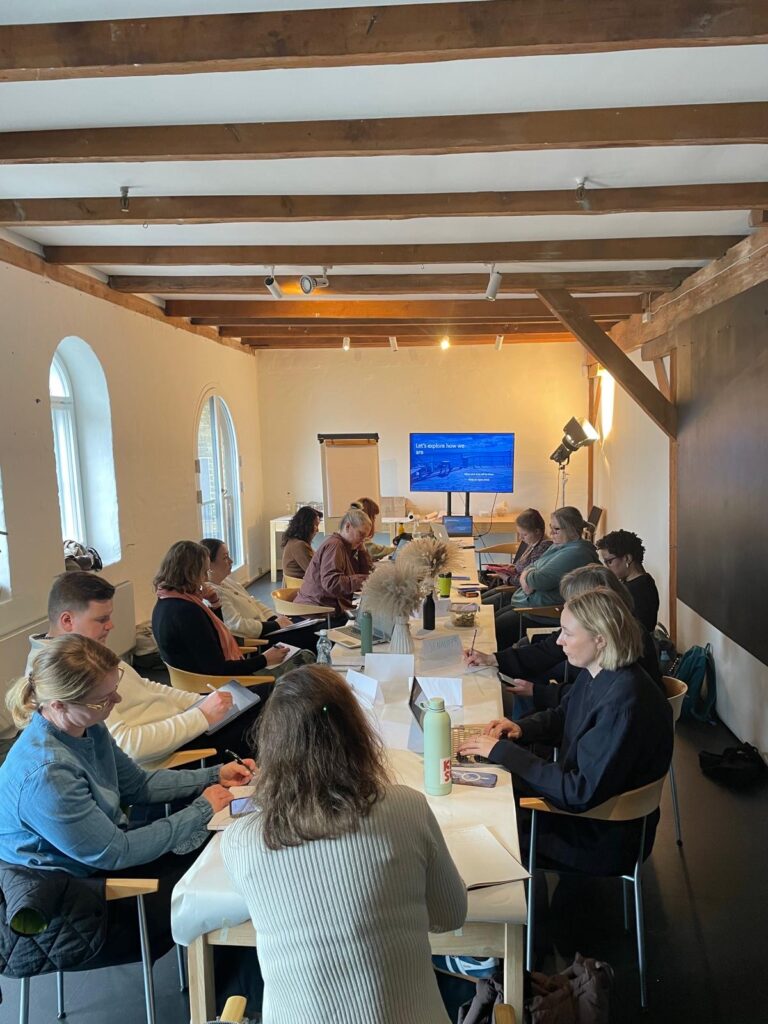
Image credit: English Job Denmark
What both the conversation and the workshop make clear is that job searching here isn’t just a formal process; it’s deeply human. “You have to keep it positive. And that is not easy when you’re job searching, getting rejections,” Leslea says, because this isn’t just a test of your skills — it tests your resilience, your confidence, your sense of direction. And without support, it’s easy to internalize the silence. “You need to find a community that can support you. Finding your people is a good thing.”
Towards the end of our conversation, I asked what she would want Danish readers to understand. She paused, then said simply, “I think open your doors, open your home.” It’s a seemingly small ask, but it points to something deeper about how to bridge the gaps that can feel daunting, “It’s not them and us. It’s a mutual understanding.”
And that feels like the clearest way to understand the Danish job market — not as a closed system, but as one built on relationships that take time to form. The silence after an application isn’t always rejection. Often, it’s distance. And distance can be reduced — gradually, intentionally, and, as Leslea’s work makes clear, not alone.
Get in touch with Leslea
To learn more about Leslea Petersen’s work — including career coaching, CV and LinkedIn support, workshops, and networking events — visit English Job Denmark. She also offers consultations and community-led sessions designed to help international professionals build visibility, strengthen their positioning, and navigate the Danish job market with greater clarity.