

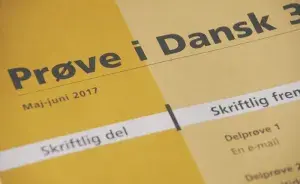
Halløjsa to all of you taking the PD3 exam in May/June 2026!
As the last Danish language exam for many people – and the one that holds the most weight towards visas, jobs, permanent residency and citizenship – it can also bring with it a lot of stress.
I took PD3 in May/June 2023 and passed with a 12/10/12. Here are my best tips to help you do your best, broken down by each section of the exam.
Feel free to reach out to me at @nearlydanishdame on Instagram for more details or to chat further about it!
Læseforståelse Delprøve 1 (quick reading)
In this part of the exam, you’ll be tasked with scanning a multipage document to answer 15 factual questions in 25 minutes. Most questions are who, what, where, and when questions, but there are a few yes/no questions. This is a scanning and fast reading exercise to quickly locate pertinent information under a time constraint.
The Table of Contents is your friend! Use it to quickly familiarize yourself with the sections and refer back to throughout the questions. Generally questions come in chronological order in the document. Underline in each question what you’re looking for (a person, date, place, number, etc.). Look for keywords (nøgleord) between the questions and the document – there will be a direct connection between these in the question and the document.
Don’t panic if you can’t find the answer. Move on after 20-30 seconds and come back. It’s much better to miss one question, than 5 at the end that you didn’t have time for. Last tip: when you answer, just answer in one word or number. There’s no need for long answers or possible confusion here.
Læseforståelse Delprøve 2A (multiple choice)
In this part of the exam, you’ll read a roughly 1.5 page document about a societal issue. You’ll have three multiple choice questions to respond to, and the focus is on detailed reading comprehension.
Read through the questions once but don’t waste time reading the answers yet. Underline what you’re looking for. Read through the entire document, underlining and making notes.
Now to the answers! Look for distractors – close answers that reference something in the article that you read, but which are not completely accurate or correct. Try to prove answer options ‘wrong’. Usually you can find something in the incorrect answers that is false or was referenced, but slightly differently in the article. There will only be one answer which is entirely correct.
Læseforståelse Delprøve 2B (missing sentences)
In this section of the exam, you’ll receive roughly two pages of written text about a societal issue. Five short sections will have been removed from the text and are listed in a random order on the following page. Your task is to put them into the correct places in the document, and they often resemble each other! So your task is to understand the text in detail and how everything fits together seamlessly.
Quickly read through possible answers, underlining key words. Read the article and mark it up. The correct answer always refers back to the preceding 1-2 lines, and may refer to the following, but not necessarily. Find the connection – the keyword, the topic, the quote. If you think there are multiple options, make a note of both and see if you can narrow it down as you move on. At the end, read through the whole article with your answers set in and see if the flow is correct or if anything sounds off.
Læseforståelse Delprøve 3 (missing word)

In this final section of reading comprehension, you’ll receive a one page text document with eight blank spaces where words or expressions have been removed. On the next page, you’ll have four options for each of those missing blanks and your task is to choose the correct one. This task relates to both reading comprehension and breadth of vocabulary.
Learn your adverbs! There is a huge focus on them in this section of PD3. Find a handout online that has adverbs and memorize as many as you can. Put them into categories, for example:
- those that signify a contrast (men, imidlertid, dog, hvorimod, omvendt, selvom, derimod)
- those that mean a consequence of something (så, derfor, dermed, således, følgelig)
- those that signal a clarification (fordi, da, eftersom, idet, for, nemlig, pga.)
Determine if the word you’re looking for continues the train of thought or shifts to the contrary. That will help you find the right adverb or verb. Keep an eye out for questions that are about order: is something the consequence of something or the cause of something?
Tip: Determine if you can find any synonyms in the 4 possible answers. If they are synonymous, they cannot be the answer, so they can be excluded.
Unfortunately, some of this exam is also just about how much vocabulary you’ve accumulated, so you can get lucky or unlucky regarding if you know the verb or noun referenced. It’s okay, it’s just one question!
Skriftlig fremstilling (written)
The written part of PD3 involves two sections – an email and a longer essay about a societal topic from which you can choose from two topics – and you’ll be given 2.5 hours for both. You may bring a verb list with you and as many dictionaries as you’d like with you, so find some that offer different things: dansk-engelsk, engelsk-dansk, retskrivningsordbog, etc.
Don’t spend too long on the email. Make sure to include: Hej or Kære ________. Tak for mailen. Answer the underlined points. Suggest whatever they ask you to do in the last point. Read through everything for småfejl (small mistakes!). Don’t spend a ton of time here.
For the longer skriftlig section, you can choose between writing about a diagram or a topic. For both, my recommendation is to structure your answer like a pyramid in terms of how much time you use on them, using most of your time on point 3, vurder (assess).
Beskriv (2-3 sentences)
Fortæl (5-7 sentences) – consider using ‘jeg tror’
Vurder (7-12 sentences) – consider using ‘jeg synes’
Don’t be too concrete. Don’t state things as facts, but as possibilities (kan være, muligvis, mange, måske, hænger sammen med), which allows you to show nuance in your language skills. Write generally about society, not about yourself or your own anecdotes. Remember to have an option, remember to elaborate, remember to make an argument, remember to give examples.
For the last step (vurder) here are 7 steps you could follow, which will give you 7 concrete sentences for the last question.
- Dit synespunkt – your viewpoint
- Dit argument – your argument for that viewpoint
- Uddyb med eksempler – elaborate with one or two examples
- Et imod synespunkt – acknowledge an opposing viewpoint
- Et argument – a short argument for why this is the case
- Uddyb med eksempler – one short example supporting this
- Din nuancerede vurdering (use this last point to tie it all together: Despite both sides of the argument, this is what I think…)
Use the extra time to read over your essay several times for all those småfejl. Read through one time for just verb tenses, one time just for adjective agreement, one time just for bestemt form, etc.
Muntlig (spoken exam). You will be evaluated on your structure and pronunciation for your presentation. We can do another post on the muntlig eksamen, as it approaches. If you’re interested, let Last Week in Denmark know!
Whatever happens during the written exam, don’t forget you can fail the entire exam and still pass if you get high marks on the muntlig exam.
If you want to talk more about either the skriftlig or the mundtlig exams, I just started tutoring services, and would welcome a one-on-one session with you! Reach out at @nearlydanishdame on Instagram or nearlydanishdame@gmail.com.

Held og lykke, knæk og bræk og pøj pøj, kære venner! You got this!
Kh,
Brooke